Food system transparency has become a defining demand of contemporary food governance as consumers, regulators, producers, retailers, and civil society seek clearer information about food safety, sustainability, provenance, and accountability. Yet transparency is still frequently reduced to traceability, understood as the capacity to follow a product through production, processing, distribution, and retail. Traceability remains essential because it can support food safety, provenance verification, recall management, and supply-chain visibility. However, it offers only a partial view of the decisions, data practices, and governance arrangements that increasingly shape food systems. The central problem is that traceability can show where food has been without explaining why food-system decisions are made, who benefits from data use, how algorithmic judgements are produced, or how affected stakeholders can question decisions. As artificial intelligence, digital platforms, automated decision support, blockchain systems, and data-intensive infrastructures become more embedded in food systems, transparency must include decision logic as well as product movement. A narrow traceability model may increase visibility while leaving power asymmetries, accountability gaps, and ethical risks unresolved. Transparency therefore needs to be reframed as a broader socio-technical condition. This Perspective Article argues that food system transparency must move beyond conventional traceability toward explainable, participatory, and ethics-centred AI. Explainable AI can make algorithmic decisions more understandable to producers, regulators, firms, consumers, and affected communities. Participatory design can ensure that transparency systems reflect stakeholder needs, rights, and lived realities rather than only institutional or commercial priorities. Ethics-centred governance can connect technical transparency with fairness, accountability, privacy, contestability, and public trust. The article contributes a conceptual framework for reimagining food system transparency as understandable, contestable, inclusive, accountable, and sustainability-oriented. It positions AI not merely as a tool for monitoring food supply chains but also as a governance object that must itself be explained, scrutinised, and democratically shaped. The proposed perspective highlights practical implications for food businesses, technology developers, policymakers, regulators, and civil society organisations. It concludes that transparent AI can support more trustworthy food systems only when traceability is integrated with explanation, participation, ethical responsibility, and accountable decision-making.
Food system transparency has become increasingly important as supply chains are datafied through sensors, platforms, analytics, and smart-farming infrastructures. These systems can generate large volumes of production, environmental, logistical, and market data, making it possible to monitor food systems at unprecedented levels of granularity. However, the rise of big data in smart farming also means that transparency can no longer be understood only as product information or supply-chain documentation. It must also address how digital infrastructures organise knowledge, decision-making, and control within agricultural and food systems [1].
The social significance of digital agriculture lies in the fact that technologies are embedded in institutions, markets, advisory systems, governance structures, and everyday practices. Smart farming and Agriculture 4.0 therefore raise questions about who defines useful data, who controls digital platforms, whose expertise counts, and how technological change affects relationships across the food system. A transparency agenda that ignores these social and institutional dimensions risks treating digitalisation as a neutral technical upgrade rather than a restructuring of food-system governance. For this reason, food transparency must be analysed as a socio-technical issue involving actors, rules, infrastructures, and power relations [2].
The politics of precision agriculture further demonstrates that digital food technologies can shape sustainability narratives rather than simply deliver objective information. Technologies promoted as efficient, sustainable, or transparent may also reinforce particular interests, concentrate decision-making power, or narrow public debate about alternative food-system futures. This matters because transparency should not only disclose data but also reveal how technological systems frame problems, allocate benefits, and define legitimate solutions. Moving beyond traceability therefore requires asking how food-system decisions are made, explained, governed, and challenged [3].
Figure 1 summarises the article’s core argument by showing how conventional traceability must be extended into explainable, participatory, ethics-centred, accountable, and sustainability-oriented food-system transparency.
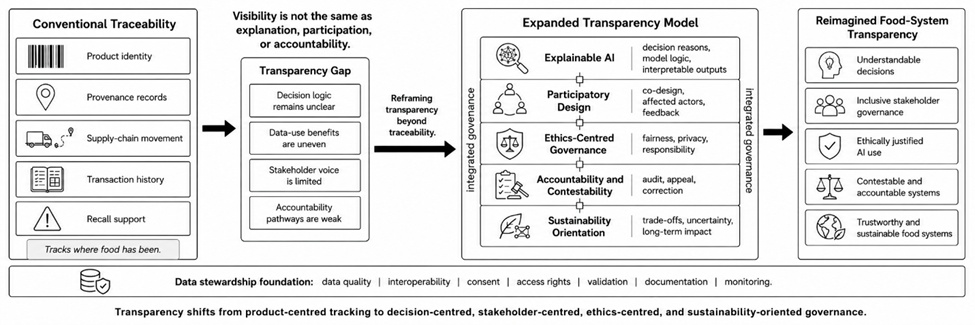
Figure 1. From Traceability to Decision-Centred Food-System Transparency
This Perspective Article argues that traceability is necessary but insufficient for genuine food system transparency. Agriculture 4.0 and related digital transformations require responsible transition pathways that account for diversity, uncertainty, social consequences, and governance responsibilities [4]. The objective is to develop a forward-looking framework in which explainable AI, participatory design, and ethics-centred governance extend transparency beyond the question of where a product came from. The article therefore reframes transparency as a decision-centred, stakeholder-centred, and accountability-centred condition for trustworthy digital food systems.
The central perspective advanced here is that food system transparency must be reimagined as more than the documentation of product movement. AI adoption across food supply chains requires a shared ethical language because technical systems affect food safety, quality, labour, sustainability, commercial relationships, and public confidence. When actors use different assumptions about responsibility, risk, fairness, or accountability, transparency becomes fragmented and difficult to govern. A broader transparency model must therefore connect data visibility with ethical interpretation across the food sector [5].
Responsible AI in agriculture also requires systemic understanding of risks and externalities rather than isolated evaluation of technical performance. AI tools may optimise yields, classify risks, predict demand, or support supply-chain decisions, but their effects can extend across ecological, social, economic, and institutional domains. Transparency must therefore ask not only whether an AI system works, but also what consequences it produces, who carries those consequences, and whether externalities are recognised. This systemic view prevents transparency from becoming a narrow performance claim detached from food-system impacts [6].
Trustworthy food-system AI further depends on responsibility, accountability, adoption conditions, regulation, and institutional trust. Technologies that promise transparency may fail to build trust if stakeholders cannot identify who is responsible for model outputs, data practices, errors, exclusions, or harms. AI-enabled food transparency therefore requires governable systems in which roles, responsibilities, and avenues for challenge are visible. Responsibility must be designed into the institutional environment of AI rather than assumed to emerge from technical capability alone [7].
The article’s core argument is that traceability should be treated as one layer of transparency, not as its endpoint. Food systems need product-centred records, but they also need decision-centred explanations, stakeholder-centred participation, ethics-centred governance, and accountability-centred oversight. This means that AI should be understood both as a tool that can improve transparency and as a system that must itself be made transparent. A reimagined model of food system transparency must therefore combine shared ethical language, systemic risk awareness, and clearly assigned responsibility [5-7].
Conventional food traceability systems are designed to identify products, follow their movement, and document transformations across supply-chain stages. Their components commonly include product identifiers, process records, actor links, data capture mechanisms, and information retrieval procedures. These functions are crucial for food safety, recall management, provenance verification, fraud prevention, and regulatory compliance. Yet the components of traceability define a narrower infrastructure for tracking food than the broader transparency needed to explain decisions, responsibilities, and consequences [8].
Blockchain-enabled traceability has intensified interest in digital food transparency by promising tamper-resistant records, decentralised verification, and improved visibility across supply chains. Such systems can strengthen documentation of transactions, provenance, and product flows, particularly where information asymmetry or fraud risk is high. However, blockchain applications in agriculture and food supply chains also face implementation barriers, including data-quality problems, interoperability constraints, governance uncertainty, cost, scalability, and uneven stakeholder capacity. The promise of blockchain transparency therefore depends on the wider organisational and institutional conditions under which records are produced, validated, interpreted, and used [9].
The limitations of traceability become clearer when blockchain is treated as a transparency solution in itself. Boundary conditions for blockchain-based food traceability include credible data entry, stakeholder alignment, governance rules, legal arrangements, incentives, and coordination across supply-chain actors. If these conditions are absent, a digital ledger may preserve records without ensuring that those records are meaningful, fair, complete, or accountable. Traceability can therefore increase informational visibility while still failing to explain why decisions are made, how risks are distributed, or who is answerable when harms occur [10].
A broader model of transparency must retain the strengths of traceability while addressing its governance limits. Traceability can answer where a product has been, but explainable and ethics-centred transparency must also address how data are interpreted, how automated decisions are justified, how stakeholders participate, and how accountability is enforced. Without these additional layers, traceability may become a technical proxy for transparency rather than a pathway toward public understanding and institutional responsibility. Table 1 compares conventional traceability with explainable and ethics-centred transparency in food systems [8-10].
Table 1. From Traceability to Transparency: Comparing Conventional Food Traceability with Explainable, Participatory, and Ethics-Centred AI Approaches
Dimension | Conventional food traceability | Explainable, participatory, and ethics-centred transparency |
Primary question | Where did the product come from and where did it move? | How are food-system decisions made, explained, governed, challenged, and improved? |
Main object of transparency | Product identity, movement, provenance, and transaction history. | Product flows, data practices, algorithmic decision logic, governance responsibilities, stakeholder rights, and accountability pathways. |
Typical technologies | Barcodes, RFID, enterprise databases, digital records, blockchain ledgers, and supply-chain tracking tools. | Traceability systems combined with explainable AI, participatory design processes, audit mechanisms, ethical governance protocols, and contestability channels. |
Main value | Supports recalls, provenance verification, fraud reduction, compliance, and logistical visibility. | Supports understanding, accountability, legitimacy, trust, fairness, sustainability-oriented decisions, and democratic oversight. |
Key limitation | May record movements and transactions without explaining decisions or power relations. | Requires stronger governance capacity, stakeholder participation, contextual explanation, and institutional accountability. |
Stakeholder role | Often treated as data providers, data recipients, or compliance actors. | Treated as co-designers, rights-holders, affected parties, evaluators, and potential challengers of decisions. |
Accountability logic | Accountability is often linked to documented custody, transaction records, or procedural compliance. | Accountability is linked to explainable decisions, responsible actors, auditability, ethical justification, and accessible routes for contestation. |
Risk if poorly governed | Creates technical visibility without empowerment, interpretation, or trust. | Creates more meaningful transparency only if explanation, participation, ethics, and accountability are embedded from design to deployment. |
Explainable AI provides an essential foundation for rethinking transparency in food systems because algorithmic decisions increasingly influence risk classification, production planning, logistics, sustainability assessment, and quality control. In this context, transparency cannot mean only that data are available; it must also mean that AI-supported decisions can be interpreted, evaluated, and questioned by relevant actors. Concepts and taxonomies from explainable AI help distinguish between technical interpretability, human-understandable explanation, model transparency, and accountability-oriented explanation. These distinctions are important for food systems because different stakeholders need different kinds of explanation to understand and act on AI outputs [11].
Transparent food decisions also require practical methods for explaining black-box models. Machine-learning systems used for fraud detection, food safety prediction, quality grading, demand forecasting, or supply-chain risk assessment may produce outputs that are accurate yet difficult for users to understand. Explanation methods can help clarify which inputs shaped a model’s output, whether the model behaves consistently, and whether decision pathways are plausible in a given operational context. Such methods are necessary if AI tools are to support accountable food governance rather than simply automate opaque judgement [12].
The need to “open” black-box systems becomes especially urgent when AI shifts food-system decisions away from human-only assessment toward automated or semi-automated decision support. Producers, regulators, retailers, and consumers may all be affected by algorithmic classifications, yet each group may require a different explanation format, level of technical detail, and route for response. Explainability should therefore be understood as communicative transparency as well as model interpretability. A technically sophisticated explanation that cannot be understood by its intended audience may fail as a transparency mechanism [13].
Algorithmic opacity should not be treated as an unavoidable property of complex systems. Accountability can be designed through institutional procedures, documentation requirements, audit practices, legal standards, and mechanisms for challenge, even when full technical transparency is difficult. In food systems, this means that explainable AI should be linked to responsibilities for validation, monitoring, appeal, and correction. Transparent food decisions therefore require both technical explanation and governance arrangements that make algorithmic power answerable [14].
Participatory design is essential because food-system transparency cannot be defined only by technology developers, large firms, regulators, or data owners. Food systems involve farmers, food workers, processors, retailers, consumers, inspectors, platform operators, and communities affected by environmental and social consequences. Co-innovation approaches show that complex primary-sector challenges are better addressed when multiple actors contribute to problem framing, system design, implementation, and learning. For AI-enabled transparency, participation helps ensure that systems respond to real governance needs rather than only technical possibilities [15].
Responsible innovation in Agriculture 4.0 requires broadening the range of voices included in the design and assessment of digital technologies. Participation matters because transparency systems can otherwise become tools of surveillance, compliance pressure, or market control imposed on less powerful actors. If farmers, workers, consumers, and affected communities are not involved in defining what should be transparent, explainable, and contestable, digital systems may reproduce existing asymmetries. Participatory transparency therefore supports legitimacy by making system design responsive to those who experience its consequences [16].
The socio-ethical challenges of smart farming show why participation must be integrated across the technology-development lifecycle. Issues such as data ownership, privacy, labour impacts, dependency on platforms, fairness, and accountability cannot be resolved through technical optimisation alone. Responsible research and innovation encourages anticipation, inclusion, reflexivity, and responsiveness, all of which are relevant to AI-enabled food transparency. Participation should therefore shape not only the user interface of transparency systems but also their objectives, governance rules, and accountability pathways [17].
A participatory model of food-system transparency treats affected stakeholders as co-designers and rights-holders rather than passive recipients of information. This changes the purpose of transparency from one-way disclosure to shared governance of data, explanation, and decision-making. In practice, participatory AI can help define what counts as a meaningful explanation, which risks deserve monitoring, which data uses require consent, and which decisions should be open to challenge. Such participation is a democratic condition for transparency because it links visibility with agency [15-17].
Ethics-centred AI provides the normative foundation for transparency because food-system decisions affect welfare, autonomy, justice, sustainability, and public confidence. Ethical AI frameworks commonly emphasise principles such as beneficence, non-maleficence, autonomy, justice, and explicability, all of which are relevant to food systems shaped by automated decision support. These principles broaden transparency beyond information access by asking whether AI systems produce fair, understandable, and socially beneficial outcomes. In this sense, transparency becomes an ethical practice rather than a technical feature [18].
The wider landscape of AI ethics guidelines shows convergence around transparency, fairness, accountability, privacy, responsibility, and human oversight. This convergence is useful for food-system governance because AI-enabled transparency systems must manage sensitive data, commercial interests, public expectations, and unequal stakeholder capacities. However, general principles need careful translation into food-specific contexts such as supply-chain monitoring, safety decisions, sustainability claims, and farm-level data governance. Ethics-centred transparency must therefore connect general AI ethics with the concrete risks and responsibilities of food systems [19].
Principles alone cannot guarantee ethical AI if they are not supported by institutions, professional norms, enforcement mechanisms, and accountable governance. In food systems, a company may claim transparency while still using opaque models, inaccessible data policies, or weak mechanisms for contesting automated decisions. Ethical transparency therefore requires procedures that make responsibilities visible and consequences actionable. Without such mechanisms, ethics risks becoming a language of legitimacy rather than a structure of accountability [20].
Public trust in food systems depends on confidence in value-chain actors, governance arrangements, and institutional reliability, not merely on the quantity of data disclosed. Consumers and other stakeholders may distrust systems that provide detailed traceability records if they cannot understand who produced the information, how it was verified, or whether actors are accountable for decisions. AI can intensify this problem if algorithmic decisions are opaque, biased, or imposed without participation. Trustworthy transparency therefore requires technical reliability, ethical governance, and visible accountability across the food value chain [21].
Reimagining food system transparency requires shifting from product-centred tracking to decision-centred accountability. Smart-farming research on trust, transparency, and benefit-sharing shows that stakeholders may withhold trust when they do not know how their data are used, who benefits, or whether value is fairly distributed. This concern applies broadly to AI-enabled food systems because data visibility alone does not answer questions about benefit allocation, control, or legitimacy. A reimagined transparency model must therefore make data use, decision logic, and benefit-sharing visible and governable [22].
Food-system data governance must also address ownership, access, control, privacy, liability, and the conditions under which stakeholders are willing to share data. Farmers’ reluctance to share data is not simply resistance to innovation; it can reflect uncertainty about legal rights, commercial exploitation, platform dependency, and lack of trust. AI-enabled transparency systems that rely on data extraction without clear governance may weaken rather than strengthen legitimacy. Transparency must therefore include explicit rules for data stewardship, consent, access, responsibility, and redress [23].
Autonomous and AI-enabled technologies in food supply chains require reflexive governance architectures that can evaluate ethical implications across design, deployment, monitoring, and revision. Reflexive governance is important because transparency systems operate in changing environments where risks, stakeholder expectations, and technological capacities evolve. Instead of treating transparency as a static dashboard or ledger, governance should support continuous questioning of assumptions, impacts, exclusions, and responsibilities. This makes transparency an adaptive capability rather than a fixed information product [24].
Figure 2 operationalises the proposed framework by mapping how different stakeholders require distinct forms of transparency, explanation, and governance across the lifecycle of AI-supported food-system decisions.
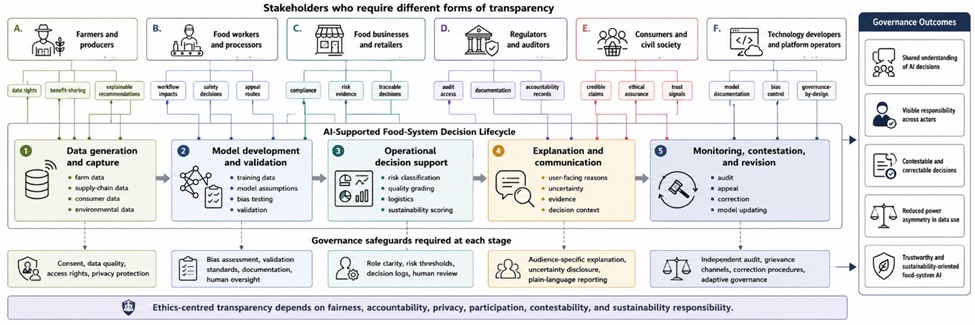
Figure 2. Stakeholder-Centred AI Transparency Governance Across the Food-System Decision Lifecycle
A reimagined model of food system transparency should also support sustainability-oriented decision-making rather than narrow optimisation. Digital agriculture can contribute to the design of sustainable agricultural systems when data and models are used to evaluate trade-offs, environmental consequences, and long-term resilience. This means that transparent AI should explain not only immediate outputs but also how sustainability goals, constraints, uncertainties, and value judgements shape decisions. Table 2 synthesises the proposed model for reimagining food system transparency through explainable, participatory, and ethics-centred AI [25].
Table 2. Reimagined Food System Transparency Model: Explainability, Participation, Ethical Governance, Trust Mechanisms, and Practical Decision Logic
Model layer | Core transparency question | AI-enabled function | Governance requirement | Practical decision logic |
Traceability foundation | Where did the product, data, or input move? | Digital records, provenance tracking, supply-chain monitoring, recall support, and verification tools. | Data-quality standards, interoperable records, credible validation, and clear responsibilities for data entry. | Establish reliable visibility before making claims about accountability or trust. |
Explainability layer | Why was a decision, classification, prediction, or recommendation made? | Interpretable models, explanation tools, model documentation, decision logs, and stakeholder-facing explanations. | Explanation standards, model validation, audit access, and communication tailored to different users. | Make algorithmic reasoning understandable enough for action, review, and challenge. |
Participatory layer | Who defines what should be transparent, explainable, and contestable? | Co-design workshops, stakeholder mapping, participatory risk assessment, feedback systems, and inclusive evaluation. | Inclusion of farmers, workers, consumers, regulators, technology developers, and affected communities. | Treat transparency as shared governance rather than one-way disclosure. |
Ethics-centred governance layer | Are rights, responsibilities, risks, and benefits fairly governed? | Bias assessment, privacy controls, accountability mapping, consent protocols, and impact monitoring. | Ethical review, legal compliance, institutional responsibility, and mechanisms for redress. | Connect technical transparency with fairness, accountability, privacy, and contestability. |
Trust mechanism layer | Why should stakeholders trust the system and its operators? | Verification dashboards, third-party audits, benefit-sharing records, explanation reports, and grievance channels. | Independent oversight, visible accountability, accessible communication, and response to stakeholder concerns. | Build trust through reliable institutions and accountable practices, not data disclosure alone. |
Sustainability orientation | How does the system support long-term food-system resilience and sustainability? | Sustainability scoring, scenario analysis, resource-use modelling, and trade-off explanation. | Transparent assumptions, stakeholder review of sustainability metrics, and monitoring of unintended consequences. | Use AI to support responsible choices while revealing uncertainty, trade-offs, and value judgements. |
Food businesses and technology developers should build explainability, accountability, and ethical review into AI-enabled transparency systems from the earliest design stages. Responsible use of AI in digital agriculture requires practical recommendations that address data governance, fairness, privacy, model performance, stakeholder communication, and risk management. This means that explainability should not be added after deployment as a public-relations layer. It should be embedded through model documentation, user-centred explanations, audit trails, and clear procedures for correcting errors or challenging decisions [26].
Regulators and policymakers should create conditions under which digital innovation supports sustainable and resilient agricultural systems rather than narrow efficiency or market concentration. Policy should encourage interoperable data standards, transparent platform governance, independent auditing, participatory assessment, and safeguards for less powerful actors in the food system. Digital innovation can contribute to sustainability and resilience, but only when adoption conditions, distributional effects, and institutional responsibilities are addressed. Transparency policy should therefore connect AI governance with sustainability governance and food-system resilience [27].
Across the food sector, practical transparency should be organised around the full lifecycle of AI systems. Before deployment, stakeholders should help define the problem, data requirements, explanation needs, ethical risks, and accountability arrangements. During deployment, organisations should monitor model performance, data quality, bias, stakeholder impacts, and the accessibility of explanations. After deployment, transparency should include auditability, revision, grievance mechanisms, and learning processes that allow AI systems to remain responsible as food-system conditions change [26, 27].
Food system transparency must move beyond traceability toward explainable, participatory, and ethics-centred AI. Traceability can show movement, provenance, and transaction histories, but it cannot by itself reveal decision logic, governance responsibilities, stakeholder rights, power asymmetries, or accountability pathways. As AI becomes more embedded in food safety, supply-chain management, sustainability assessment, quality control, and market coordination, transparency must become decision-centred as well as product-centred. A more trustworthy, democratic, and sustainable food system will depend on AI systems that are understandable, contestable, inclusive, ethically governed, and accountable to the people and environments they affect.
None
None
None
None
Open Access The author(s) retain copyright. This article is licensed under the Creative Commons Attribution-NonCommercial-ShareAlike 4.0 International License. It may be shared and adapted for non-commercial purposes with appropriate attribution, an indication of changes, and distribution of adaptations under the same license. Third-party material may be subject to separate terms identified in its credit line. View the license at https://creativecommons.org/licenses/by-nc-sa/4.0/.
 Agro Intelligence Research Press