Food systems increasingly generate consumer data through digital platforms, shopping records, dietary applications, wearable technologies, loyalty schemes, and personalised nutrition services. These data can reveal patterns of preference, dietary behaviour, product use, affordability constraints, and health-oriented needs. However, consumer data are often used for commercial targeting while remaining disconnected from product reformulation, nutrition improvement, and public health goals. AI-enabled food intelligence is frequently positioned as a tool for predicting consumer preferences or delivering personalised recommendations. This narrow use limits the potential of AI to support healthier food environments, more acceptable reformulated products, and more transparent consumer communication. A broader framework is needed to connect consumer insight with nutrition evidence, product innovation, ethical governance, and public trust. This article proposes a consumer-centred food intelligence framework linking AI, nutrition personalization, product reformulation, trust, transparency, and public health. The framework treats consumers not only as data sources but also as beneficiaries, participants, and evaluators of food-system innovation. It explains how individual and aggregated consumer intelligence can inform dietary advice, product design, reformulation priorities, and responsible communication. The article contributes a structured conceptual model for ethically transforming consumer data into health-oriented and trust-sensitive food-system decisions. It argues that AI should not only recommend diets or predict purchasing behaviour, but should also help translate nutritional evidence into acceptable products and transparent innovation pathways. Consumer-centred food intelligence is presented as a foundation for more responsible, healthier, and publicly trusted digital food systems.
Artificial intelligence is increasingly embedded in food-industry operations, where it supports sensing, prediction, quality control, automation, and decision support across production and service settings [1]. At the same time, personalised nutrition has reframed dietary guidance around individual characteristics, health needs, biological variability, and behavioural context [2]. These developments create an opportunity to connect data-driven food technologies with more consumer-centred and health-oriented food-system innovation. Yet the value of this connection depends on whether AI is used only to optimise commercial interaction or also to advance nutrition, reformulation, transparency, and public trust.
Consumer-level data are now generated through digital nutrition tools, online food platforms, shopping environments, wearable devices, food logging systems, loyalty schemes, and digitally mediated food-choice technologies. Digital food environments increasingly shape what consumers see, compare, purchase, and consume, which means that food choice is no longer limited to physical retail or household settings [3]. These environments can amplify convenience and personalization, but they can also intensify unequal exposure to unhealthy options or opaque recommendation practices. A consumer-centred approach therefore requires attention to both individual data and the wider digital contexts in which food decisions occur.
The gap addressed in this article is the separation between AI-enabled personalization, product reformulation, and public health-oriented food innovation. Reformulation can influence the nutritional quality of consumption when product composition changes are reflected in what households actually purchase and eat [4]. However, reformulation strategies are often treated as technical or regulatory tasks rather than as part of a broader consumer-intelligence system. Linking reformulation with consumer data can help identify changes that are nutritionally meaningful, sensory acceptable, affordable, and transparent to the people affected by them.
This article develops an original framework for Consumer-Centred Food Intelligence as a structured way to connect AI, nutrition personalization, reformulation, consumer acceptance, trust, and ethical governance. The framework is conceptual and does not report new empirical data. It argues that AI should not only predict preferences or generate personalised dietary advice, but should also support the translation of consumer needs into healthier product design and responsible communication. The proposed model positions consumer intelligence as a bridge between individual dietary support, aggregated product insights, reformulation priorities, and public health accountability [1].
Consumer-centred food intelligence can be defined as the ethical and analytical use of consumer data to support healthier, more acceptable, more transparent, and more trustworthy food-system decisions. This concept goes beyond market segmentation because it treats consumer data as a resource for improving nutrition, product quality, safety, accessibility, and public value. Big-data approaches in food systems show the importance of integrating heterogeneous data streams rather than relying on isolated signals or single-purpose datasets [5]. In this framework, consumer intelligence becomes meaningful only when it is connected to evidence about food composition, health outcomes, product performance, and social context.
A consumer-centred approach also requires attention to the digital interfaces through which food decisions are shaped. Online grocery stores and digital food-choice environments can use nudges, ranking systems, prompts, defaults, and recommendations to influence what consumers notice and select [6]. These tools can support healthier decisions when designed responsibly, but they may undermine trust if they are opaque, manipulative, or driven mainly by commercial objectives. Consumer-centred food intelligence therefore requires design principles that make digital influence visible, explainable, and aligned with consumer welfare.
The proposed framework also connects consumer-facing data with upstream food-system intelligence. Big data in smart farming and agri-food systems shows that production, supply-chain, and product-quality information can be integrated into wider decision systems [7]. Although such upstream data do not replace consumer insight, they can help align product development with ingredient availability, quality constraints, sustainability goals, and reformulation feasibility. A consumer-centred model should therefore connect what people need and accept with what food systems can responsibly produce and improve.
Consumers should not be positioned only as passive data generators whose preferences are extracted for prediction. They should also be treated as beneficiaries and participants in food innovation, especially when data-driven decisions affect dietary advice, product composition, pricing, labelling, and health claims. This requires intelligence systems that incorporate nutritional needs, behavioural context, affordability, cultural relevance, accessibility, and trust rather than reducing consumers to purchase probabilities [5]. In this sense, Consumer-Centred Food Intelligence is both an analytical framework and a governance commitment.
AI-enabled nutrition personalization uses data and computational methods to translate individual characteristics into dietary advice, product suggestions, behavioural feedback, and adaptive nutrition support. Nutrition recommendation systems can combine user profiles, food preferences, dietary restrictions, health goals, and food-composition data to generate more tailored guidance [8]. Such systems are especially relevant when consumers face complex decisions about nutrient quality, convenience, affordability, and long-term dietary change. However, personalization should be judged not only by technical accuracy but also by usefulness, fairness, transparency, and alignment with public health.
Precision nutrition has expanded the role of computational modelling by recognising that people may respond differently to similar foods or dietary patterns. Machine-learning approaches can help analyse individual variability across dietary intake, biomarkers, lifestyle characteristics, and other health-related data [9]. This does not mean that all dietary advice should become highly individualized or biologically deterministic. Rather, consumer-centred personalization should combine individual relevance with population-level nutrition principles and equitable food-environment support.
A key promise of AI-enabled personalization is the ability to model food-specific responses using individual-level data. Personalized prediction of postprandial glycemic responses illustrates how dietary guidance can move beyond average effects by estimating how specific foods may affect specific individuals [10]. Such approaches can improve relevance, but they also raise questions about data quality, model generalisability, privacy, interpretation, and the risk of shifting too much responsibility onto individuals. Consumer-centred food intelligence should therefore link personalised advice with product reformulation and healthier defaults in the broader food environment.
Personalised nutrition advice systems require deliberate design choices about data collection, feedback timing, user interaction, explanation, and transparency [11]. In a consumer-centred food-intelligence model, these systems should not only tell individuals what to eat but should also generate aggregated insights that can inform product reformulation, healthier retail design, and responsible food communication. This means that personalization must serve both individual guidance and system-level learning, while protecting privacy and avoiding unfair targeting. Table 1 summarises how AI-enabled nutrition personalization can translate consumer data into dietary recommendations, product insights, and trust-sensitive food decisions.
Table 1. AI-Enabled Nutrition Personalization in Consumer-Centred Food Intelligence: Data Inputs, Analytical Methods, Consumer Outputs, and Trust Requirements
Consumer data input | AI-enabled analytical method | Consumer-facing output | Product and reformulation insight | Trust and governance requirement |
Dietary intake records, food logs, and meal patterns | Dietary pattern recognition and nutrient-gap analysis | Tailored dietary feedback and meal suggestions | Identification of common nutrient shortfalls that can guide healthier product design | Clear explanation of how dietary data are used and protected |
Shopping histories and online grocery behaviour | Preference modelling and recommendation algorithms | Healthier product suggestions and substitution prompts | Detection of reformulation opportunities in frequently purchased categories | Transparent distinction between health-oriented guidance and commercial promotion |
Wearable, lifestyle, and health-related data | Adaptive modelling of behaviour, activity, and nutrition goals | Context-sensitive advice on timing, portion size, and dietary balance | Insight into consumer segments needing convenient, affordable, or functionally improved products | Consent-based data collection and limits on secondary data use |
Individual metabolic or biomarker data | Predictive modelling of personalised dietary responses | More relevant guidance for foods likely to affect individual outcomes | Support for product concepts designed around glycemic, satiety, or nutrient-response profiles | Cautious communication of uncertainty and avoidance of overclaiming |
Consumer feedback, ratings, and stated preferences | Sentiment analysis, clustering, and acceptability prediction | Recommendations adapted to taste, culture, budget, and dietary restrictions | Evidence on whether healthier reformulated products are likely to be accepted | Inclusion of cultural relevance, affordability, and user control in system design |
Aggregated anonymised consumer intelligence | Population-level pattern detection and decision-support modelling | Improved digital food environments and healthier defaults | Prioritisation of reformulation targets with high public health relevance | Privacy-preserving analytics, bias monitoring, and accountability mechanisms |
Product reformulation is a practical bridge between consumer intelligence and public health improvement because it changes the nutritional profile of foods that people already buy and consume. Reformulation is most effective when it improves health-related composition without making products unacceptable in taste, texture, price, or identity. Evidence on salt-reduced foods shows that consumer acceptance is a central condition for reformulated products to succeed in real markets [12]. For Consumer-Centred Food Intelligence, this means reformulation should begin with both nutritional targets and a detailed understanding of consumer acceptance thresholds.
AI can support reformulation by modelling relationships among nutrient composition, ingredient substitution, sensory attributes, cost, shelf life, sustainability, and regulatory constraints. Population modelling studies show that reformulation can influence nutrient intakes and health outcomes, but the magnitude of benefit depends on product categories, baseline consumption, and the extent of compositional change [13]. Consumer intelligence can help prioritise categories where reformulation would have high public health relevance and realistic consumer uptake. This makes reformulation a system-level intervention rather than a purely technical adjustment to recipes.
Nutrient profiling and front-of-package labelling can also guide reformulation because they translate complex nutrition information into product-level signals that consumers, companies, and regulators can interpret. Global progress in front-of-package nutrition labelling demonstrates how labelling policies can shape both consumer understanding and industry incentives for product improvement [14]. In a consumer-centred framework, AI can connect labelling data, product-composition databases, purchase patterns, and consumer feedback to identify where reformulation is needed most. Such integration can help ensure that healthier products are not only technically improved but also understandable and credible to consumers.
Health-oriented innovation should therefore align consumer preference, nutritional quality, affordability, accessibility, and transparent communication. Reformulation that reduces salt, sugar, saturated fat, or energy density may fail if consumers perceive the change as hidden, lower quality, or inconsistent with product expectations [12]. Conversely, data-driven reformulation can build trust when companies explain why changes were made, how healthfulness was improved, and how sensory quality was protected. Consumer-Centred Food Intelligence positions reformulation as a co-ordinated process that links consumer data, nutrition science, product design, and public health value [13, 14].
Trust is essential for AI-enabled nutrition and food product innovation because consumers must decide whether a system, product, or organisation is acting in their interest. Consumer acceptance of novel food technologies depends not only on technical performance but also on perceived benefits, risks, naturalness, familiarity, and institutional credibility [15]. AI-enabled food intelligence will therefore be judged by how well it supports meaningful consumer needs rather than by novelty alone. A consumer-centred approach must treat acceptance as a design requirement from the beginning of innovation.
Trust in AI is shaped by perceptions of reliability, competence, transparency, and appropriate human oversight. Empirical research on human trust in artificial intelligence shows that users are more likely to rely on AI when they understand its role, perceive it as capable, and believe that its use is accountable [16]. In food and nutrition contexts, this implies that recommendation systems should clarify whether advice is based on health evidence, purchase history, commercial promotion, or user-stated goals. Trust is weakened when consumers cannot distinguish between personalised guidance and targeted marketing.
Explainability is especially important when AI influences dietary advice, product recommendations, or reformulation communication. Explainable AI can improve trust and acceptance when explanations are understandable, causally meaningful, and useful for decision-making rather than merely technical [17]. For nutrition personalization, explanations should help consumers understand why a recommendation fits their dietary pattern, health goal, budget, or cultural preference. For reformulation, explanations should clarify what was changed, why it matters nutritionally, and how product quality was maintained.
Consumers may resist AI-driven health advice if they believe that algorithms cannot recognise personal uniqueness, lived experience, or contextual complexity. Research on resistance to medical artificial intelligence shows that people may reject algorithmic advice when they perceive it as insensitive to individual particularity [18]. Similar concerns may arise in personalised nutrition when consumers feel reduced to data points or when recommendations conflict with cultural food practices. Consumer-Centred Food Intelligence should therefore combine algorithmic support with user control, human accountability, cultural sensitivity, and transparent communication.
AI-enabled food intelligence has public health potential when it supports healthier diets, better product composition, and food environments that make nutritious choices easier. Nutrition policy research shows that healthier eating is shaped by environments, markets, affordability, regulation, and governance rather than by individual responsibility alone [19]. This is important because personalised nutrition tools can unintentionally frame diet quality as only a matter of personal optimisation. A public health-oriented framework should instead use consumer intelligence to improve both individual guidance and the conditions under which food choices are made.
Ethical governance is necessary because AI-enabled nutrition systems often depend on sensitive personal data, including dietary behaviour, health goals, purchase histories, location patterns, and sometimes biomarkers. Machine learning in health contexts raises ethical challenges related to consent, privacy, bias, accountability, explainability, and responsible deployment [20]. These concerns are directly relevant to personalised nutrition because food data can reveal intimate information about health status, culture, income, family structure, and daily routines. Consumer-centred systems must therefore limit data collection to legitimate purposes and provide meaningful control over data use.
Recommender systems create additional ethical risks because they can shape attention, preferences, and behaviour through ranking, filtering, and personalised exposure. Ethical analysis of recommender systems highlights concerns about opacity, manipulation, unfair targeting, narrow optimisation, and conflicts between user welfare and platform objectives [21]. In food systems, these risks are amplified when commercial goals favour products that are profitable but not health-promoting. Responsible food intelligence should therefore evaluate recommendation outcomes against nutrition quality, equity, transparency, and public health value.
Equity must be central to Consumer-Centred Food Intelligence because AI tools can widen inequalities if they serve only consumers with digital access, high literacy, disposable income, or willingness to share data. Public health nutrition requires attention to the social and commercial conditions that shape diet, while machine-learning governance requires safeguards against biased or exclusionary deployment [19, 20]. Ethical recommender design also requires monitoring whether different groups receive fair, useful, and non-manipulative recommendations [21]. The framework therefore treats accountability, explainability, privacy, and equity as core infrastructure rather than optional ethical additions.
The proposed Consumer-Centred Food Intelligence Framework consists of five connected layers: consumer data and context; AI-enabled nutrition personalization; product reformulation and health-oriented innovation; trust, transparency, and consumer acceptance; and public health and ethical governance. AI can function as a feedback-loop technology that learns from consumer interaction and adapts services, communication, and product strategies over time [22]. In this framework, feedback loops should be used not only to increase engagement or sales but also to improve dietary relevance, reformulation priorities, and public health alignment. The central design question is whether AI helps food systems understand and serve consumers better in ways that are transparent and socially beneficial.
The first layer captures consumer data and context, including dietary intake, preferences, shopping behaviour, affordability, cultural relevance, accessibility, health goals, and digital interaction patterns. The second layer uses AI-enabled personalization to translate these data into dietary recommendations, product suggestions, and adaptive feedback. The third layer aggregates privacy-protected consumer intelligence to guide reformulation and health-oriented product innovation. Responsible digital food-system transition requires attention to diversity, governance, and responsibility rather than treating technology as neutral or automatically beneficial [23]. Figure 1 presents the proposed Consumer-Centred Food Intelligence Framework, showing how consumer data and context are transformed through AI-enabled personalization, reformulation intelligence, trust-building mechanisms, and ethical governance into healthier and more publicly accountable food-system decisions.
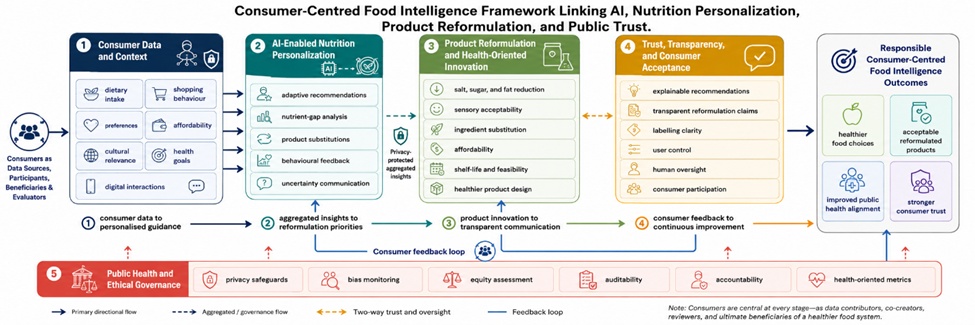
Figure 1. Consumer-Centred Food Intelligence Framework Linking AI, Nutrition Personalization, Product Reformulation, and Public Trust
The fourth layer focuses on trust, transparency, and consumer acceptance, ensuring that recommendations and reformulated products are communicated in ways that consumers can understand and evaluate. The fifth layer embeds public health and ethical governance through privacy safeguards, bias monitoring, accountability, explainability, and health-oriented performance metrics. AI applications in the food industry, including computer vision and quality assessment, show that technical intelligence can support monitoring, classification, and product-development decisions when connected to clear operational goals [24]. In the proposed framework, such technical capacity is valuable only when it is linked to consumer benefit, nutritional improvement, and trustworthy governance.
Information flows through the framework in four directions: from consumer data to personalised nutrition guidance, from aggregated insights to reformulation decisions, from product innovation to transparent consumer communication, and from consumer feedback to continuous improvement. These flows should be iterative, meaning that consumer responses to recommendations and reformulated products become evidence for refining both algorithms and products. The framework therefore integrates AI-enabled consumer interaction with responsible food-system transformation rather than separating digital personalization from product innovation [22-24]. Table 2 presents the proposed Consumer-Centred Food Intelligence Framework linking AI, nutrition personalization, product reformulation, public health, and trust.
Table 2. Consumer-Centred Food Intelligence Framework: AI Functions, Nutrition Personalization, Product Reformulation, Public Health Logic, and Trust-Building Mechanisms
Framework layer | Core AI function | Nutrition personalization role | Product reformulation role | Public health logic | Trust-building mechanism |
Consumer data and context | Integrates dietary, shopping, preference, behavioural, and health-related data | Identifies individual needs, constraints, goals, and food-choice contexts | Reveals category-level patterns in unmet needs and acceptance barriers | Links individual behaviour with wider food-environment influences | Consent, data minimisation, privacy protection, and user control |
AI-enabled nutrition personalization | Generates adaptive recommendations and decision support | Provides tailored dietary advice, product substitutions, and feedback | Produces aggregated insights into desired product attributes and nutrient gaps | Supports healthier choices without relying only on individual responsibility | Explainable recommendations and clear uncertainty communication |
Product reformulation and health-oriented innovation | Models nutrient composition, sensory acceptance, cost, and feasibility | Aligns personalised needs with available and acceptable products | Guides reductions in salt, sugar, saturated fat, or other risk-related components | Improves the healthfulness of commonly consumed products | Transparent explanation of reformulation goals and product changes |
Trust, transparency, and consumer acceptance | Evaluates communication, feedback, and acceptability signals | Ensures advice is understandable, culturally relevant, and actionable | Tests whether healthier products are acceptable to target consumer groups | Prevents health-oriented innovation from failing through rejection or misunderstanding | Labelling clarity, explainability, human oversight, and consumer participation |
Public health and ethical governance | Monitors bias, equity, accountability, and system outcomes | Prevents unfair or exclusionary personalization | Prioritises reformulation where population benefit is greatest | Aligns commercial innovation with healthier food environments | Independent evaluation, auditability, fairness safeguards, and accountable governance |
For food companies, retailers, and technology developers, the framework implies that consumer data should be used to improve health-oriented innovation rather than only to refine targeting. Social-science research on digital agriculture and smart food-system transitions highlights the need to study how digital technologies reshape institutions, roles, participation, and inclusion [25]. Companies should therefore invest in responsible data infrastructure, privacy-preserving analytics, explainable recommendation systems, and reformulation tools that connect consumer acceptance with nutritional improvement. Retailers and platforms should also evaluate whether digital nudges and recommendations improve diet quality rather than merely increasing basket value.
For public health agencies and regulators, the framework suggests the need for governance models that can evaluate AI-enabled nutrition systems, digital food environments, and reformulation claims. Algorithmic ethics research identifies problems such as unfairness, opacity, accountability gaps, and insufficient auditability, while also pointing toward solutions such as transparency, oversight, and governance safeguards [26]. Regulators may need to develop criteria for responsible use of consumer nutrition data, health-oriented personalization claims, and algorithmic recommendation practices. Public agencies can also encourage shared metrics that assess whether AI-supported innovation improves population nutrition and reduces inequities.
Future research should empirically validate the framework across nutrition platforms, online grocery systems, reformulated product categories, and public health interventions. Studies should examine whether AI-supported reformulation produces products that are nutritionally meaningful, affordable, sensorially acceptable, and trusted by different consumer groups [25]. Research should also test governance approaches for consent, privacy, explainability, fairness auditing, and accountability in consumer nutrition data systems [26]. A stronger evidence base is needed to show when Consumer-Centred Food Intelligence genuinely improves health-oriented food innovation rather than simply intensifying commercial personalization.
Consumer-Centred Food Intelligence offers a framework for linking AI, nutrition personalization, product reformulation, and public trust within a more responsible model of food-system innovation. The central contribution of the framework is its argument that consumer intelligence should not be reduced to preference prediction, commercial targeting, or isolated dietary advice. Instead, AI-enabled food intelligence should help translate consumer needs and nutrition evidence into healthier products, transparent recommendations, accountable communication, and ethically governed decision systems. As digital food systems expand, consumer-centred food intelligence can become a foundation for more trusted, health-oriented, inclusive, and responsible innovation.
None
None
None
None
Open Access The author(s) retain copyright. This article is licensed under the Creative Commons Attribution-NonCommercial-ShareAlike 4.0 International License. It may be shared and adapted for non-commercial purposes with appropriate attribution, an indication of changes, and distribution of adaptations under the same license. Third-party material may be subject to separate terms identified in its credit line. View the license at https://creativecommons.org/licenses/by-nc-sa/4.0/.
 Agro Intelligence Research Press