Food systems are increasingly embedding algorithmic traceability systems that combine blockchain infrastructures, AI-supported verification, IoT sensors, QR-enabled disclosure, and digital chain-of-custody tools. These systems are commonly promoted as instruments of transparency, fraud prevention, and consumer reassurance. Their deeper theoretical significance, however, lies in the way they reorganise the social foundations through which food becomes trusted. Existing approaches to food trust often emphasise interpersonal confidence, brand reputation, certification labels, and institutional credibility. Yet these approaches do not fully explain what happens when trust claims are mediated by automated records, distributed ledgers, sensor-generated evidence, and platform-based verification interfaces. The central problem addressed in this article is whether algorithmic traceability merely increases information or whether it changes the nature of food trust itself. This article develops an original theory of algorithmic food trust transformation. It argues that algorithmic traceability shifts food trust from a relational and reputational regime toward a system-mediated regime organised around visibility, verification, and institutional confidence. The article does not report new empirical data; instead, it builds theory by synthesising research on food trust, traceability, blockchain, digital transparency, certification, consumer behaviour, and food governance. The proposed theory identifies three sequential mechanisms. Algorithmic visibility makes selected aspects of the supply chain seeable; verification converts food claims into auditable assertions; and institutional confidence encourages consumers and market actors to rely on the functioning of technical and regulatory systems rather than on direct personal knowledge. These mechanisms do not eliminate trust, but they relocate it from persons and brands toward infrastructures, platforms, certifiers, and governance arrangements. The article contributes to food sociology and trust studies by showing that algorithmic traceability is not simply a technical improvement in supply chain information. It rewires the foundations of food trust and creates new vulnerabilities linked to data integrity, institutional legitimacy, platform control, and the opacity of verification systems. The theory therefore calls for a more critical understanding of digital food trust as a sociotechnical achievement rather than a natural consequence of transparency.
Digital traceability has become one of the most powerful promises attached to contemporary food system transformation. Blockchain ledgers, IoT sensors, QR codes, smart labels, and analytics platforms are increasingly presented as ways to make food supply chains more transparent, responsive, and trustworthy [1]. In this emerging discourse, “radical transparency” suggests that consumers can see where food comes from, how it has moved, and whether claims about quality, origin, safety, or sustainability can be supported by reliable evidence [2]. Yet the sociological question is not only whether more information is available, but how such information changes the social basis on which food is trusted.
Food trust has long been shaped by distance between consumers and production systems. As food chains expand across regions, firms, intermediaries, and regulatory jurisdictions, consumers rarely know the producers, processors, or handlers involved in the products they purchase [3]. This distance creates a trust problem because safety, authenticity, sustainability, and provenance are often credence qualities that cannot be directly verified at the point of consumption [4]. Traceability technologies therefore intervene in a social field already marked by asymmetry, uncertainty, and dependence on institutions.
The central question of this article is whether algorithmic traceability creates more trust or transforms trust into something else. Studies of food traceability show that consumers may value information about origin, handling, and authenticity, but such valuation depends on whether the information source is considered credible and whether the system behind it appears trustworthy [5]. Blockchain and digital traceability systems intensify this problem because they invite consumers to rely not only on labels or brands, but on encoded records, platform interfaces, and verification infrastructures [6]. The theoretical issue is therefore the movement from trusting people and organisations toward relying on algorithmically mediated systems.
This article develops a theory of visibility, verification, and institutional confidence to explain this transformation. It draws on research on consumer food trust, digital traceability, blockchain adoption, supply chain transparency, food fraud, and certification infrastructures [7]. The argument is that algorithmic traceability does not remove the need for trust; rather, it redistributes trust across technical systems, institutional actors, standards, and data infrastructures. The article proceeds by establishing the theoretical background, defining food trust as an institutional problem, analysing algorithmic visibility and verification, and proposing a theoretical model for future empirical research.
Trust theory distinguishes between direct personal trust and more abstract forms of system reliance. In traditional food contexts, trust may emerge through interpersonal familiarity with farmers, retailers, or local suppliers, but modern food systems require consumers to rely on organisations, standards, regulators, and supply chain intermediaries that they cannot personally observe [3]. This distinction is important because the object of trust changes from a known person to a complex institutional arrangement. Food trust is therefore not merely an individual attitude but a sociological response to dependence under conditions of limited knowledge.
Consumer food trust research shows that trust is multidimensional, involving perceptions of competence, honesty, care, transparency, and institutional reliability [7]. Measurement work on consumer trust in food demonstrates that trust must be understood across actors and system levels rather than as a simple preference or product evaluation [8]. This means that consumers may trust a product label, distrust a retailer, rely on a regulator, and still feel uncertain about the wider chain that produced the food. Algorithmic traceability enters precisely this layered field of partial trust, delegated assurance, and institutional dependence.
Food scandals and authenticity crises reveal how fragile this system-level trust can be. Research on food fraud and authenticity shows that consumers often interpret fraud not only as a product failure but as evidence of broader institutional weakness in monitoring, certification, and enforcement [4]. The same logic appears in studies of food traceability, where trust in traceable information depends on confidence in the organisations and technologies that produce the information [9]. Thus, food trust is continuously reconstructed through signals, labels, audits, reputations, and governance mechanisms.
Digital innovation complicates this theoretical landscape because it introduces algorithmic mediation into the trust relationship. Blockchain, IoT, and platform-based traceability systems promise immutable records, automated data capture, and improved supply chain transparency, yet their credibility still depends on implementation quality, governance arrangements, and institutional acceptance [10]. Research on blockchain adoption in food supply chains shows that technology cannot be separated from people, processes, performance expectations, and organisational readiness [11]. The theoretical gap is that food trust studies have not fully explained how algorithmically generated evidence changes the distinction between trust, verification, and institutional confidence.
Food trust is institutional because consumers are asked to believe in systems they cannot directly inspect. A consumer purchasing milk, meat, produce, or processed foods depends on farmers, processors, logistics providers, retailers, certifiers, auditors, regulators, and information systems that operate outside ordinary sensory evaluation [12]. Even when consumers express trust in a brand, that trust is often a compressed judgement about the wider institutional field behind the product. In this sense, food trust is not reducible to personal confidence in one actor; it is confidence in a chain of coordinated assurances.
Algorithmic traceability intervenes in this institutional problem by making selected parts of the chain visible and recordable. Technologies such as blockchain and IoT systems can document product movement, production events, storage conditions, certification records, and compliance claims across multiple actors [13]. However, the institutional problem is not solved simply because records exist, since consumers and regulators must still trust the accuracy of input data, the integrity of system design, and the legitimacy of those controlling access to traceability information [14]. Algorithmic traceability therefore shifts the trust problem from hidden supply chains to the governance of visibility itself. Figure 1 illustrates the transformation of food trust from relational and brand-based assurance to algorithmically mediated institutional confidence.
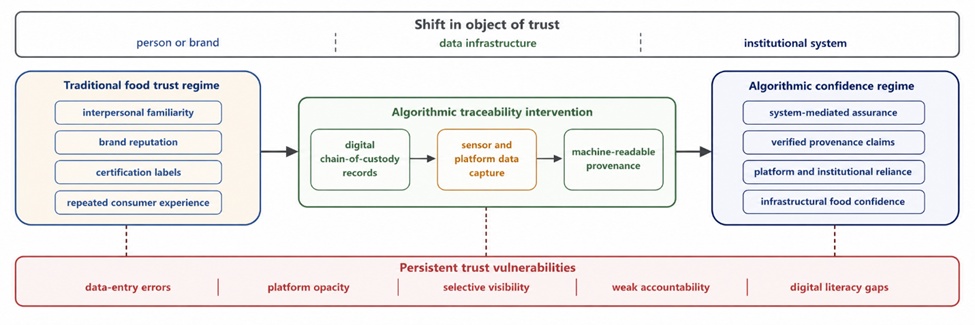
Figure 1. Transformation of Food Trust Under Algorithmic Traceability: From Relational Assurance to System-Mediated Institutional Confidence
Traditional food trust models rely heavily on reputation, familiarity, certification, and repeated experience. Emerging algorithmic trust mechanisms rely more strongly on digital records, machine-readable provenance, automated disclosure, smart verification, and platform-mediated evidence [15]. Table 1 contrasts traditional food trust models with emerging algorithmic trust mechanisms. This contrast clarifies why algorithmic traceability should be theorised not as a supplement to existing trust practices but as a reconfiguration of how trust claims are produced, circulated, and accepted.
Table 1. Traditional vs. Algorithmic Food Trust: Contrasting Foundations, Mechanisms, and Vulnerabilities
Dimension | Traditional food trust model | Algorithmic food trust mechanism | Main vulnerability |
Primary basis of assurance | Interpersonal familiarity, brand reputation, retailer credibility, certification labels | Digital provenance records, blockchain entries, IoT sensor data, QR-enabled disclosure, platform verification | Trust may shift to technical systems without sufficient understanding of how records are generated |
Main object of trust | Farmer, seller, brand, certifier, or regulator | Traceability infrastructure, verification platform, data architecture, algorithmic audit process | Consumers may not know which institution is accountable when the system fails |
Information structure | Selective, periodic, label-based, and often difficult to verify independently | Continuous, granular, machine-readable, and potentially auditable across supply chain stages | Data overload may reduce practical understanding rather than improve confidence |
Verification logic | “Trust me” claims supported by reputation, certification, or legal compliance | “Verify me” claims supported by records, automated checks, smart contracts, and digital chain-of-custody | False precision may emerge if poor data inputs are treated as reliable evidence |
Consumer role | Interprets labels, brand signals, prior experience, and social recommendations | Interprets digital interfaces, QR records, provenance dashboards, and verification scores | Digital literacy may become a condition of food confidence |
Institutional role | Regulators and certifiers provide background assurance | Regulators, platforms, certifiers, and technology providers jointly shape confidence | Accountability may become fragmented across technical and institutional actors |
Trust failure mode | Scandal, fraud, brand betrayal, certification weakness, regulatory failure | Data manipulation, platform opacity, sensor failure, blockchain-entry errors, governance gaps | Algorithmic failure may create wider confidence crises because the system claims objectivity |
Sociological implication | Trust remains relational, reputational, and institutionally supported | Trust becomes infrastructural, data-mediated, and institutionally automated | Food trust may be transformed into reliance on algorithmic confidence |
The institutional character of food trust also explains why algorithmic traceability can both strengthen and destabilise confidence. Blockchain-based traceability may reassure consumers when it is associated with credible institutions, recognisable brands, and clear product claims [16]. Yet the same systems may produce scepticism if consumers perceive them as marketing instruments, opaque platforms, or unverifiable technical promises [17]. The central theoretical implication is that algorithmic traceability does not abolish institutional dependence; it deepens it by embedding food trust in digital infrastructures that require their own forms of governance.
Algorithmic traceability begins with visibility, but visibility here means more than the disclosure of product information. It refers to the technical and institutional capacity to make supply chain events recordable, linkable, searchable, and displayable across organisational boundaries. Blockchain and distributed ledger systems are often promoted because they can connect fragmented actors through shared records, yet their theoretical importance lies in how they redefine what counts as visible evidence in food governance [18]. Visibility becomes algorithmic when it is produced through data architectures rather than through direct observation or interpersonal familiarity.
This shift changes the social form of transparency. Earlier transparency tools often depended on labels, brand narratives, voluntary disclosure, or certification claims, whereas algorithmic traceability promises continuous records of origin, movement, storage, and handling conditions [2]. IoT-enabled systems and blockchain infrastructures extend visibility from the product surface to the logistical and informational history behind the product [13]. As a result, consumers are invited to trust not only what a label states, but the chain of digital traces through which the claim is assembled.
The politics of algorithmic visibility concerns who decides what becomes visible and what remains hidden. Traceability platforms may display origin, batch movement, or certification status while leaving labour conditions, supplier power relations, pricing practices, or data ownership largely invisible [17]. Reviews of blockchain in food systems emphasise that technical transparency does not automatically produce social transparency, because data access, interface design, and governance rules determine what different actors can see [19]. Visibility is therefore selective even when it appears comprehensive.
The first theoretical mechanism is that algorithmic traceability transforms food trust by converting invisible supply chain complexity into curated digital visibility. This process can increase confidence when visible records are meaningful, interpretable, and institutionally backed, but it can also produce superficial transparency if consumers see only simplified dashboards detached from deeper governance processes [6]. The issue is not whether the system shows more information in absolute terms, but whether the information shown is socially consequential. Algorithmic visibility is thus a mediated achievement rather than a neutral technical window into the food chain.
Visibility alone does not create trust unless visible information is converted into credible evidence. Verification is the second mechanism through which algorithmic traceability transforms food trust, because it changes food claims from statements of assurance into assertions that can be checked, audited, or computationally confirmed [20]. In traditional settings, claims such as organic, local, authentic, safe, or sustainably produced often depend on certification schemes and reputational credibility. In algorithmic systems, those claims are increasingly linked to data entries, automated records, smart contracts, and compliance logic.
Smart contracts and blockchain-based verification systems are especially important because they promise to automate parts of the assurance process. When a product moves through a supply chain, verification can be attached to time-stamped records, sensor readings, custody transfers, and rule-based checks [20]. This produces a shift from “trust me” to “verify me,” where confidence is generated through the claim that records can be inspected rather than merely believed. The sociological implication is that food assurance becomes less narrative and more evidentiary, although the evidence is still institutionally produced.
Verification also depends on the quality of the data entering the system. Blockchain can make records difficult to alter after entry, but it cannot guarantee that the original data were accurate, complete, or honestly entered [21]. Studies of blockchain traceability repeatedly warn that the so-called oracle problem remains central: digital verification is only as reliable as the physical-world sensors, human inputs, audit procedures, and governance arrangements that connect food products to data records [14]. Therefore, algorithmic verification can strengthen confidence only when data generation is itself trustworthy.
The second theoretical mechanism is that verification transforms trust from an expectation of honesty into a reliance on auditable procedures. This does not eliminate human judgement; instead, it relocates judgement into the design of standards, sensor systems, audit protocols, and platform governance [22]. Consumers may perceive verified traceability as more reliable than ordinary claims, but their confidence depends on whether verification is understood as independent, competent, and protected from manipulation. Verification therefore mediates between visibility and institutional confidence.
Institutional confidence is the third mechanism in the proposed theory. In algorithmic traceability systems, consumers do not need to personally know the farmer, processor, auditor, or logistics provider; they are encouraged to rely on the functioning of a technical-institutional system [5]. This differs from interpersonal trust because the object of reliance is not a person’s moral intention but a system’s capacity to generate, preserve, and verify evidence. Food trust therefore becomes increasingly system-dependent.
This transformation is particularly visible in consumer responses to blockchain-enabled food traceability. Research on consumer adoption shows that blockchain traceability can increase purchase intention or confidence when consumers perceive the system as credible, useful, and associated with trustworthy institutions [15]. However, the same technology may fail to generate confidence when consumers do not understand how it works or when the providing platform lacks legitimacy [16]. Institutional confidence is therefore not produced by technology alone but by the perceived alignment of technology, governance, and credible intermediaries.
Platforms, certifiers, regulators, and technology providers become central intermediaries in this new trust regime. The consumer-facing interface may appear simple, such as a QR code or provenance score, but behind that interface lies a chain of data standards, permissions, audits, and organisational responsibilities [10]. Adoption studies show that people, processes, performance expectations, and technical capacities all shape whether blockchain food systems are accepted and trusted [11]. Institutional confidence emerges when these elements appear coordinated and reliable.
The risk is that algorithmic traceability may produce a confidence crisis when systems fail. If consumers are told that a food product is algorithmically verified, then a later discovery of fraud, sensor failure, data manipulation, or platform opacity may damage not only one brand but the broader credibility of digital assurance [23]. This is different from a traditional brand scandal because the failure appears to undermine the infrastructure that promised objectivity. Algorithmic trust is therefore powerful but brittle, because it concentrates confidence in systems that may be difficult for ordinary consumers to interrogate.
The proposed theoretical model explains food trust transformation as a movement from visibility to verification to institutional confidence. Algorithmic visibility makes selected supply chain conditions seeable; verification converts those visible traces into evidence; and institutional confidence stabilises consumer reliance on the system that produces and validates the evidence [24]. The model is sequential because visibility must precede verification, and verification must be credible before confidence can emerge. It is also iterative because failures in verification can force redesigns of visibility, data capture, and governance.
This model differs from traditional food trust models because it does not treat trust primarily as a relationship between consumer and brand. Instead, it treats trust as a sociotechnical outcome produced by interactions among digital infrastructures, institutional actors, data standards, and consumer interpretations [25]. Blockchain-based soybean traceability and other food-chain applications illustrate how provenance claims become embedded in technical architectures rather than communicated only through labels or marketing narratives [26]. In this model, food trust is no longer only communicated; it is engineered, displayed, verified, and governed.
Figure 2 presents the proposed theoretical mechanism linking algorithmic visibility, verification, and institutional confidence in digital food systems.
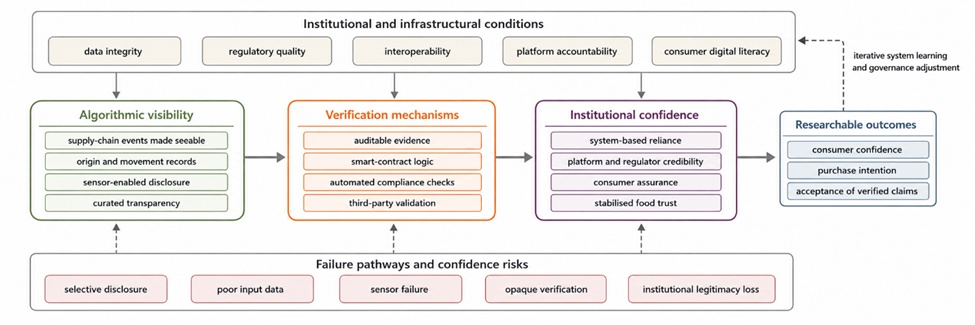
Figure 2. Visibility–Verification–Institutional Confidence Model of Algorithmic Food Trust Transformation
Several boundary conditions determine whether the transformation succeeds or fails. First, data integrity is essential because visibility and verification collapse if the recorded information is incomplete or manipulated [21]. Second, regulatory quality matters because consumers need assurance that platforms, certifiers, and firms are themselves accountable [27]. Third, consumer digital literacy shapes whether traceability information becomes meaningful confidence or simply another opaque technical signal [7]. Table 2 presents the proposed theoretical model of algorithmic traceability and the transformation of food trust.
Table 2. Proposed Theoretical Model of Algorithmic Traceability and Food Trust Transformation: Visibility, Verification, and Institutional Confidence Pathways
Model component | Core theoretical claim | Operational mechanism | Key actors | Expected trust transformation | Failure condition |
Algorithmic visibility | Food trust begins to shift when hidden supply chain processes become digitally seeable | Blockchain records, QR codes, IoT sensors, digital chain-of-custody logs, provenance dashboards | Producers, processors, logistics actors, retailers, technology platforms | Consumers move from relying on general claims to observing curated supply chain evidence | Visibility is selective, confusing, inaccessible, or controlled by actors with weak legitimacy |
Verification | Visibility becomes trust-relevant only when digital traces are transformed into auditable evidence | Smart contracts, automated compliance checks, third-party certification links, audit trails, sensor validation | Certifiers, auditors, regulators, platform providers, data stewards | Claims such as origin, safety, authenticity, and sustainability become “verified” rather than merely asserted | Verification depends on poor data inputs, weak auditing, inaccurate sensors, or unverifiable platform rules |
Institutional confidence | Consumers rely on the system’s functioning rather than on direct personal knowledge of food actors | Governance standards, regulatory oversight, trusted interfaces, institutional endorsement, platform accountability | Regulators, brands, retailers, certification bodies, technology firms | Trust shifts from interpersonal or brand-based belief to system-mediated confidence | System failure damages confidence because the infrastructure promised objectivity and control |
Iterative feedback | Trust transformation is reinforced or weakened through repeated consumer and institutional experience | Consumer adoption, complaint response, recall performance, audit outcomes, platform updates | Consumers, firms, public agencies, civil society organisations | Successful performance stabilises algorithmic confidence over time | Scandals, opaque updates, or unresolved disputes generate scepticism |
Boundary conditions | Algorithmic trust is contingent rather than automatic | Data integrity, digital literacy, governance quality, institutional legitimacy, interoperability | Whole food system network | Algorithmic traceability becomes credible when technical and institutional systems align | Technical transparency without social accountability produces shallow or fragile trust |
The model also implies that algorithmic traceability changes the distribution of power in food markets. Actors who control traceability platforms, data standards, verification interfaces, and audit architectures may gain influence over which claims become credible and which forms of value are recognised [28]. Barriers to blockchain implementation in agri-food chains show that adoption is shaped by cost, organisational readiness, interoperability, legal uncertainty, and stakeholder acceptance [29]. Thus, algorithmic confidence is not merely a consumer response; it is a governance arrangement that restructures authority over food truth.
The first proposition is that higher levels of algorithmic visibility in a food supply chain will be positively associated with consumer institutional confidence, provided that the visible information is interpretable and linked to credible governance actors. This proposition follows from evidence that consumer confidence in food depends on trust in the food value chain rather than on product information alone [3]. It also reflects blockchain research showing that transparency technologies become meaningful when consumers connect them to credible quality signals [16]. Future empirical studies can test whether visibility affects confidence directly or whether the effect is mediated by perceived usefulness and source credibility.
The second proposition is that the relationship between algorithmic visibility and institutional confidence is mediated by perceived verification reliability. Consumers may see many digital records, but confidence should increase only when they believe that those records have been checked, protected, and independently validated [9]. This proposition can be tested by comparing consumer responses to simple traceability disclosure, certified digital provenance, and automated verification interfaces. It also suggests that verification quality may matter more than the quantity of information shown.
The third proposition is that the effect of verification on institutional confidence is moderated by trust in the institution or platform providing the verification. A verification claim from a retailer, regulator, independent certifier, or private technology vendor may not carry the same social meaning, because each actor occupies a different position in the food governance field [8]. Research on blockchain adoption barriers further suggests that confidence depends on stakeholder acceptance, implementation capability, and institutional legitimacy rather than on technical design alone [28]. Empirical studies should therefore examine not only whether algorithmic traceability works, but whose verification consumers are willing to accept.
This article has developed a theory of algorithmic traceability and the transformation of food trust. The central argument is that digital traceability does not simply provide more information about food products; it changes the social architecture through which food becomes credible. Trust moves from personal relationships and brand reputation toward a system of algorithmic visibility, automated verification, and institutionally mediated confidence.
The theory contributes to food sociology and trust studies by showing that algorithmic traceability is both a technical infrastructure and a social ordering mechanism. It makes certain parts of the supply chain visible, turns selected claims into auditable evidence, and encourages consumers to rely on systems that appear objective, continuous, and institutionally supported. Yet this transformation is incomplete and fragile because visibility can be selective, verification can depend on weak data inputs, and institutional confidence can collapse when algorithmic systems fail.
Future research should empirically test the proposed propositions across different products, markets, cultures, and governance arrangements. Food system actors should also recognise that replacing interpersonal or brand-based trust with algorithmic confidence creates new responsibilities rather than fewer responsibilities. The deeper implication is that the future of food trust will depend not only on what technologies can show, but on whether the institutions behind those technologies deserve confidence.
None
None
None
None
Open Access The author(s) retain copyright. This article is licensed under the Creative Commons Attribution-NonCommercial-ShareAlike 4.0 International License. It may be shared and adapted for non-commercial purposes with appropriate attribution, an indication of changes, and distribution of adaptations under the same license. Third-party material may be subject to separate terms identified in its credit line. View the license at https://creativecommons.org/licenses/by-nc-sa/4.0/.
 Agro Intelligence Research Press