Intelligent agriculture is often presented as a technological pathway for increasing productivity, reducing input waste, and improving farm-level decision-making. In this view, the farm is commonly treated as an optimisation target in which sensors, analytics, and automated recommendations are used to improve decisions at a particular moment. Although this perspective has advanced digital agriculture, it does not fully explain how farms accumulate experience, revise practices, and become more capable over time. This article argues that the intelligent farm should be conceptualised not only as a data-driven production system but also as a learning system. A learning system is one that senses changing conditions, interprets feedback, adapts action, and modifies its decision logic across repeated cycles of experience. This framing shifts attention from isolated optimisation events to the longer-term evolution of farm knowledge, adaptive capacity, and agronomic intelligence. The objective of the article is to develop a theory of the intelligent farm as a learning system. The theory integrates three mechanisms: continuous feedback, local adaptation, and agronomic intelligence evolution. Together, these mechanisms explain how intelligent farms can move from collecting data to building situated knowledge that improves future decision quality. The proposed theory shows that intelligent farms become smarter when feedback streams are interpreted through local context and converted into evolving decision rules. Two tables are included: one contrasts optimisation and learning system views of the intelligent farm, and the other presents the full theoretical model. The article concludes that treating farms as learning systems offers a more realistic and resilient paradigm for intelligent agriculture.
The contemporary image of the intelligent farm is dominated by sensors, satellites, drones, yield monitors, connected machinery, and machine-learning models. Reviews of big data and smart farming show how digital agriculture has expanded the ability of farms to capture operational, environmental, and biological signals at increasing scale [1]. This image is powerful because it suggests that the farm can be observed more precisely and managed more efficiently than in conventional agricultural systems.
Yet much of the dominant framing treats the intelligent farm as an optimisation system rather than as a learning system. Smart farming is often described in terms of improving productivity, reducing inputs, increasing efficiency, or generating more accurate recommendations for specific management decisions [2]. This framing is valuable, but it tends to focus on the quality of a decision at a point in time rather than on the farm’s capacity to improve its decision logic through accumulated experience.
The central theoretical question is therefore not simply how artificial intelligence can optimise farm decisions, but what it would mean to treat the farm itself as a learning entity. Machine learning in agriculture already demonstrates that algorithmic models can detect patterns across crop, soil, weather, and operational data [3]. However, a farm becomes a learning system only when such patterns are connected to feedback, interpretation, local adaptation, and the progressive refinement of agronomic knowledge.
This article develops a theory of the intelligent farm as a learning system. It synthesises evidence from digital agriculture, precision farming, agricultural knowledge systems, and adaptive decision technologies to explain how farms may become smarter over time [4]. The article first establishes the theoretical background, then defines farms as learning systems, develops three core mechanisms, presents a theoretical model, and derives research propositions for future empirical testing.
The theoretical foundation of the intelligent farm as a learning system begins with the recognition that farms are complex socio-technical systems rather than passive production units. Digital agriculture research increasingly shows that farm performance emerges from interactions among biological processes, technological infrastructures, farmer judgement, markets, data platforms, and environmental variability [5]. This complexity means that intelligence cannot be reduced to prediction accuracy alone, because farm decisions must remain adaptive under changing ecological and operational conditions.
Cybernetic feedback provides a second theoretical foundation because intelligent farms depend on repeated cycles of sensing, interpretation, action, and correction. Internet of Things applications in agriculture demonstrate how connected devices can transform fragmented observations into continuous streams of operational and environmental feedback [6]. However, feedback becomes theoretically significant only when it changes how the system acts, learns, and revises its own decision assumptions.
A third foundation comes from agricultural knowledge systems and organisational learning, where learning involves more than information accumulation. Digitalisation changes how agricultural knowledge is produced, shared, validated, and applied, especially when data-driven tools interact with farmer expertise and advisory systems [7]. The theoretical gap is that these ideas have rarely been integrated into a unified model explaining how continuous feedback, local adaptation, and evolving agronomic intelligence together make the intelligent farm a learning system.
A farm can be defined as a learning system when it operates as a socio-technical entity that senses conditions, interprets signals, acts on decisions, evaluates outcomes, and modifies future decision rules. In this view, technologies such as sensors and analytics are not sufficient by themselves; they become part of learning only when they support adaptive change over time. Digital agriculture research shows that data infrastructures can support more sustainable system design, but the learning system view asks how those infrastructures reshape the farm’s capacity for ongoing improvement [5].
The distinction between using technology and becoming a learning system is central to this theory. A farm may use remote sensing, yield mapping, or automated recommendations while still repeating the same decision logic season after season. By contrast, a learning farm uses feedback to revise assumptions about soil response, crop behaviour, input timing, climatic stress, machinery performance, and management priorities, which aligns with the broader shift toward smart farming as a dynamic socio-technical transformation [8].
The farm as learning system also requires attention to human judgement and institutional context. Social science research on digital agriculture shows that smart farming is shaped by farmers, advisers, technology providers, data ownership arrangements, and platform dependencies [4, 9]. Therefore, the intelligent farm is not a machine that learns independently of people, but a distributed learning arrangement in which digital systems and human actors jointly interpret feedback and refine agronomic action.
Figure 1 illustrates the proposed theoretical shift from viewing the intelligent farm as a static optimisation target to understanding it as a dynamic socio-technical learning system.
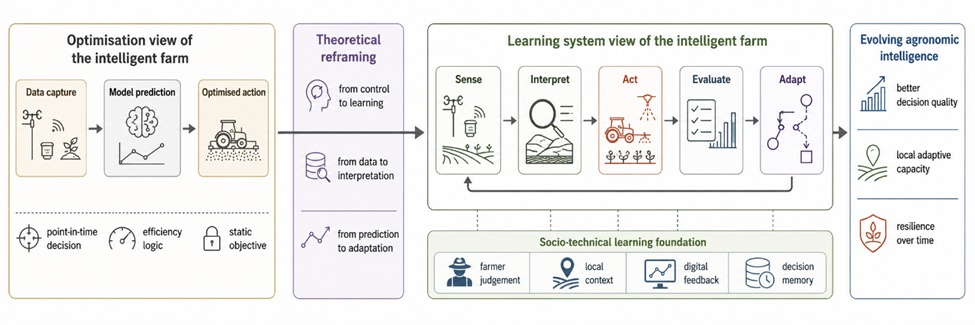
Figure 1. From Optimisation Target to Learning System: Reframing the Intelligent Farm as a Socio-Technical Entity That Senses, Interprets, Acts, Evaluates, and Adapts Over Time
This theory contrasts the optimisation view and the learning system view to clarify why intelligence should be understood as adaptive capacity rather than static technical performance. Precision agriculture technologies can improve productivity and environmental outcomes, but their longer-term value depends on whether they support repeated learning across variable conditions [10]. Table 1 contrasts the traditional optimisation view with the learning system view of the intelligent farm.
Table 1. Optimisation System vs. Learning System View of the Intelligent Farm: Contrasting Logics, Processes, and Outcomes
Dimension | Optimisation system view | Learning system view |
Core image of the farm | The farm is a production unit to be optimised through better data and more efficient control. | The farm is a socio-technical learning entity that improves through repeated sensing, interpretation, action, and reflection. |
Primary goal | Maximise yield, reduce inputs, or improve operational efficiency at a given decision point. | Improve decision quality, adaptive capacity, and agronomic intelligence over time. |
Role of data | Data provide inputs for prediction, monitoring, and recommendation. | Data become feedback signals that support interpretation, contextual learning, and revision of future decisions. |
Role of technology | Sensors, platforms, and algorithms are tools for precision control. | Technologies are learning infrastructures that connect observation, interpretation, adaptation, and knowledge evolution. |
Treatment of context | Local variation is often treated as a parameter to be measured and managed. | Local variation is treated as a source of situated knowledge that changes how the farm learns. |
Decision logic | Decisions are improved by selecting the best action under current conditions. | Decisions evolve as the farm learns from prior actions, outcomes, failures, and changing environmental conditions. |
Human role | Farmers supervise, validate, or implement technology-generated recommendations. | Farmers co-produce learning by interpreting feedback, correcting models, and embedding tacit knowledge into decisions. |
Temporal orientation | Short-term performance improvement and immediate operational optimisation. | Multi-season learning, path-dependent knowledge accumulation, and long-term adaptive improvement. |
Main risk | Overconfidence in generic models, static optimisation, and centralised control. | Fragmented feedback, weak interpretation, and failure to convert data into durable agronomic intelligence. |
Desired outcome | More efficient farm management. | A farm that becomes progressively smarter, more resilient, and more locally adapted over time. |
Continuous feedback is the first mechanism through which the intelligent farm becomes a learning system. In digital agriculture, feedback is generated through soil sensors, weather stations, crop imagery, machinery telemetry, yield monitors, and platform-based farm records, creating a dense observational layer around farm activity [11]. These signals allow the farm to compare intended actions with observed outcomes, which is the starting point for learning rather than merely monitoring.
The difference between open-loop control and closed-loop learning is theoretically important. In open-loop systems, a recommendation is generated and implemented without systematic attention to how the outcome modifies future decision logic. In closed-loop systems, the observed response of soil, crop, machinery, or livestock becomes an input into later interpretation and action, which is consistent with the wider use of agricultural data analytics to transform repeated observations into decision-relevant knowledge [12].
Continuous feedback becomes more powerful when it captures not only agronomic outcomes but also uncertainty, error, and deviation. Computer vision and artificial intelligence applications in crop production show how visual data can identify crop status, disease symptoms, weed pressure, and growth variability [13]. For the intelligent farm as a learning system, such signals matter because they reveal where existing decision assumptions worked, failed, or require revision.
The theory therefore distinguishes corrective feedback from transformative feedback. Corrective feedback supports single-loop learning by adjusting irrigation, fertiliser, spraying, or machinery action within an existing decision frame, while transformative feedback supports double-loop learning by questioning the assumptions behind that frame. Deep learning applications in agriculture illustrate the growing technical capacity to detect complex patterns, but the learning system perspective asks whether those patterns lead to revised agronomic reasoning across time [14].
Local adaptation is the second mechanism of the intelligent farm as a learning system. Farms differ in soil structure, slope, hydrology, micro-climate, cropping history, pest ecology, labour availability, machinery constraints, and farmer objectives. Because of this heterogeneity, generic digital models must be interpreted and adjusted through local experience, even when they are trained on large agricultural datasets [3].
The tension between generic artificial intelligence and site-specific adaptation is especially visible in precision management. Machine-learning approaches can support site-specific decisions, but their value depends on whether they are calibrated to field-level variability and farm-specific management goals [15]. A learning farm therefore does not simply import external intelligence; it contextualises external models through repeated local feedback and practical experimentation.
Local adaptation also requires attention to how data move through farm infrastructures. Internet of Things and data analytics systems can provide continuous information flows, but implementation challenges remain around interoperability, connectivity, data quality, and decision relevance [16]. These challenges mean that contextual learning is not only an algorithmic task; it is also an infrastructural and organisational process through which farm-specific evidence becomes usable.
Farmer-in-the-loop adaptation is central because local knowledge often captures relationships that are difficult for remote or generic models to observe directly. Smart farming technologies develop within specific practical and regional contexts, and their adoption depends on how farmers perceive usefulness, complexity, and fit with existing management routines [17]. The learning system view therefore positions farmers not as passive users of artificial intelligence, but as co-learners who help align digital models with situated agronomic reality.
Agronomic intelligence is the third mechanism in the proposed theory. It refers to accumulated, actionable knowledge about how a specific farm responds to management actions under changing environmental, biological, and operational conditions. This knowledge is not identical to data volume, because large datasets become intelligent only when they are transformed into decisions, explanations, routines, and revised assumptions that improve future action [7].
Decision evolution occurs when repeated feedback and local adaptation modify the rules by which the farm chooses future interventions. Reinforcement learning research in crop management shows how decision systems can learn policies through repeated interaction between actions, states, rewards, and future consequences [18]. In a farm learning system, this logic is broader than algorithmic optimisation because the reward structure must include yield, input efficiency, soil health, risk, resilience, and long-term sustainability.
Agronomic intelligence also evolves through the integration of tacit farmer knowledge with computational models. Responsible artificial intelligence in agriculture requires attention to risks, externalities, social consequences, and system-level interactions that cannot be reduced to technical prediction performance [19]. Therefore, decision evolution should include mechanisms for human correction, farmer explanation, contested interpretation, and reflection on whether the system is learning the right objectives.
The accumulation of agronomic intelligence is path-dependent because past decisions influence what the farm can learn next. Digital innovations for sustainable and resilient agricultural systems indicate that data-driven tools can support adaptation, but their effects depend on institutions, incentives, governance, and the capacity to connect farm-level decisions with broader sustainability goals [20]. The learning farm is therefore not simply a more automated farm; it is a farm whose decision memory becomes progressively richer, more contextual, and more capable of guiding future action.
The proposed theoretical model defines the intelligent farm as a learning system composed of three interacting mechanisms: continuous feedback, local adaptation, and agronomic intelligence evolution. Continuous feedback generates signals from fields, crops, machinery, weather, markets, and management outcomes, while local adaptation contextualises those signals within the farm’s unique conditions. Agronomic intelligence then converts repeated feedback and contextual interpretation into evolving decision rules, which aligns with the broader role of digital agriculture in designing sustainable agricultural systems [5].
The model is dynamic rather than linear because learning occurs through repeated cycles across seasons. Digital Agricultural Knowledge and Information Systems illustrate how digitalisation can support diversified and multifunctional agricultural systems by connecting data, knowledge, and decision support [21]. In the proposed theory, this connection is treated as a learning architecture in which the farm’s prior decisions shape future data, future interpretation, and future adaptive capacity.
The model also includes path dependence, learning curves, and resilience as system properties. Site-specific nitrogen management and on-farm precision experimentation show that farms can improve decisions by repeatedly testing, observing, and refining management responses under local conditions [22]. Table 2 presents the proposed theoretical model of the intelligent farm as a learning system.
Table 2. Proposed Theoretical Model of the Intelligent Farm as a Learning System: Feedback Loops, Adaptation Mechanisms, and Intelligence Evolution
Model component | Theoretical role | Core learning process | Main farm-level mechanism | Expected contribution to intelligence evolution |
Continuous feedback streams | Provide the observational basis for learning. | Repeated sensing of environmental, biological, operational, and outcome signals. | Soil sensors, crop imagery, yield monitors, machinery telemetry, weather data, and management records. | Converts farm activity into interpretable feedback rather than isolated data points. |
Outcome comparison | Links action to consequence. | Evaluation of whether interventions produced expected or unexpected results. | Comparing predicted and observed yield, stress, input response, disease pressure, or resource use. | Reveals errors, deviations, and performance gaps that stimulate learning. |
Corrective learning loop | Supports single-loop learning. | Adjusting actions within existing assumptions. | Modifying irrigation, fertiliser, pest control, seeding, or machinery settings. | Improves operational precision and near-term decision performance. |
Assumption-revising loop | Supports double-loop learning. | Revising the decision rules, thresholds, or objectives that guide action. | Reconsidering input timing, risk thresholds, crop-zone definitions, or sustainability priorities. | Enables deeper learning when previous decision logic no longer fits local conditions. |
Local adaptation mechanism | Contextualises general knowledge. | Translating generic models and external recommendations into site-specific practice. | Field-level calibration, farmer feedback, edge-based adjustment, and on-farm experimentation. | Makes intelligence locally valid rather than merely technically sophisticated. |
Agronomic memory | Stores accumulated experience across seasons. | Retaining relationships among actions, contexts, outcomes, and explanations. | Farm records, model histories, decision logs, farmer notes, and advisory interpretations. | Allows the farm to learn from its own past rather than restarting each season. |
Intelligence evolution | Produces progressively better decision capability. | Refining decision rules through repeated feedback, adaptation, and interpretation. | Updated recommendations, improved risk anticipation, better timing, and refined intervention logic. | Generates a smarter farm whose decisions become more resilient, contextual, and knowledge-rich. |
Governance and responsibility layer | Ensures that learning remains accountable and aligned with farm goals. | Human review of model behaviour, data quality, objectives, and unintended effects. | Farmer-in-the-loop validation, transparent decision records, and responsible data stewardship. | Prevents learning from becoming opaque, misaligned, or detached from agronomic judgement. |
The full model suggests that the farm becomes intelligent when it can remember, compare, adapt, and revise. Reinforcement learning with crop growth models demonstrates the possibility of using dynamic feedback to support sequential agronomic decisions, especially where actions have delayed consequences [23]. However, the theory extends this logic beyond formal algorithms by treating the whole farm as a learning arrangement in which technologies, farmers, advisers, infrastructures, and ecological responses jointly shape the evolution of agronomic intelligence.
Figure 2 presents the mechanism through which continuous feedback, local adaptation, and agronomic memory combine to produce evolving agronomic intelligence.
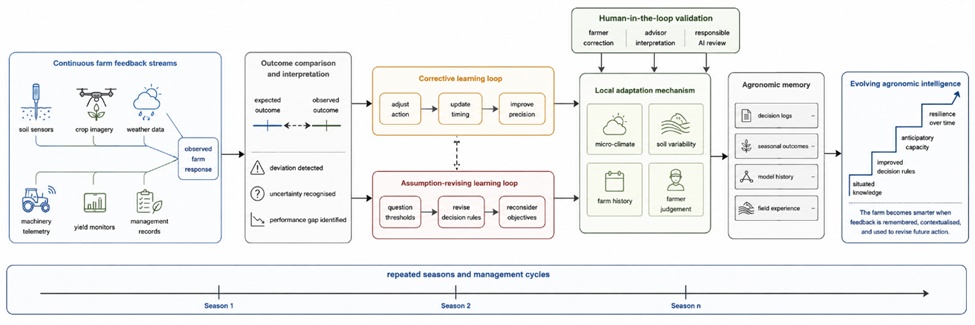
Figure 2. Dynamic Learning Architecture of the Intelligent Farm: How Continuous Feedback, Local Adaptation, Agronomic Memory, and Decision Revision Produce Evolving Agronomic Intelligence
The first proposition is that the density and quality of continuous feedback loops are positively associated with the rate of agronomic intelligence evolution. Farms with richer feedback from sensors, imagery, machinery, and outcomes should be better able to identify mismatches between intended and actual results. Farm management information systems already show how digital functions can support practical farm decisions, but the learning system perspective predicts that their value depends on whether they create usable feedback for future adaptation [24].
The second proposition is that local adaptation mediates the relationship between generic artificial intelligence model performance and on-farm decision quality. A technically strong model may still produce weak decisions if it is not contextualised to soil variability, micro-climate, management history, and farmer objectives. On-farm testing of sustainable intensification practices shows that local experimentation can help translate digital agriculture into farm-specific learning, which supports the proposition that adaptation is the bridge between prediction and agronomic intelligence [25].
The third proposition is that intelligent farms with double-loop learning capabilities will show greater resilience under climate, market, and biological shocks than farms limited to corrective optimisation. A corrective system may adjust inputs after stress is observed, but a double-loop learning system can reconsider crop strategy, risk thresholds, intervention timing, and sustainability objectives. Future research should therefore examine not only whether digital agriculture improves immediate efficiency, but also whether it changes how farms learn, remember, and adapt under uncertainty [26].
This article has developed a theory of the intelligent farm as a learning system. It argued that intelligent agriculture should not be understood only as a technical effort to optimise production, minimise inputs, or automate decisions. The central contribution is a conceptual shift from the farm as an optimisation target to the farm as a socio-technical system capable of continuous learning.
The proposed theory identifies continuous feedback, local adaptation, and agronomic intelligence evolution as the three mechanisms through which farms become smarter over time. These mechanisms explain how sensor data and digital models can move beyond immediate decision support toward the accumulation of situated agronomic knowledge. The framework also clarifies why human judgement, local context, and decision memory remain essential to intelligent agriculture.
Future research should empirically test the propositions developed in this article across different crops, regions, technologies, and governance settings. Agricultural technologists should design systems that do more than control, predict, or recommend; they should design systems that help farms learn. Viewing the intelligent farm as a learning system offers a more adaptive, resilient, and forward-looking foundation for the next stage of intelligent agriculture.
None
None
None
None
Open Access The author(s) retain copyright. This article is licensed under the Creative Commons Attribution-NonCommercial-ShareAlike 4.0 International License. It may be shared and adapted for non-commercial purposes with appropriate attribution, an indication of changes, and distribution of adaptations under the same license. Third-party material may be subject to separate terms identified in its credit line. View the license at https://creativecommons.org/licenses/by-nc-sa/4.0/.
 Agro Intelligence Research Press