Intelligent farming systems increasingly depend on data generated through sensors, machinery, satellites, digital platforms, advisory tools, farm management software, and artificial intelligence-enabled decision-support systems. These systems promise more precise monitoring, improved resource allocation, and better responsiveness to environmental and operational uncertainty. As farm operations become more data-intensive, farm data shift from being a by-product of agricultural activity to becoming a strategic asset within intelligent farming systems. This transformation creates governance problems that cannot be resolved through technical data management alone. Farm data raise contested questions about ownership, consent, access, interoperability, platform dependence, accountability, and farmer control. These questions are especially important because data generated on farms may be used beyond the original farming context for commercial analytics, platform development, benchmarking, insurance, input recommendation, credit scoring, or supply-chain governance. The objective of this article is to develop a data stewardship framework for intelligent farms. The framework is designed to clarify how ownership, consent, access, interoperability, accountability, and farmer-control mechanisms can be organised in ways that support responsible digital agricultural innovation. It treats data stewardship as a governance function that mediates between innovation, commercial data use, and the protection of farmers’ decision-making authority. The article is based on a governance framework synthesis peer-reviewed articles published. It does not present new empirical data. Instead, it synthesises literature on digital agriculture, smart farming, agricultural data governance, platformisation, responsible innovation, interoperability, and farmer data rights to construct a practical and conceptual governance framework. The article maps farm data as a governance problem, analyses ownership and consent issues, examines interoperability and platform dependence, and proposes a stewardship framework for intelligent farms. Three tables summarise ownership and control issues, interoperability risks, and the proposed framework. Responsible intelligent farming requires data stewardship arrangements that protect farmer control while enabling trustworthy data sharing and innovation.
Intelligent farming has become a central expression of digital transformation in agriculture because sensors, platforms, digital twins, machinery data, satellite information, and algorithmic decision tools increasingly shape how farm conditions are monitored and acted upon [1]. Big data in smart farming has been described as a major shift in agricultural systems because data are collected across production, logistics, advisory, and management processes rather than remaining confined to isolated farm records [2, 3]. Digital agriculture therefore reorganises farming around continuous data generation, data integration, and data-mediated decision-making.
The governance significance of this shift lies in the fact that farm data are not neutral technical inputs. Literature on smart farming and responsible innovation shows that digital tools can reconfigure relationships among farmers, technology providers, advisers, regulators, retailers, and input suppliers [4, 5]. As data become embedded in platforms and decision-support systems, they influence who can access knowledge, who can define problems, and who benefits from agricultural innovation.
Farm data governance has become especially important because farmers often face uncertainty about what data are collected, how they are reused, and whether benefits are shared fairly. Studies of trust and transparency in smart farming show that farmers may hesitate to share data when they do not know what platforms do with those data or how commercial value is extracted from them [6]. Legal and governance analyses further indicate that reluctance to share data is shaped by unclear ownership rights, contractual complexity, and weak farmer control over downstream data use [7].
This article develops an original governance framework for data stewardship in intelligent farms. It focuses on ownership, consent, access, interoperability, platform dependence, accountability, and farmer control as interdependent governance problems rather than separate technical issues. The aim is to provide a practical and conceptual framework that supports responsible innovation while ensuring that farmers remain meaningful participants in the governance of data generated through their land, labour, machinery, and production systems [8, 9].
Farm data become a governance problem when ordinary agricultural activities are converted into data flows that can be aggregated, analysed, commercialised, and reused beyond the farm. Datafication changes the status of soil measurements, machinery logs, yield maps, animal records, weather responses, and input decisions by turning them into assets within wider digital ecosystems [2]. This process creates new opportunities for optimisation, but it also raises questions about who has authority over the interpretation and secondary use of data generated through farming practice.
Platformisation intensifies these governance concerns because data are often stored, processed, and analysed within proprietary digital infrastructures. Research on digital agriculture highlights that platforms can mediate farmers’ access to agronomic recommendations, benchmarking tools, input markets, and compliance systems [5]. When platforms become central intermediaries, farm data governance is no longer only about privacy or storage, but also about dependency, bargaining power, and the capacity of farmers to contest or redirect data-driven decisions.
Technical data management is insufficient because governance problems involve rights, responsibilities, accountability, and institutional trust. Ethical analyses of smart farming argue that responsible innovation requires attention to power, inclusion, transparency, and social consequences rather than simply improving data quality or analytical performance [4]. Similarly, work on agricultural big data and power shows that data infrastructures can generate asymmetries when farmers provide data but lack equivalent influence over how value, risk, and accountability are distributed [10].
Ownership in intelligent farming is difficult to define because farm data may be generated through overlapping contributions from farmers, machinery manufacturers, platform providers, agronomists, software vendors, and remote-sensing infrastructures. Legal scholarship has shown that agricultural data often do not fit neatly within conventional ownership categories, which makes contractual arrangements and platform terms central to practical control [7]. As a result, farmers may experience limited control even when data originate from their fields, equipment, animals, or production decisions.
Control is therefore broader than formal ownership because it includes the ability to access, move, interpret, correct, restrict, share, or withdraw data from digital systems. Research on European agricultural data governance argues that policy debates should move beyond narrow “data ownership” claims toward more comprehensive governance arrangements that address access rights, reuse conditions, and institutional safeguards [11]. In intelligent farming, the key governance question is not only who owns data, but who can exercise meaningful control over data throughout their lifecycle.
Platform power complicates farmer autonomy because contractual terms may permit extensive data reuse while offering farmers limited visibility over downstream analytics, aggregation, or commercial application. Studies of smart farming trust indicate that farmers’ willingness to share data depends on transparency, benefit-sharing, and confidence that data will not be used against their interests [6]. This creates a tension between innovation models that depend on large-scale data aggregation and governance models that protect farmers from extraction, surveillance, and unilateral platform control.
A stewardship approach must therefore distinguish between data origin, legal rights, operational control, commercial reuse, and accountability. Farmer-centred governance should ensure that data generated through farming practice cannot be treated simply as platform resources detached from the people and places that produced them [12]. Table 1 maps the main ownership and control issues in intelligent farm data governance.
Table 1. Ownership and Control in Intelligent Farming Data Governance: Data Types, Rights Claims, Control Risks, and Governance Responses
Farm data governance issue | Examples of data or digital practice | Main rights or control claim | Governance risk for farmers | Proposed governance response |
Data generated on farm through machinery and sensors | Yield maps, tractor logs, irrigation data, soil sensors, animal monitoring records | Farmers should retain practical authority over data generated through their land, labour, assets, and production decisions | Platforms or equipment providers may treat generated data as reusable commercial assets without meaningful farmer control | Establish farmer-recognised data control rights covering access, reuse, correction, deletion, portability, and withdrawal |
Contractual control through platform terms | Farm management software agreements, machinery cloud services, advisory platform terms | Contracts should be understandable, negotiable, and aligned with fair data-use expectations | Standardised contracts may permit broad reuse, unclear sharing, and weak remedies for farmers | Require plain-language data-use terms, layered consent, renewal points, and independent review of high-risk clauses |
Aggregated and derived data | Benchmarking datasets, predictive models, input recommendations, regional performance analytics | Farmers should have visibility over how individual data contribute to aggregated products and derived value | Data can be commercialised after aggregation while farmers lose traceability, bargaining power, and benefit-sharing opportunities | Create benefit-sharing, transparency, and attribution rules for aggregated and derived agricultural data products |
Access to farm data by third parties | Insurers, lenders, retailers, input suppliers, certification bodies, advisers | Third-party access should be specific, consent-based, limited, and auditable | Data may be reused for pricing, risk scoring, compliance pressure, or commercial profiling without farmer awareness | Introduce auditable third-party access logs, purpose limitation, time limits, and farmer approval for secondary use |
Platform-mediated decision control | Recommendation systems, predictive analytics, digital twins, automated alerts, advisory dashboards | Farmers should remain able to question, override, and contextualise data-driven recommendations | Decision authority may shift from farmers to platform analytics, reducing experiential judgement and autonomy | Require explainability, contestability, human override, and documentation of decision-support limitations |
Data portability and exit rights | Moving farm records between platforms, APIs, machinery systems, or cooperative data spaces | Farmers should be able to move usable data without losing historical records or operational continuity | Vendor lock-in can make switching costly and can trap farmers in proprietary ecosystems | Mandate interoperable export formats, reasonable API access, and continuity protections when farmers leave platforms |
Accountability for data misuse or harm | Incorrect recommendations, unauthorised sharing, discriminatory analytics, breach of confidentiality | Farmers should have clear remedies and accountable points of contact | Responsibility may be diffused across vendors, platforms, advisers, and data processors | Establish grievance channels, audit mechanisms, liability allocation, and independent stewardship oversight |
Collective control over shared agricultural data | Cooperative datasets, regional disease surveillance, sustainability monitoring, supply-chain data pools | Farmers should be represented in governance of shared data infrastructures | Collective datasets may reproduce unequal bargaining power if platforms control rules and access | Develop cooperative data governance, farmer representation boards, data trusts, and shared stewardship agreements |
Consent in intelligent farming must be treated as an ongoing governance relationship rather than a one-time acceptance of platform terms. Farmers may agree to digital services without fully understanding how data will be aggregated, analysed, transferred, or reused for secondary commercial purposes [6]. Because smart farming systems can collect data continuously, meaningful consent requires clarity about purpose, duration, third-party access, withdrawal options, and the consequences of refusing data sharing.
Access governance is equally important because farm data may circulate among machinery providers, input suppliers, advisers, insurers, lenders, researchers, retailers, and public agencies. The legal uncertainty surrounding agricultural data means that access is often shaped by contracts rather than by clear statutory ownership rights [7]. A stewardship approach should therefore define access permissions in practical terms, including who can access which data, for what purpose, under what conditions, and with what accountability mechanisms.
Trust and transparency are central to responsible data sharing because farmers are more likely to participate when they understand how data use creates value and how risks are managed. Research on smart farming governance in Ireland shows that governance actors perceive digital agriculture through competing expectations around innovation, risk, trust, and institutional responsibility [13, 14]. Data-sharing systems should therefore make data flows visible, communicate benefits and risks clearly, and avoid treating farmers as passive data providers.
Collective data-sharing arrangements may offer an alternative to purely bilateral platform contracts because they can strengthen farmers’ bargaining power and enable shared governance over agricultural data resources. Responsible innovation research suggests that digital agriculture requires inclusive design processes that account for unequal capacities, contested values, and real-world complexity [15, 16]. Cooperatives, data trusts, and farmer-led data spaces can help align data sharing with collective benefit, but only if farmers have genuine representation in rule-setting, monitoring, and dispute resolution.
Interoperability is a governance issue because farmers cannot exercise meaningful control over data if information is trapped in incompatible formats, proprietary dashboards, or closed machinery ecosystems. Digital twins and other advanced smart farming applications depend on the integration of physical, biological, environmental, and operational data across systems [17]. Without interoperable standards, farmers may lose the ability to compare services, move records, combine tools, or maintain continuity when changing providers.
Platform dependence emerges when technical design, contractual restrictions, and data architecture make it costly for farmers to leave a digital service. Agricultural data-sharing platforms can create value by linking datasets, actors, and decision processes, but they can also concentrate control over data infrastructures [18, 19]. When platforms define formats, interfaces, analytics, and access rules, they may become gatekeepers rather than neutral service providers.
Vendor lock-in is not only a market problem; it is also a governance problem because dependence can reduce farmer autonomy and weaken accountability. Digitalisation has been described as both a sustainability opportunity and a dilemma because the same systems that promise efficiency can deepen dependency and redistribute control away from farmers [20]. Governance frameworks should therefore treat portability, open standards, API access, and service exit rights as farmer-control mechanisms rather than optional technical features [21].
Interoperability also affects sustainability governance because fragmented data systems make it difficult to evaluate environmental, economic, and social outcomes across farms, regions, and supply chains. Semantic and standards-based data-sharing approaches show that agricultural supply chains require shared vocabularies and interoperable infrastructures if data are to support sustainable food systems rather than remain isolated within proprietary silos [22]. Table 2 summarises interoperability and platform-dependence risks affecting intelligent farm data systems.
Table 2. Interoperability and Platform Dependence in Intelligent Farming: Technical Barriers, Lock-in Mechanisms, and Governance Implications
Interoperability or platform-dependence issue | Technical or organisational barrier | Lock-in mechanism | Governance implication | Stewardship response |
Closed data formats | Farm records, sensor outputs, or machinery logs stored in proprietary formats | Farmers cannot easily move historical data to competing services | Data control becomes dependent on vendor permission rather than farmer authority | Require exportable, machine-readable, standardised data formats |
Restricted API access | Platforms limit external integration with advisory tools, cooperative systems, or public services | Farmers must remain within one provider ecosystem to use accumulated data | Platform providers gain gatekeeping power over agricultural data flows | Establish fair API access rules, documented interfaces, and non-discriminatory integration conditions |
Fragmented farm data systems | Soil, weather, machinery, crop, livestock, and financial data stored separately | Farmers cannot assemble a complete operational data record without platform mediation | Decision-support quality and farmer oversight are weakened by data silos | Promote interoperable farm data architectures and shared semantic standards |
High switching costs | Migration requires manual work, technical support, subscription changes, or loss of records | Farmers avoid changing providers even when services are costly or unsuitable | Market choice becomes constrained, reducing accountability through competition | Create data portability rights, switching assistance, and continuity guarantees |
Proprietary analytics pipelines | Platforms generate recommendations through opaque models and undisclosed data processing | Farmers depend on platform interpretations without access to underlying assumptions | Decision authority shifts toward the platform and away from situated farmer judgement | Require explainability, model documentation, and farmer-facing uncertainty communication |
Aggregated benchmarking systems | Platforms compare farms through internal datasets not accessible to participants | Farmers contribute data but cannot inspect how benchmarks are constructed | Value extraction occurs without reciprocal transparency or control | Introduce rules for benchmark governance, aggregation disclosure, and farmer participation |
Multi-actor data ecosystems | Advisers, insurers, lenders, retailers, public bodies, and technology firms use overlapping data | Responsibility becomes dispersed across many actors and contracts | Farmers may not know who is accountable for misuse, error, or harm | Build access registers, shared accountability protocols, and auditable data-use trails |
Infrastructure inequality | Smaller farms may lack technical capacity, broadband access, or advisory support | Farmers with fewer resources become dependent on bundled platform services | Data stewardship may benefit larger or better-resourced farms unless capacity gaps are addressed | Provide cooperative support, public digital infrastructure, and capacity-building programmes |
Farmer data rights should be understood as practical governance rights that enable farmers to know, access, correct, move, restrict, contest, and withdraw data use. Security and privacy scholarship in smart farming shows that farm data infrastructures are exposed to risks involving unauthorised access, cyberattack, confidentiality breaches, and misuse of operational information [23, 24]. Rights-based stewardship must therefore include both legal protections and technical safeguards that make farmer control operational rather than symbolic.
Accountability mechanisms are needed because intelligent farming systems can produce harms that are difficult to trace to a single actor. Incorrect recommendations, biased analytics, unauthorised sharing, security breaches, and opaque platform decisions may involve software vendors, data processors, advisers, equipment manufacturers, and downstream users [25]. A stewardship framework should therefore include audit trails, role-based responsibility, independent review, and grievance channels that allow farmers to challenge data practices and seek remedy.
Explainability and contestability are especially important when farm data are converted into recommendations that affect agronomic practice, financial decisions, input use, or compliance. Studies of big data and algorithmic identity in agriculture suggest that farmers’ social and professional identities may be reshaped when algorithms classify, rank, or interpret their practices [12]. Accountability must therefore protect not only data security, but also farmers’ capacity to question how data-driven systems represent their farms, evaluate their decisions, and influence their future options.
The proposed framework defines data stewardship as the coordinated governance of farm data across the full data lifecycle, from generation and collection to access, reuse, sharing, storage, portability, audit, and deletion. Its first principle is ownership clarity, but it deliberately moves beyond ownership alone by specifying practical control rights over data access, reuse, correction, withdrawal, and portability [11]. This approach recognises that formal ownership may remain legally contested while farmer control can still be strengthened through enforceable stewardship rules.
The second principle is meaningful consent, which requires consent procedures that are specific, understandable, revisable, and proportionate to the risk of data use. Consent should distinguish between operational service delivery, agronomic advice, research use, benchmarking, commercial analytics, and third-party transfer [6]. Because agricultural platforms often rely on long-term and continuous data flows, stewardship should include periodic renewal, layered information, consent dashboards, and clear refusal options.
The third principle is accountable interoperability, which treats standards, portability, and API access as governance requirements rather than purely technical preferences. Data-sharing platforms and semantic infrastructures can support innovation when they make data usable across systems, but they must also prevent new forms of platform dependency and unaccountable aggregation [18, 22]. Table 3 presents the proposed data stewardship framework for intelligent farms.
Table 3. Proposed Data Stewardship Framework for Intelligent Farms: Governance Principles, Institutional Mechanisms, Technical Requirements, and Farmer-Control Measures
Governance principle | Institutional mechanism | Technical requirement | Farmer-control measure | Expected governance contribution |
Ownership clarity | Farm data charters, fair contract standards, cooperative governance rules | Data inventories that identify source, type, processor, and reuse conditions | Recognition of farmer authority over access, reuse, correction, portability, and withdrawal | Reduces ambiguity over who may use farm data and under what conditions |
Meaningful consent | Layered consent procedures, renewal points, independent contract review | Consent dashboards, purpose tags, expiry dates, and third-party access notices | Ability to approve, refuse, revise, or withdraw consent for specific data uses | Turns consent from passive acceptance into active governance participation |
Controlled access | Access registers, role-based permissions, third-party approval processes | Identity management, permission controls, data-use logs, and access alerts | Visibility over who accessed data, when, why, and under which permission | Limits unauthorised use and strengthens farmer oversight of data circulation |
Interoperability and portability | Open standards policies, API governance, cooperative data spaces | Machine-readable exports, documented APIs, shared semantic vocabularies | Ability to move usable farm data across platforms without losing continuity | Reduces vendor lock-in and supports meaningful market choice |
Accountability and auditability | Independent stewardship boards, audit protocols, grievance procedures | Audit trails, model documentation, risk logs, and traceable data-processing records | Ability to challenge misuse, error, unfair profiling, or harmful recommendations | Creates routes for remedy and assigns responsibility across data ecosystems |
Explainability and contestability | Decision-support review rules, advisory accountability standards | Farmer-facing explanations, uncertainty indicators, model limitation statements | Ability to question, override, and contextualise algorithmic recommendations | Protects farmer judgement and prevents blind dependence on platform analytics |
Benefit-sharing | Cooperative data pools, data trusts, shared value agreements | Aggregation transparency, attribution records, benefit-tracking systems | Participation in decisions about commercial reuse and collective value distribution | Aligns data innovation with fairness and reciprocal value creation |
Capacity and inclusion | Training programmes, public support, cooperative advisory services | Usable interfaces, low-cost compliance tools, multilingual support, accessible documentation | Practical ability to understand and use stewardship rights regardless of farm size | Prevents data governance from favouring only large or digitally advanced farms |
The fourth principle is farmer-centred accountability, which requires institutions capable of monitoring data practices, resolving disputes, and representing farmer interests in digital ecosystems. Emerging debates on agricultural data policy show that stakeholder trust depends on whether governance instruments are enforceable, inclusive, and responsive to real power imbalances [26]. The framework therefore combines contractual safeguards, cooperative oversight, technical standards, auditability, and grievance mechanisms to ensure that intelligent farming innovation remains accountable to farmers.
Figure 1 synthesises the proposed data stewardship framework by showing how intelligent farm data flows can be governed through ownership clarity, meaningful consent, controlled access, interoperability, accountability, and farmer-control mechanisms.
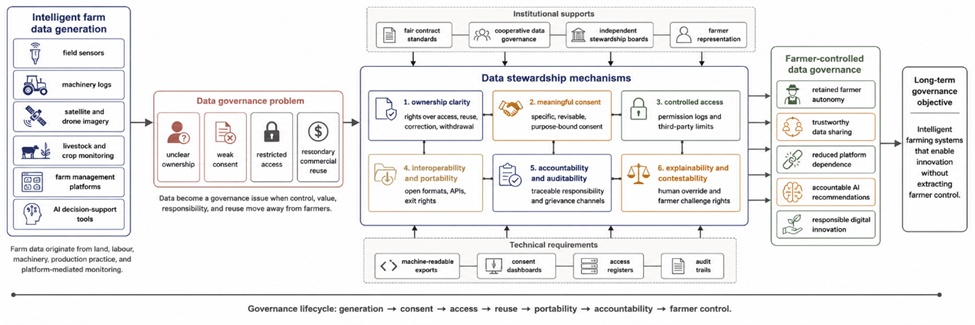
Figure 1. Data Stewardship Framework for Intelligent Farms: Governing Farm Data Flows from Data Generation to Farmer-Controlled Accountability
Implementation may fail if data stewardship becomes a compliance exercise rather than a practical governance system. Farmers and farm organisations may face burdens related to legal interpretation, contract negotiation, technical migration, cybersecurity, and monitoring of third-party data use [23, 27]. Managers of agricultural platforms should therefore simplify data terms, provide usable consent tools, document data flows, and make stewardship practices visible within ordinary service interfaces.
A second risk is uneven capacity because small farms, less-connected rural areas, and resource-constrained producers may lack the time, infrastructure, or advisory support needed to exercise data rights effectively. Research on digital agriculture in low-income and complex settings warns that good intentions can produce exclusion when design processes overlook practical constraints and local realities [16]. Policymakers and cooperatives should therefore invest in shared data infrastructure, farmer training, independent advice, and collective bargaining mechanisms that make stewardship accessible beyond large or technologically advanced farms.
A third risk is platform resistance, especially where business models depend on proprietary data accumulation, restricted interoperability, and broad secondary-use permissions. Platformisation in agriculture can produce oligopolistic dynamics when a small number of actors control data infrastructures, interfaces, and ecosystem participation [28]. Farm organisations, regulators, and industry bodies should respond by requiring fair contract standards, portability rights, open interfaces, audit obligations, and participatory governance processes that make responsible data stewardship a condition of legitimate intelligent farming innovation.
This article developed a governance framework for data stewardship in intelligent farms by treating farm data as a contested governance object rather than a neutral technical resource. It showed that ownership, consent, access, interoperability, platform dependence, accountability, and farmer control are interdependent issues that must be addressed together. The framework contributes a structured way to organise responsible farm data governance without presenting new empirical data.
The central argument is that intelligent farming requires stronger stewardship arrangements if digital innovation is to support farmers rather than weaken their autonomy. Ownership language alone is insufficient because farmers need practical rights to understand, access, move, restrict, contest, and benefit from data generated through their farming systems. Meaningful stewardship must therefore combine institutional mechanisms, technical standards, transparent contracts, participatory governance, and enforceable accountability.
Future intelligent farming systems should be designed around accountable, interoperable, and farmer-centred data governance. Such systems can enable trustworthy data sharing and innovation while protecting farmers from extraction, lock-in, and opaque decision-making. Responsible agricultural digitalisation depends not only on better analytics, but on governance arrangements that keep farmers in control of the data infrastructures shaping their work, livelihoods, and futures.
None
None
None
None
Open Access The author(s) retain copyright. This article is licensed under the Creative Commons Attribution-NonCommercial-ShareAlike 4.0 International License. It may be shared and adapted for non-commercial purposes with appropriate attribution, an indication of changes, and distribution of adaptations under the same license. Third-party material may be subject to separate terms identified in its credit line. View the license at https://creativecommons.org/licenses/by-nc-sa/4.0/.
 Agro Intelligence Research Press