Smart agriculture increasingly combines artificial intelligence, sensor networks, automation, remote sensing, robotics, and decision-support systems to guide agricultural production and resource management. These technologies promise more precise monitoring, faster diagnosis, improved input targeting, and better coordination of farm operations. Their sustainability value, however, depends on how optimisation goals are defined and how decisions interact with ecological, technical, and social systems. A central problem is that algorithmic systems are often evaluated through yield gains, input efficiency, prediction accuracy, or operational performance. These metrics are important, but they do not necessarily reveal whether an improvement in one sustainability domain shifts pressure onto another. A farm system may become more productive while increasing water demand, energy dependence, biodiversity risk, or unequal exposure to technological burdens. This article develops a conceptual model of algorithmic sustainability trade-offs in smart agriculture. The model explains how yield, water, energy, biodiversity, and equity operate as connected outcome domains rather than isolated evaluation categories. It treats trade-offs as system-level tensions that emerge through optimisation objectives, data availability, decision rules, platform design, governance arrangements, and implementation contexts. The article contributes a systems-oriented framework for analysing when smart agriculture supports sustainability and when it redistributes environmental or social costs. It argues that algorithmic optimisation should not be treated as automatically sustainable simply because it improves efficiency or prediction. Instead, smart agriculture should be assessed by how its decisions balance productivity, resource use, ecological resilience, and distributional fairness.
Smart agriculture refers to the growing use of data infrastructures, farm platforms, sensors, remote sensing, analytics, and connected management tools to support agricultural decisions. In this context, data are not simply descriptive inputs; they increasingly structure how farms observe crops, interpret variability, and coordinate interventions. Big-data systems in smart farming therefore reorganise decision-making across production, resource, and market domains [1].
Artificial intelligence and machine learning further extend this transformation by converting agricultural observations into predictive and prescriptive forms of decision support. These systems can classify crop conditions, estimate risks, recommend input timing, and support management choices at scales and speeds that exceed conventional observation. Machine-learning applications in agriculture show that algorithmic systems are becoming central to how farm knowledge is produced and operationalised [2].
The sustainability implications of smart agriculture cannot be understood through technical performance alone. Digital agriculture is embedded in institutional arrangements, advisory systems, data ownership structures, farmer capabilities, and uneven access to infrastructure. Social-science research on digital agriculture shows that adoption, governance, power, and inclusion are central to whether digital technologies improve or undermine agri-food sustainability [3].
This article develops a conceptual model of algorithmic sustainability trade-offs in smart agriculture. It builds from the premise that digital tools can contribute to sustainable system design when their optimisation objectives are connected to broader ecological and social outcomes rather than narrow operational metrics. Digital agriculture can help design more sustainable agricultural systems, but only when the system-level consequences of algorithmic choices are made visible and governable [4].
A sustainability trade-off occurs when improvement in one outcome produces pressure, loss, risk, or unequal burden in another outcome. In smart agriculture, these trade-offs are distinctive because algorithmic systems encode objectives, select metrics, prioritise data, and recommend interventions that may privilege some outcomes over others. Precision farming sits at the nexus of agricultural production and environmental management, making it a useful entry point for analysing how productivity gains may coexist with ecological pressures [5].
Technical optimisation differs from sustainability balancing. A technical system may optimise fertiliser timing, irrigation scheduling, machinery routing, or yield prediction without explicitly accounting for biodiversity, energy demand, labour displacement, or uneven access to benefits. Precision agriculture technologies have been assessed across greenhouse-gas mitigation, productivity, and economics, illustrating why smart-agriculture evaluation must move beyond any single performance indicator [6].
The conceptual challenge is that smart farming can generate both sustainability pathways and sustainability tensions. It can improve monitoring, reduce unnecessary input use, and support more responsive management, yet it can also strengthen dependency on data-intensive infrastructures or intensify production logics. Smart farming is therefore best understood as a conditional pathway to sustainable agriculture rather than as an inherently sustainable technological category [7].
This article conceptualises algorithmic sustainability trade-offs as relationships among five outcome domains: yield, water, energy, biodiversity, and equity. Yield gains may increase resource pressure, water savings may require energy-intensive infrastructure, biodiversity monitoring may be excluded from optimisation models, and efficiency benefits may accrue unevenly across farms. This multidimensional framing follows the production-environment logic of precision farming while extending it to social distribution, governance, and ecological resilience [5].
Yield optimisation is a dominant objective in smart agriculture because production remains the most visible and economically rewarded performance metric. Deep-learning methods support crop detection, disease recognition, yield-related classification, and field-level prediction, thereby strengthening the technical capacity to target interventions around productivity signals. These capabilities can improve management precision, but they also make yield a powerful organising construct in algorithmic farm systems [8].
Crop data management determines which variables are captured, structured, and made actionable. Smart farming systems may collect detailed information on plant status, soil conditions, machinery operations, and spatial variability, yet the data pipeline can still privilege variables that are easiest to measure, monetise, or optimise. Crop data management therefore mediates which sustainability concerns become visible to decision-support systems and which remain secondary [9].
Yield prediction models can help farmers anticipate production outcomes, allocate inputs, and manage risk. However, when predictive accuracy is centred on yield alone, the optimisation logic may treat water, energy, biodiversity, and equity as constraints rather than co-equal sustainability objectives. Machine-learning approaches to crop-yield prediction demonstrate the strength of algorithmic productivity assessment while also highlighting why yield should not become the sole proxy for sustainable performance [10]. Figure 1 illustrates how yield-oriented algorithmic optimisation can create cross-domain sustainability trade-offs by transferring pressure from productivity gains into water use, energy dependence, biodiversity risk, and equity concerns.
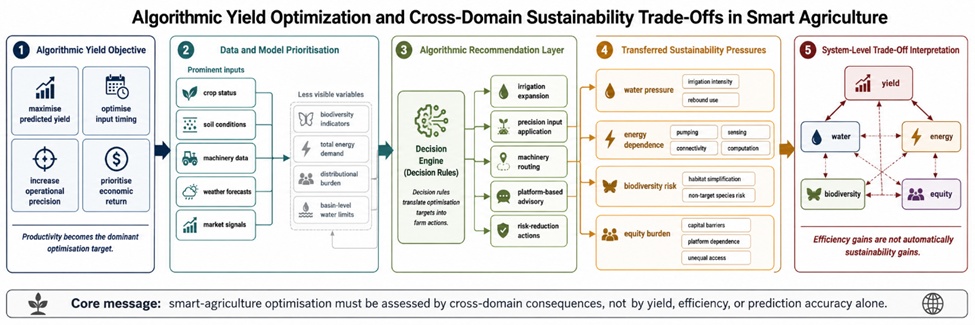
Figure 1. Algorithmic Yield Optimization and Cross-Domain Sustainability Trade-Offs in Smart Agriculture
A conceptual trade-off emerges when yield-oriented algorithms recommend actions that increase output while shifting costs into less visible domains. Higher yields may depend on irrigation expansion, energy-intensive pumping, dense sensor networks, chemical input regimes, proprietary platforms, or capital-intensive machinery that are not evenly available to all producers. Table 1 summarises key sustainability trade-offs created when smart agriculture systems prioritise yield optimisation and resource efficiency.
Table 1. Yield Optimization and Resource-Pressure Trade-Offs in Smart Agriculture: Algorithmic Objectives, Sustainability Benefits, Water and Energy Pressures, Biodiversity Risks, and Equity Concerns
Algorithmic objective | Intended sustainability benefit | Potential water pressure | Potential energy pressure | Potential biodiversity risk | Potential equity concern | Conceptual trade-off interpretation |
Maximise predicted yield | Higher productivity and improved planning | More irrigation may be recommended to reduce yield risk | More pumping, sensing, cooling, and data processing may be required | Intensification may reduce habitat complexity | Larger farms may capture benefits first | Productivity gains can displace costs into water, energy, ecological, and access domains. |
Optimise input timing | Reduced waste and more precise field operations | Water scheduling may favour crop demand over catchment limits | Automation and monitoring can increase electricity demand | Narrow input optimisation may overlook non-target species | Producers without advisory support may be excluded | Efficiency at plot level may not equal sustainability at system level. |
Increase operational precision | Better spatial targeting of interventions | Irrigation zones may become more intensive in high-response areas | Precision machinery and connectivity increase infrastructure dependence | Simplified management zones may ignore ecological heterogeneity | High capital costs may widen adoption gaps | Precision can reduce average waste while concentrating pressure in selected spaces. |
Prioritise economic return | Improved profitability and investment justification | Water use may be justified where marginal returns are high | Energy costs may be treated as acceptable if yield gains compensate | Biodiversity may remain outside profitability metrics | Tenant farmers and smallholders may face weaker bargaining power | Economic optimisation can marginalise unpriced sustainability outcomes. |
Reduce input per unit of output | Improved apparent resource efficiency | Total water use may rise if production expands | Total energy demand may rise through rebound effects | Landscape simplification may continue despite input efficiency | Benefits may depend on access to platforms and analytics | Relative efficiency can coexist with absolute resource pressure. |
Water is a central trade-off domain because smart agriculture often promises to reduce waste through sensing, monitoring, forecasting, and automated irrigation control. Precision irrigation systems can connect soil moisture data, crop demand estimates, and management thresholds to more responsive water decisions. Such systems make water use algorithmically governable, but they also make sustainability dependent on how water-saving objectives are defined and constrained [11].
Smart irrigation can improve water-use efficiency when monitoring and control strategies are designed around crop needs, soil conditions, and timely intervention. However, efficiency at the field scale does not automatically guarantee basin-level sustainability, especially if saved water enables expanded production or more intensive cropping. Smart irrigation therefore creates a feedback loop in which apparent water savings may be reinforced, offset, or reversed depending on governance and farm-level incentives [12].
Energy enters the trade-off model because sensor-intensive and automated systems require power for monitoring, communication, data transmission, pumping, computation, and sometimes cooling or storage. Wireless sensor networks in precision agriculture illustrate that digital farm infrastructures create an energy layer that must be managed alongside agronomic performance. Renewable energy harvesting can reduce this burden, but it does not remove the need to account for the material and infrastructural demands of digital monitoring [13].
The water-energy tension can be conceptualised as a coupling between resource-saving decisions and infrastructure-dependent implementation. A smart irrigation recommendation may reduce water losses while increasing electricity use through pumping, sensor networks, automated valves, connectivity, or cloud-based analytics. For this reason, water and energy should be evaluated together, because optimisation in one domain can conceal transferred pressure in the other [12].
Biodiversity is a core sustainability domain because agricultural optimisation can alter habitat structure, crop diversity, input regimes, and landscape heterogeneity. Climate-smart and productivity-oriented interventions may create tensions between crop yield and biodiversity when production gains become the dominant assessment criterion. Biodiversity-yield trade-offs show that ecological outcomes cannot be treated as secondary externalities of production-centred smart agriculture [14].
Ecological consequences are also spatially and temporally dynamic. A management action that appears efficient at field scale may have different implications across landscapes, seasons, species interactions, and habitat mosaics. Biodiversity-agriculture trade-offs are moving targets, which means algorithmic systems should not assume that ecological costs are fixed, linear, or easily represented by a single indicator [15].
Digital agriculture can improve biodiversity visibility when remote sensing, ecological monitoring, and data integration are used to identify farmland biodiversity patterns. Yet this potential depends on whether ecological variables are incorporated into decision systems rather than left outside the optimisation problem. Digital tools can narrow biodiversity knowledge gaps, but only if biodiversity is measured as a decision-relevant sustainability construct [16].
The conceptual model treats biodiversity as both an outcome domain and a feedback condition. When ecological complexity is ignored, algorithmic systems may reinforce simplified production systems, monoculture intensification, or narrow input-efficiency metrics. When biodiversity information is integrated, smart agriculture can support more ecologically aware decisions that recognise habitat quality, species interactions, and landscape resilience as part of sustainability performance [16].
Equity tensions arise because smart agriculture redistributes benefits, risks, knowledge, and control across different actors. Data ownership, platform dependence, advisory access, and technology costs can shape who benefits from algorithmic optimisation and who becomes more dependent on external systems. The politics of digital agricultural technologies show that these systems are not neutral tools but socio-technical arrangements that can reorganise power in food systems [17].
Unequal access to connectivity, capital, skills, data infrastructures, and technical support can make algorithmic sustainability benefits unevenly distributed. Digital agriculture may improve efficiency for well-resourced farms while increasing exclusion for producers who cannot afford platforms, equipment, or subscription-based advisory systems. Patterns of inequality in digital agriculture therefore make equity a necessary sustainability outcome rather than a later adoption concern [18].
Smallholder-facing digital systems can create new channels for agrarian commerce, knowledge exchange, and market participation. At the same time, platform-mediated participation may expose small farmers to dependency, visibility without bargaining power, or data relations that they cannot easily control. Small-farmer engagement with big technology platforms demonstrates why digital inclusion must be evaluated through both access and power [19].
Equity is not separate from yield, water, energy, or biodiversity trade-offs. Farmers with greater capital may adopt systems that reduce input waste and improve yields, while low-resource producers may face higher relative costs, weaker data rights, and lower capacity to contest recommendations. The conceptual model therefore treats distributional effects as cross-cutting outcomes that shape who receives sustainability benefits and who bears hidden burdens [18].
The proposed conceptual model defines algorithmic sustainability trade-offs as system-level consequences of optimisation decisions in smart agriculture. The model includes five outcome domains: yield, water, energy, biodiversity, and equity. Responsible AI in agriculture requires attention to systemic risks and externalities, which supports treating trade-offs as interconnected consequences rather than isolated technical failures [20].
The first construct is the algorithmic objective, which specifies what the system is designed to optimise. Objectives may prioritise yield, input efficiency, profitability, water savings, operational timing, or risk reduction, but the choice of objective also determines which outcomes become secondary. Responsible innovation in Agriculture 4.0 provides a governance lens for aligning optimisation with farmer, public, and ecological values rather than assuming that technical efficiency is sufficient [21].
The second construct is the mediating mechanism through which algorithmic objectives affect sustainability outcomes. These mechanisms include data availability, optimisation logic, platform design, transparency, farmer capability, advisory interpretation, governance safeguards, and responsiveness to local conditions. Responsible innovation for precision agriculture highlights anticipation, inclusion, reflexivity, and responsiveness as mechanisms that can shape whether digital tools reinforce or reduce sustainability trade-offs [22]. Figure 2 presents the proposed governance-oriented conceptual model, showing how algorithmic objectives, mediating mechanisms, and boundary conditions shape sustainability outcomes across yield, water, energy, biodiversity, and equity.
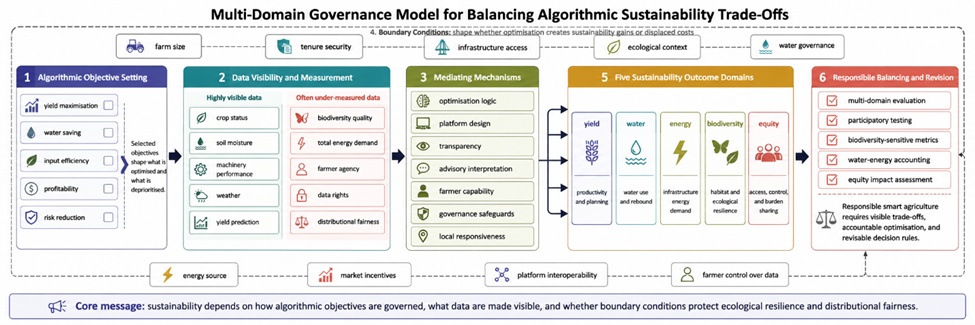
Figure 2. Multi-Domain Governance Model for Balancing Algorithmic Sustainability Trade-Offs
The third construct is the boundary condition, which determines whether a smart-agriculture pathway improves system-level outcomes or shifts costs across domains. Boundary conditions include farm size, tenure security, infrastructure access, ecological context, water governance, energy source, market incentives, platform interoperability, and farmer control over data. Agriculture 4.0 transition pathways require attention to diversity and responsibility because digital transformation unfolds differently across farming contexts [23]. Table 2 presents the proposed conceptual model of algorithmic sustainability trade-offs in smart agriculture.
Table 2. Proposed Conceptual Model of Algorithmic Sustainability Trade-Offs in Smart Agriculture: Yield, Water, Energy, Biodiversity, Equity, Mediating Mechanisms, and Boundary Conditions
Model component | Conceptual definition | Yield pathway | Water pathway | Energy pathway | Biodiversity pathway | Equity pathway | Mediating mechanisms | Boundary conditions |
Algorithmic objective setting | The sustainability or performance target encoded into the system | Yield maximisation may dominate decision rules | Water savings may be defined at field rather than basin scale | Energy costs may be omitted from optimisation | Biodiversity may be excluded from objective functions | Equity may be treated as adoption rather than distribution | Objective selection, weighting, optimisation thresholds | Policy goals, farm economics, advisory priorities |
Data visibility | The degree to which relevant variables are measured and usable | Crop status becomes highly visible | Soil moisture and irrigation data become actionable | Sensor and machinery energy use may remain less visible | Species, habitat, and landscape data may be incomplete | Access, skills, and farmer control may be poorly measured | Sensors, remote sensing, platforms, data standards | Connectivity, monitoring capacity, data ownership |
Optimisation logic | The decision rule that converts data into recommendations | Productivity gains are prioritised | Irrigation timing is adjusted | Pumping and computation may increase | Ecological complexity may be simplified | Benefits may favour users with stronger resources | Prediction models, recommendation engines, decision thresholds | Model design, transparency, farmer agency |
Implementation context | The farm and regional conditions in which the technology is used | Yield effects vary by crop, soil, and management | Water effects depend on scarcity and allocation rules | Energy effects depend on power source and infrastructure | Biodiversity effects depend on landscape heterogeneity | Equity effects depend on capital, tenure, gender, and advisory access | Local adaptation, training, governance safeguards | Farm size, water governance, energy systems, institutional support |
System-level outcome | The aggregate sustainability result after interactions across domains | Higher output may improve food availability | Water use may decline or rebound | Energy demand may be reduced, shifted, or intensified | Biodiversity may be protected or eroded | Benefits and risks may be fairly shared or concentrated | Feedback loops, monitoring, accountability, participatory revision | Regulation, market incentives, public investment, interoperability |
Practical implementation should evaluate smart agriculture through sustainability and resilience rather than efficiency alone. Policymakers, farm advisors, technology firms, and sustainability auditors should ask whether optimisation reduces total pressure or merely improves a narrow performance indicator. Digital innovations for sustainable and resilient agricultural systems require assessment designs that connect productivity, resource use, risk, and long-term system robustness [24].
Technology design should include transparency about optimisation goals, participatory testing, equity impact assessment, biodiversity-sensitive metrics, and water-energy accounting. Farmer organisations and advisory services can help ensure that decision-support systems are interpretable, locally relevant, and open to contestation when recommendations conflict with farmer knowledge or ecological priorities. Responsible and socially inclusive digital innovation requires attention to participation, usability, benefits, risks, and the distribution of control across food, water, and land systems [25].
Future research should empirically test the trade-off pathways proposed in this model across diverse crops, farm sizes, regions, and governance settings. Comparative studies should examine when algorithmic optimisation produces genuine multi-domain sustainability gains and when it displaces costs into hidden ecological, energy, water, or equity domains. Governance research should also address corporate lock-ins, interoperability, platform dependency, and farmer control because these conditions shape whether digital agriculture can support sustainability without deepening dependency [26].
This article has developed a conceptual model of algorithmic sustainability trade-offs in smart agriculture across yield, water, energy, biodiversity, and equity. The model shows that smart agriculture can support sustainability when optimisation is guided by multi-dimensional evaluation, responsible governance, ecological awareness, and equity-sensitive design. It also shows that yield gains, input efficiency, or predictive accuracy can become misleading indicators when they conceal transferred costs across resource, ecological, or social domains. The future of smart agriculture therefore depends on designing algorithmic agricultural systems that improve production without displacing environmental and social costs onto hidden or vulnerable domains.
None
None
None
None
Open Access The author(s) retain copyright. This article is licensed under the Creative Commons Attribution-NonCommercial-ShareAlike 4.0 International License. It may be shared and adapted for non-commercial purposes with appropriate attribution, an indication of changes, and distribution of adaptations under the same license. Third-party material may be subject to separate terms identified in its credit line. View the license at https://creativecommons.org/licenses/by-nc-sa/4.0/.
 Agro Intelligence Research Press