Intelligent agriculture increasingly relies on data-intensive systems, including sensors, connectivity, decision-support tools, automation, platforms, machine learning, and analytics. These systems are often presented as pathways toward more productive, efficient, resilient, and sustainable farming. Yet their social effects depend on how access, control, capability, risk, and value are distributed across agricultural actors. The central problem addressed in this article is that intelligent agriculture can deepen inequality when digital systems are unevenly organised. Farmers and rural actors may face different levels of access to infrastructure, data, technical support, platform services, financial capacity, and bargaining power. As a result, the benefits of digitalisation may accumulate among actors already positioned to use, govern, and monetise data-driven systems. This article develops a theory of digital inequality in intelligent agriculture. The theory explains how data access, infrastructure gaps, platform dependence, and uneven value capture interact to shape distributional outcomes. It treats inequality not as a side effect of incomplete adoption but as a process produced through socio-technical relations. The approach integrates scholarship on digital agriculture, rural digital divides, agricultural platforms, farmer capability, data governance, infrastructure inequality, responsible innovation, and value distribution. Rather than treating smart farming as a neutral technological transition, the article develops constructs, mechanisms, relationships, boundary conditions, and propositions. The aim is to explain how digital agricultural systems can reproduce, intensify, or reduce inequality.The proposed theory argues that digital inequality in intelligent agriculture emerges through linked pathways of data exclusion, infrastructure disadvantage, capability constraint, platform control, and value appropriation. These pathways influence who can participate in intelligent agriculture, who becomes dependent on digital intermediaries, who bears risks, and who captures benefits. The article concludes that intelligent agriculture should be evaluated by its distributional consequences as well as its technical performance.
Intelligent agriculture has become a central language for describing the digital transformation of farming through smart farming, precision agriculture, sensor systems, automation, artificial intelligence, analytics, and data-driven decision support. These technologies are often framed as instruments for improving productivity, input efficiency, sustainability monitoring, and agricultural competitiveness. The theoretical challenge is that such systems do not enter a socially neutral field; they reorganise relations among farmers, advisors, technology providers, supply-chain actors, and institutions. A theory of digital inequality in intelligent agriculture must therefore begin from the premise that digitalisation is a socio-technical transformation rather than a simple technological upgrade [1].
Smart farming also extends agricultural datafication beyond individual fields and machines into broader systems of coordination, forecasting, logistics, benchmarking, input management, certification, and market participation. As farm data move across platforms, cloud systems, machinery ecosystems, and supply-chain infrastructures, decision power can shift toward actors capable of aggregating, analysing, and governing data at scale. This matters because the value of intelligent agriculture is not located only in on-farm efficiency; it is also produced through data circulation and control. The expansion of big data in smart farming therefore raises distributional questions about who can access analytical capacity and who becomes a source of data for others [2].
The promise of intelligent agriculture is frequently linked to sustainability, food security, climate adaptation, and competitiveness, but the direction of innovation is shaped by institutions, firms, policy priorities, and dominant imaginaries of agricultural progress. If farmers and rural communities have limited influence over what problems are prioritised, digital systems may optimise for commercially profitable forms of agriculture while neglecting less visible needs. Responsible innovation is therefore not merely an ethical supplement to technology deployment; it is a condition for determining whose futures are built into agricultural digitalisation. A theory of inequality must ask who shapes innovation trajectories, not only who adopts the resulting tools [3].
This article develops a theory of digital inequality in intelligent agriculture centred on four interacting constructs: data access, infrastructure gaps, platform dependence, and uneven value capture. The theory argues that digital inequality is produced when these constructs reinforce one another across farm, platform, supply-chain, institutional, and territorial levels. The article proceeds by establishing the theoretical foundations of agricultural digital inequality, defining the core constructs, explaining data and infrastructure mechanisms, analysing platform dependence, and presenting a distributional theory of value capture. The resulting argument treats inequality as an active pathway through which digital systems allocate benefits, burdens, risks, and decision power [4].
Digital inequality in intelligent agriculture builds on rural digital divide theory but requires a broader distributional vocabulary. Rural disadvantage is not limited to whether a farmer has an internet connection; it also concerns the quality, reliability, affordability, and usability of digital infrastructure, and the capacity to turn access into meaningful participation. Unequal ICT availability, adoption, and use create layered constraints that influence whether rural actors can benefit from digital services. Infrastructure gaps should therefore be understood as structural rural development constraints rather than isolated technical deficits [5].
A socio-technical perspective further shows that agricultural digitalisation redistributes labour, skills, monitoring practices, and community risks. Automation and data-driven systems can reduce some forms of physical work while increasing dependence on technical knowledge, external service providers, and machine-readable management routines. These changes affect not only individual farmers but also rural labour relations, intergenerational skills, and the organisation of farm communities. Digital inequality emerges when the ability to adapt to these changes is unevenly distributed across farms and territories [6].
Datafication also changes what counts as valid agricultural knowledge. Precision agriculture and big-data systems can elevate sensor readings, models, algorithms, and platform analytics while marginalising experiential, local, and tacit forms of farmer expertise. This creates an epistemic inequality pathway in which some actors gain authority because they control the infrastructures through which agricultural reality is measured and interpreted. Data-driven farming may create new publics and possibilities for shared experimentation, but it can also enclose agronomic knowledge within proprietary systems [7].
The theoretical background must also include data governance and ethics because intelligent agriculture redistributes rights, responsibilities, and exposure to risk. Smart-farming ethics are closely tied to questions of data ownership, transparency, privacy, power distribution, accountability, and societal consequences. Inequality is therefore not only a question of access to technology but also a question of who can govern the conditions under which digital systems operate. This article treats data governance, capability, infrastructure, platform power, and value distribution as interdependent dimensions of one inequality process [8].
Digital inequality in intelligent agriculture refers to the uneven distribution of access, capability, control, risk, and value associated with data-driven agricultural systems. It differs from a narrow adoption gap because it includes the terms on which farmers use technologies, share data, depend on platforms, and participate in value creation. The central question is not simply whether a farmer uses a digital tool, but whether that use improves autonomy, bargaining power, decision quality, and economic security. In this sense, the promise of agricultural big data is contested when farmers perceive that benefits may flow primarily to larger farms or better-positioned actors rather than to farming communities more broadly [9].
This theory defines digital inequality as a multi-level process operating through farm characteristics, territorial infrastructure, advisory systems, platform ecosystems, market position, and institutional governance. Farm size, income, education, age, gender, geography, connectivity, digital skill, machinery access, and supply-chain position can all shape whether intelligent agriculture expands or constrains opportunity. These factors do not act separately; they interact through agricultural innovation systems that connect technologies, policies, advisors, firms, researchers, and farmers. Digital inequality is therefore mediated by the design and governance of agricultural innovation systems, not merely by individual farmer choice [10].
The theory-building synthesis identifies four core relationships. First, data access affects decision quality and bargaining power because actors who cannot access or interpret relevant data are disadvantaged in production, markets, certification, and sustainability reporting. Second, infrastructure gaps and capability constraints shape who can adopt, adapt, and contest intelligent systems. Third, platform dependence can transform participation into dependency when farmers rely on proprietary systems for analytics, market access, finance, or agronomic advice. Fourth, uneven value capture occurs when the value generated by data and digital coordination is appropriated by actors other than those who produce, maintain, or bear the risks of agricultural work [11].
Digital inequality in intelligent agriculture is thus not a single divide but a set of linked inequality pathways. Figure 1 presents the proposed theory of digital inequality in intelligent agriculture, showing how data exclusion, infrastructure disadvantage, capability constraint, platform dependence, and uneven value capture interact across farm, platform, supply-chain, institutional, and territorial levels.
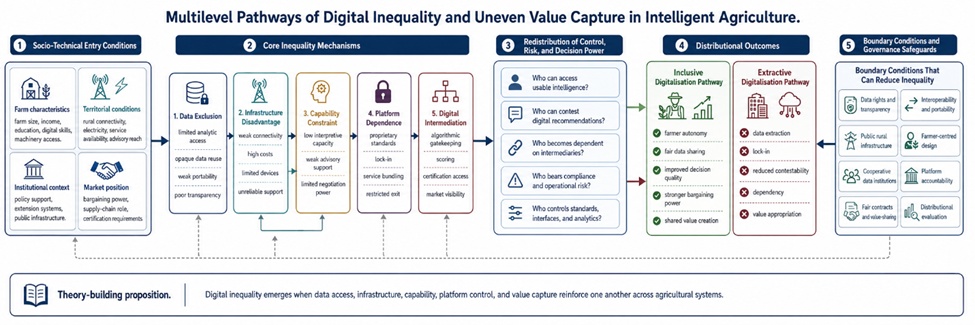
Figure 1. Multilevel Pathways of Digital Inequality and Uneven Value Capture in Intelligent Agriculture
Data exclusion can weaken capability; weak capability can increase dependence on platforms; platform dependence can reduce bargaining power; and reduced bargaining power can shift value away from farmers and rural communities. The theory also includes boundary conditions: governance safeguards, interoperability, public infrastructure, farmer organisations, cooperative data arrangements, advisory support, and inclusive innovation processes may reduce inequality if they alter the distribution of access, control, and value. Table 1 summarises the core theoretical constructs of digital inequality in intelligent agriculture.
Table 1. Core Theoretical Constructs of Digital Inequality in Intelligent Agriculture: Data Access, Infrastructure Gaps, Capability Constraints, Platform Dependence, Uneven Value Capture, and Boundary Conditions
Core construct | Definition in the proposed theory | Inequality pathway | Distributional outcome | Boundary condition |
Data access | The ability of farmers and agricultural actors to obtain, interpret, reuse, share, and contest farm, machine, environmental, market, and platform-generated data. | Data exclusion limits decision quality, weakens bargaining power, and restricts participation in analytics-based markets and sustainability reporting. | Better-resourced actors gain informational advantage, while less-resourced actors become data sources without equivalent analytical benefits. | Transparent data-use rules, portability, interoperability, farmer consent, and benefit-sharing arrangements. |
Data rights | The formal and practical ability to control data collection, access, reuse, privacy, portability, and redress. | Ambiguous rights enable data extraction, asymmetric contracts, and limited farmer control over downstream uses. | Farmers may lose autonomy over data-derived insights, benchmarking, risk scoring, and commercial targeting. | Clear governance rules, enforceable rights, trusted intermediaries, and collective bargaining over data terms. |
Infrastructure gaps | Uneven access to connectivity, electricity, devices, sensors, machinery, cloud systems, technical services, and advisory support. | Poor infrastructure prevents meaningful participation even when digital tools formally exist. | Rural and small-scale actors face exclusion from digital services, real-time decision support, and platform-mediated markets. | Public rural infrastructure, affordable access, shared equipment models, and inclusive service networks. |
Capability constraints | Uneven ability to understand, adapt, maintain, evaluate, and negotiate digital agricultural systems. | Limited digital literacy and advisory support increase dependency on external providers. | Farmers with weaker capabilities capture fewer benefits and bear greater risks of misinterpretation, mis-selling, or technological lock-in. | Training, extension support, peer learning, cooperative capacity-building, and farmer-centred design. |
Platform dependence | Reliance on proprietary platforms, machinery ecosystems, advisory systems, input-provider tools, or digital intermediaries for analytics, services, markets, finance, or certification. | Dependence creates lock-in, reduces contestability, and shifts control over standards, interfaces, and data flows. | Platforms and dominant firms can appropriate data value, shape decisions, and influence market access. | Open standards, interoperability, competition policy, public-interest platforms, and cooperative data institutions. |
Uneven value capture | Unequal appropriation of economic, informational, strategic, or sustainability-related benefits generated by intelligent agricultural systems. | Value flows toward actors controlling analytics, platforms, infrastructure, market channels, or intellectual property. | Farmers may contribute data and operational risk while downstream actors capture higher-margin benefits. | Fair contracts, value-sharing mechanisms, farmer ownership models, policy safeguards, and distributional evaluation. |
Boundary conditions | Institutional, technical, social, and market arrangements that shape whether digitalisation widens or reduces inequality. | Governance choices mediate the relationship between digital systems and distributional outcomes. | Inclusive systems can strengthen autonomy and resilience; extractive systems can deepen dependency and exclusion. | Responsible innovation, participatory governance, farmer organisations, public investment, and accountability mechanisms. |
Data access is the first mechanism through which digital inequality becomes operational in intelligent agriculture. Farm data, machine data, soil data, weather data, satellite data, market data, advisory data, and platform-generated analytics shape what farmers can know, decide, prove, and negotiate. When farmers cannot see how their data are collected, processed, transferred, or monetised, data access becomes a question of trust, transparency, and benefit-sharing rather than only a question of technical availability. Data access therefore becomes an inequality mechanism when farmers cannot determine how data are used, by whom, and for whose benefit [12].
Data rights deepen this mechanism because access without control may still leave farmers dependent on external actors. Legal ambiguity around farm data can weaken farmer autonomy when ownership, portability, consent, privacy, and remedies are unclear or difficult to enforce. In such conditions, farmers may be expected to provide data while lacking equivalent authority over downstream analytics, benchmarking, product development, or commercial targeting. Data-rights ambiguity therefore becomes a distributional problem because it shapes who can convert agricultural data into decision power and economic advantage [13].
Data sharing is not inherently exploitative, but its fairness depends on visible and credible benefit allocation. Farmers may be more willing to share data when they understand the purpose of sharing, the actors involved, the protections available, and the benefits that may return to them or their communities. Where these conditions are absent, data sharing can resemble extraction, particularly when farmers provide operational data while platforms, input suppliers, or downstream firms capture the resulting intelligence. Farmers’ willingness to share data therefore depends on whether benefits are visible, credible, and fairly allocated [14].
The theory proposed here defines data access as a relational construct linking information availability, interpretive capacity, rights, and benefit distribution. A farmer may technically generate large volumes of data while remaining excluded from the analytics, models, interfaces, or contractual terms that make those data valuable. This creates downstream inequality in decision quality, market participation, sustainability reporting, credit assessment, insurance access, and bargaining power. Data access is therefore not the beginning and end of digital inclusion; it is the entry point into a wider struggle over control, accountability, and value in intelligent agricultural systems [12].
Infrastructure gaps form the second mechanism of digital inequality because intelligent agriculture depends on more than individual willingness to innovate. Connectivity, electricity, devices, sensors, machinery, cloud services, advisory networks, finance, maintenance systems, and technical support shape whether digital participation is feasible. Precision-agriculture adoption varies across regions and farm types because costs, incentives, agronomic conditions, institutional support, and farm characteristics affect the capacity to invest and benefit. Adoption inequality therefore emerges where regional and farm-level conditions shape access to precision agriculture before farmers make individual technology choices [15].
Mobile technologies show why infrastructure access cannot be equated with meaningful inclusion. Smartphones may widen access to information, communication, advisory services, and farm management tools, but their value depends on affordability, skills, app relevance, connectivity quality, and integration with farm work. Some farmers may use mobile tools for basic communication while others integrate them into data-rich decision systems, platform services, and market coordination. Mobile access therefore does not automatically equal digital inclusion because adoption and use vary across farmer and farm characteristics [16].
Capability constraints convert infrastructure gaps into persistent inequality. Intelligent agriculture requires farmers and advisers to interpret data, evaluate recommendations, monitor automated systems, maintain digital tools, negotiate service contracts, and recognise when algorithmic outputs are unsuitable for local conditions. These requirements shift the basis of agricultural competence toward data interpretation, system oversight, and continuous learning. Digitalisation therefore creates new learning requirements that can advantage farmers with stronger advisory support, educational resources, technical confidence, and institutional networks [17].
The theory treats infrastructure and capability as mutually reinforcing rather than separate barriers. Poor connectivity can reduce opportunities to learn digital systems, while limited capability can make infrastructure investments less useful or more dependent on external providers. Affordability, trust, training, advisory support, and institutional capacity shape whether farmers can adopt, adapt, govern, and challenge intelligent systems. Infrastructure inequality is therefore a structural condition that shapes not only who can connect to digital agriculture, but who can use connection to build autonomy and capture value [15].
Platform dependence is the third mechanism through which digital inequality is produced in intelligent agriculture. Farm management platforms, input-provider systems, machinery ecosystems, advisory platforms, data marketplaces, and agri-food digital services increasingly mediate access to analytics, certification, finance, logistics, insurance, and market coordination. These intermediaries can make digital services easier to use, but they can also determine the rules under which farmers access data, recommendations, interfaces, and markets. Platform dependence must therefore be situated within wider agri-food power relations rather than treated only as a farm-level technical concern [18].
Platformisation becomes especially consequential when a small number of powerful technology and agribusiness actors organise digital infrastructures, standards, services, and data flows. In such ecosystems, farmers may face lock-in because data formats, machinery interfaces, software subscriptions, agronomic recommendations, and market services are difficult to move across providers. Dependence can grow even when platforms offer useful tools, because the cost of exit increases as more farm decisions are routed through proprietary systems. Agricultural platforms can therefore deepen dependency when oligopolistic actors organise data, infrastructure, and services around their own strategic interests [19].
Data governance debates often focus on ownership, but ownership alone cannot resolve the platform-dependence problem. Farmers may formally own or have claims over data while still facing practical limits created by interoperability failures, contractual complexity, fragmented services, unequal access to analytics, or low trust in data-sharing arrangements. Platform control can operate through interfaces, standards, data aggregation, service bundling, and asymmetric bargaining power even when ownership language appears farmer-friendly. Data-ownership solutions are therefore insufficient if they do not address lock-in, fragmentation, access problems, and trust deficits [20].
In the proposed theory, platform dependence is not defined as simple use of a digital platform. It refers to a condition in which farmers’ access to knowledge, markets, services, compliance tools, finance, or decision support becomes mediated by systems they cannot meaningfully govern, audit, leave, or negotiate with. Digital intermediation can reduce search costs and improve coordination, but it can also transfer control over agricultural choices to actors that own analytics, infrastructure, or market gateways. Table 2 compares the mechanisms through which data access, infrastructure gaps, and platform dependence shape inequality in intelligent agriculture [20].
Table 2. Mechanisms of Digital Inequality in Intelligent Agriculture: Data Exclusion, Infrastructure Gaps, Capability Constraints, Platform Dependence, Digital Intermediation, and Distributional Risks
Inequality mechanism | How the mechanism operates | Actors most exposed | Main distributional risk | Theory-building implication |
Data exclusion | Farmers generate data but lack access to processed analytics, model outputs, benchmarking tools, or downstream uses. | Small farms, contract farmers, less digitally skilled farmers, and actors outside premium data ecosystems. | Decision disadvantage, weak bargaining power, limited ability to verify sustainability or market claims. | Data access must be theorised as control over usable intelligence, not merely possession of raw data. |
Ambiguous data rights | Ownership, portability, consent, privacy, redress, and reuse rights remain unclear or hard to enforce. | Farmers using proprietary machinery, advisory systems, or platform-based services. | Loss of autonomy, limited remedies, and data reuse without fair return. | Data rights are boundary conditions for farmer autonomy and benefit-sharing. |
Infrastructure gaps | Connectivity, electricity, devices, machinery, sensors, cloud access, and support services are unevenly distributed. | Remote farms, low-income farmers, smallholders, and underserved rural territories. | Exclusion from real-time analytics, digital markets, and advanced advisory services. | Infrastructure is a structural inequality condition, not only a technical precondition. |
Capability constraints | Farmers lack training, advisory support, confidence, interpretive skills, or resources to adapt systems. | Farmers with limited digital literacy, weak extension access, or low capacity for experimentation. | Misuse, underuse, dependency on vendors, and lower capacity to contest recommendations. | Capability determines whether digital access becomes autonomy or dependence. |
Platform dependence | Proprietary ecosystems mediate access to services, analytics, standards, and markets. | Farmers reliant on bundled machinery, input, finance, or advisory platforms. | Lock-in, reduced contestability, and weaker bargaining power. | Platform use becomes unequal when exit, audit, interoperability, and negotiation are constrained. |
Digital intermediation | Platforms become gatekeepers between farmers and markets, finance, certification, or advice. | Farmers integrated into platform-managed value chains or compliance systems. | Algorithmic dependence, risk scoring, unequal visibility, and market exclusion. | Intermediation should be evaluated by how it redistributes decision power. |
Value appropriation | Actors controlling analytics, platforms, intellectual property, or market channels capture disproportionate benefits. | Farmers contributing data and operational risk without equivalent revenue or control. | Economic gains flow away from data producers and rural communities. | Value capture is the outcome through which earlier inequality mechanisms become economically visible. |
Uneven value capture is the outcome through which digital inequality becomes economically and politically visible. Intelligent agriculture can create value through yield optimisation, input savings, traceability, benchmarking, sustainability metrics, risk prediction, insurance scoring, market coordination, and supply-chain transparency. However, the actors who enable or produce data are not always the actors who capture the most strategic or financial benefit from it. Uneven value capture begins in innovation narratives that define which agricultural problems matter, which farms are imagined as future-ready, and whose gains are prioritised [21].
Data-driven value capture can also extend beyond day-to-day production into land, finance, and asset markets. When agricultural technologies generate data about land performance, risk, productivity, and management potential, these data can become useful to investors, lenders, insurers, landlords, and agribusinesses. Farmers may then contribute information that enhances the asset value or strategic position of actors beyond the farm. Agricultural data systems can therefore convert land, risk, and management information into assets for actors who are not necessarily those doing agricultural work [22].
Value-chain digitalisation intensifies these dynamics because digital systems increasingly coordinate production, logistics, certification, retail relationships, and sustainability claims. Digital tools may improve coordination and visibility, but they also raise governance questions about who sets standards, who controls interfaces, who bears compliance costs, and who receives premiums or market access. The same system that improves traceability for retailers may increase reporting burdens for farmers with limited digital capability. Value-chain digitalisation therefore produces contested governance questions over opportunities, risks, coordination, and distribution [23].
The proposed theory distinguishes value creation from value capture because digital efficiency gains do not determine who appropriates the resulting benefits. Data access, infrastructure conditions, platform dependence, and institutional safeguards jointly shape whether value flows to farmers, platforms, input suppliers, retailers, financiers, consumers, or public-interest goals. Policy and institutional boundary conditions are necessary because digital benefits do not emerge automatically from innovation; they are distributed through governance, contracts, markets, infrastructures, and collective capacity [24]. Table 3 presents the proposed theory of digital inequality in intelligent agriculture [25].
Table 3. Proposed Theory of Digital Inequality in Intelligent Agriculture: Constructs, Inequality Pathways, Value-Capture Mechanisms, Boundary Conditions, and Research Propositions
Theory element | Core claim | Inequality pathway | Value-capture mechanism | Boundary condition | Research proposition |
Data access | Digital inclusion depends on access to usable agricultural intelligence, not only raw data generation. | Farmers without analytic access become data providers without equivalent decision power. | Platforms and analytics providers capture value by converting farm data into proprietary insights. | Transparency, portability, interoperability, consent, and benefit-sharing. | Stronger farmer control over usable data will increase farmer autonomy and improve perceived fairness in data-sharing arrangements. |
Data rights | Rights over access, reuse, privacy, portability, and redress shape bargaining power. | Ambiguous rights create dependency and limit contestation. | Data-derived products and services may be monetised without proportional farmer return. | Clear legal protections, trusted data intermediaries, and collective governance. | Clearer data-rights arrangements will reduce perceived extraction and increase legitimate participation in intelligent agriculture. |
Infrastructure gaps | Uneven connectivity, devices, services, finance, and technical support shape participation. | Infrastructure disadvantage blocks adoption, adaptation, and evaluation. | Better-connected actors access premium services, analytics, and market channels earlier. | Public rural infrastructure, affordable digital services, and shared access models. | Infrastructure gaps will amplify digital inequality when they coincide with weak advisory systems and low affordability. |
Capability constraints | Digital agriculture requires interpretive, technical, managerial, and negotiation capabilities. | Low capability increases reliance on vendors and reduces ability to contest system outputs. | Farmers with stronger capabilities capture more operational and strategic benefits. | Training, extension support, peer learning, and farmer-centred design. | Digital capability will mediate the relationship between technology access and value capture. |
Platform dependence | Platforms mediate access to analytics, standards, markets, finance, and services. | Lock-in and proprietary standards reduce farmer choice and bargaining power. | Platform owners capture recurring value through subscriptions, data aggregation, and service bundling. | Open standards, interoperability, competition safeguards, and cooperative platforms. | Platform dependence will redistribute bargaining power away from farmers when exit, audit, and interoperability are weak. |
Digital intermediation | Intermediaries shape visibility, eligibility, scoring, certification, and market access. | Farmers become subject to algorithmic gatekeeping and data-driven ranking. | Intermediaries capture value by controlling access points in digital value chains. | Accountability, auditability, explainability, and appeal mechanisms. | Algorithmic intermediation will increase inequality when farmers cannot understand or contest decisions affecting market access. |
Uneven value capture | Digital value is distributed through contracts, data governance, market power, and institutional design. | Benefits concentrate among actors controlling analytics, platforms, capital, or market channels. | Farmers bear operational risk while higher-margin benefits flow elsewhere. | Fair contracts, value-sharing rules, farmer organisations, and distributional evaluation. | Inclusive governance safeguards will reduce unequal value capture when they alter control over data, standards, and revenue flows. |
The proposed theory generates several research propositions for testing how digital inequality operates across agricultural contexts. First, stronger farmer control over data access, portability, reuse, and benefit-sharing should increase autonomy and reduce perceptions of extraction. Second, infrastructure gaps should amplify exclusion most strongly where they coincide with weak advisory systems, low affordability, and limited technical support. Future research should therefore evaluate inequality reduction as a design, governance, and assessment problem across the smart-farming innovation cycle, rather than as a late-stage adoption issue [26].
A second set of propositions concerns platform governance and data-sharing legitimacy. Platform dependence should redistribute bargaining power away from farmers when exit costs are high, standards are proprietary, contracts are opaque, and analytics are difficult to audit. Digital capability should mediate value capture because farmers with stronger interpretive and negotiation skills are better positioned to convert digital access into economic and strategic benefit. Data governance should therefore be evaluated through plural stakeholder values, including trust, legitimacy, common-good orientation, and fair sharing arrangements [27].
Future research should compare inequality pathways across farm sizes, regions, production systems, gendered labour relations, market positions, and platform ecosystems. It should also examine smallholder-focused digitalisation, cooperative data institutions, public-interest platforms, data spaces, algorithmic accountability, and the distribution of value across agricultural supply chains. A central proposition is that data sovereignty by design can reduce data-access inequality and platform-mediated dependence when it embeds farmer control, privacy, trust, fairness, and accountability into agricultural data infrastructures. Research should therefore move from asking whether intelligent agriculture works to asking for whom it works, under what conditions, and with what distributional consequences [28].
This article has developed a theory of digital inequality in intelligent agriculture based on the interaction of data access, infrastructure gaps, platform dependence, and uneven value capture. The theory argues that digital agricultural transformation should not be understood only through technical innovation, adoption rates, or productivity improvements. It should also be understood through the distribution of control, capability, risk, dependency, and economic benefit.
The central contribution is to explain how inequality is produced through linked pathways rather than isolated barriers. Data exclusion can reduce decision power, infrastructure gaps can restrict meaningful participation, capability constraints can increase dependence, platform governance can shift bargaining power, and value-capture mechanisms can move benefits away from farmers and rural communities. Intelligent agriculture may therefore widen inequality when digital systems are organised around extraction, proprietary control, and uneven bargaining power.
The forward task is to build intelligent agricultural systems that are inclusive, accountable, and fair in the distribution of digital benefits and risks. This requires infrastructure investment, data rights, interoperability, farmer-centred design, responsible innovation, platform accountability, and value-sharing arrangements. Intelligent agriculture should be judged not only by how advanced its technologies become, but by whether farmers and rural communities can participate in, govern, and benefit from the digital systems that increasingly shape agricultural futures.
None
None
None
None
Open Access The author(s) retain copyright. This article is licensed under the Creative Commons Attribution-NonCommercial-ShareAlike 4.0 International License. It may be shared and adapted for non-commercial purposes with appropriate attribution, an indication of changes, and distribution of adaptations under the same license. Third-party material may be subject to separate terms identified in its credit line. View the license at https://creativecommons.org/licenses/by-nc-sa/4.0/.
 Agro Intelligence Research Press