Intelligent agriculture increasingly incorporates automation, artificial intelligence, robotics, sensors, digital farm platforms, remote sensing, and predictive analytics into everyday farm management. These systems are frequently presented as tools for improving efficiency, precision, productivity, and labour allocation. Yet their value cannot be assessed only through technical performance or economic output. Their deeper significance lies in how they reshape the relationship between farmers, knowledge, technology, and agronomic decision-making. A central risk is that automation may substitute for farmer expertise rather than support it. When digital systems hide decision logic, prescribe action without explanation, or reduce farmers to passive operators, they can weaken practical skill, situated judgment, and opportunities for learning. Such effects are especially important in agriculture, where decisions are made under ecological variability, uncertainty, and local specificity. Intelligent systems therefore require evaluation not only as tools of control, but also as environments that can either preserve or erode human capability. This article develops a human-centred conceptual model for shifting from automation-oriented replacement toward augmentation-oriented support in agriculture. The model is organised around three connected capability domains: skill preservation, farmer judgment, and agronomic learning. It argues that intelligent agricultural systems become augmentative when they extend perception, improve interpretation, support deliberation, enable feedback, and preserve meaningful farmer control. The model also identifies design principles and boundary conditions that determine whether digital systems strengthen or weaken human capability. The article contributes a structured way of assessing intelligent farming beyond labour substitution, prediction accuracy, or platform efficiency. It proposes that digital agricultural systems should be judged by whether they help farmers notice more, reason better, decide more reflectively, and learn more effectively from farm outcomes. This framing positions augmentation as a human-centred design and governance challenge, not merely a technical feature. Agricultural intelligence is therefore understood as a shared capability between people, technologies, advisory systems, and situated agronomic practice.
Intelligent farming now includes AI-enabled decision support, robotics, sensors, precision agriculture, remote sensing, automation, and digital farm platforms that reorganise how agricultural work is observed, measured, and managed. The digital agriculture literature shows that these technologies are not simply technical additions to farming, but part of a broader socio-technical transformation involving data, institutions, farmers, advisors, firms, and changing forms of expertise [1]. This transformation affects how farm problems are defined, how evidence is produced, and how decisions are justified. For that reason, intelligent agriculture should be analysed as a reconfiguration of human–technology interaction rather than as the linear diffusion of tools.
The dominant promise of smart farming is often expressed through efficiency, labour reduction, yield optimisation, predictive accuracy, and improved resource use. However, responsible innovation scholarship argues that agriculture’s digital transformation should also be assessed by who participates in shaping it, whose values are embedded in systems, and how future farming roles are imagined [2]. This matters because automation can redistribute agency between farmers, machines, platforms, advisors, and technology providers. A human-centred perspective therefore asks not only whether systems work, but also whether they support desirable forms of farming capability.
The practical benefits of intelligent agriculture remain constrained by barriers involving interoperability, data quality, connectivity, implementation capacity, institutional alignment, and the translation of science into farm practice [3]. These barriers are important because they show that technical promise does not automatically become farm-level augmentation. A system can be accurate in controlled conditions yet still fail to support farmer reasoning under local uncertainty. The problem is therefore not whether agriculture should use digital tools, but how such tools can be designed and governed so that they strengthen rather than displace farmer capability.
This article develops a human-centred conceptual model for moving from automation to augmentation in agriculture. The model is centred on skill preservation, farmer judgment, and agronomic learning because digitalisation reshapes agricultural knowledge, advice, expertise, and the ways farmers come to know their fields, animals, technologies, and risks [4]. It defines automation and augmentation as contrasting technology logics, then explains the mechanisms through which intelligent systems can either support or weaken human capability. The argument is that agricultural intelligence should be treated as a relational achievement between farmers, tools, advisors, institutions, and changing ecological conditions.
Automation can be defined as the delegation of tasks, control functions, monitoring routines, or decision processes to machines, algorithms, platforms, or autonomous systems. In agriculture, automation may involve robotic field operations, automated milking, algorithmic irrigation control, crop monitoring, disease detection, input optimisation, or platform-based recommendations. Augmentation differs because it uses intelligent systems to extend human perception, reasoning, decision-making, and learning while preserving meaningful farmer agency. This distinction is crucial because digitalisation can either reduce the need for human skill or create new forms of skill that combine tacit knowledge, interpretation, and technology use [5].
Autonomous agricultural robotics demonstrates why automation requires careful conceptual and ethical scrutiny. Robots may perform labour-intensive or hazardous tasks, but they also alter responsibility, accountability, oversight, and control within farming systems [6]. When autonomy is designed mainly as replacement, farmers may lose opportunities to observe crop, soil, animal, or machinery conditions directly. When autonomy is designed as augmentation, robotic systems can instead provide enhanced sensing, repeatable observations, and decision-relevant feedback while keeping farmers actively involved in interpretation and intervention.
Agricultural robots should not be treated as neutral productivity tools because their impacts depend on social, ethical, policy, labour, and governance conditions. Their value is shaped by who owns them, who can repair them, who understands their outputs, who bears risk when they fail, and whether they concentrate or distribute control over agricultural decision-making [7]. This makes the automation–augmentation distinction a boundary condition for responsible intelligent farming. A technically sophisticated system may still be socially harmful if it narrows farmer discretion or makes farm management dependent on opaque external infrastructures.
The conceptual model developed here treats automation as a technology logic and augmentation as a capability pathway. Automation-oriented systems prioritise task transfer, standardisation, and reduction of human involvement, whereas augmentation-oriented systems prioritise interpretability, shared control, adaptive learning, and farmer capability development. This does not imply that automation is always harmful or that manual work is inherently superior. Rather, the key question is whether automation is embedded in arrangements that preserve skill, support judgment, and create feedback through which farmers continue to learn [5].
Farmer skill is not limited to the physical ability to perform tasks. It includes the capacity to notice meaningful variation, interpret ecological signals, time interventions, diagnose problems, improvise under uncertainty, and coordinate technology with practical farm knowledge. Research on autonomous AgTech shows that skill has a social meaning: expertise is recognised through situated understanding, not merely through the execution of operational routines [8]. Skill preservation therefore requires digital systems that keep farmers engaged in interpretation rather than reducing them to monitors of machine outputs.
Agronomic skill also depends on knowing what kinds of knowledge matter in specific farming situations. Work on horticultural knowledge shows that food-growing expertise involves observation, embodied practice, contextual judgment, and the ability to connect biological processes with practical action [9]. Intelligent systems can preserve this skill when they support diagnosis, comparison, experimentation, and timing decisions. They can weaken it when they simplify complex agronomic reasoning into unexamined scores, alerts, or prescriptions.
Deskilling risk emerges when automated systems hide decision rules, narrow farmer discretion, reduce hands-on learning, or make farmers dependent on proprietary platforms and external technical specialists. Agricultural technologies can also reorganise labour and deepen digital divides, especially when capability-building, access, training, and rural infrastructure are unevenly distributed [10]. These risks do not mean that intelligent systems should be rejected. They mean that skill preservation must be treated as a design objective, an adoption condition, and an evaluation criterion.
A skill-preserving intelligent farming system should make expert practice more visible rather than less visible. It should help farmers compare observations, test assumptions, reflect on past decisions, and understand why a recommendation has been generated. In this sense, augmentation means that the farmer becomes more capable through interaction with the system, not merely more dependent on it. Table 1 compares automation-oriented and augmentation-oriented approaches to intelligent farming.
Table 1. Automation-Oriented and Augmentation-Oriented Approaches in Intelligent Farming: Technology Logic, Farmer Role, Skill Implications, Judgment Effects, Learning Consequences, and Design Risks
Dimension | Automation-oriented approach | Augmentation-oriented approach | Main risk if poorly designed | Human-centred design implication |
Technology logic | Transfers tasks or decisions from farmers to machines, algorithms, or platforms | Extends farmer perception, reasoning, diagnosis, and action | Task substitution becomes capability substitution | Define whether the system replaces action, supports action, or supports interpretation |
Farmer role | Operator, monitor, data provider, or exception handler | Interpreter, decision-maker, learner, co-designer, and adaptive manager | Farmer becomes passive or marginal to decision-making | Preserve meaningful control, override capacity, and contextual input |
Skill implications | Reduces need for hands-on practice and may narrow tacit expertise | Supports observation, diagnosis, timing, and practical experimentation | Deskilling and dependence on external systems | Design for skill rehearsal, explanation, and farmer-led interpretation |
Judgment effects | Encourages compliance with system recommendations | Supports deliberation through options, explanations, uncertainty, and trade-offs | Over-reliance on opaque recommendations | Present alternatives and uncertainty rather than single prescriptive answers |
Learning consequences | Produces outputs without necessarily explaining causes or consequences | Creates feedback loops between decisions, outcomes, and revised understanding | Reduced agronomic learning and weaker ecological awareness | Link recommendations to evidence, outcomes, and farm-specific learning histories |
Data relationship | Data are extracted for platform optimisation or automated control | Data are returned to farmers as usable insight for situated decisions | Loss of data agency and interpretive authority | Ensure data access, transparency, portability, and farmer-relevant visualisation |
Advisory relationship | Advisory expertise may be bypassed by automated prescription | Advisors help interpret digital outputs and support learning | Fragmentation of knowledge networks | Integrate advisors, peer learning, and extension support |
Boundary condition | Works best for stable, repeatable, low-context tasks | Works best where uncertainty, local variation, and adaptive learning matter | Misuse of automation in high-uncertainty decisions | Match autonomy level to task uncertainty, risk, and farmer capability needs |
Farmer judgment is the capacity to weigh evidence, interpret context, assess risk, and decide under uncertainty. It includes intuition, but intuition is not irrational guessing; it is an experienced form of pattern recognition built through repeated exposure to farm situations, outcomes, and constraints. Research on farmer decision-making shows that intuition is a primary process through which farmers interpret complex and incomplete information [11]. In a human-centred model, intelligent decision support should therefore strengthen reflective intuition rather than bypass it.
Decision-support systems can support farmer judgment when they make evidence clearer and deliberation easier. This requires more than presenting a recommendation; it involves showing relevant variables, explaining uncertainty, allowing comparison among options, and fitting outputs to actual decision contexts. Stakeholder involvement in agricultural decision-support design is essential because farmers, advisors, and other users understand the constraints under which decisions are made [12]. A system that is technically accurate but poorly aligned with farm practice may still weaken judgment by encouraging inappropriate reliance.
Decision support can also weaken judgment when it is opaque, overly prescriptive, or framed as superior to farmer experience. Trust in precision agriculture is socially constructed through relationships among farmers, data systems, firms, advisors, and algorithmic authority [13]. When farmers are asked to trust recommendations without understanding how they were produced, decision control can shift away from situated expertise. This creates a risk that judgment becomes compliance rather than deliberation.
Augmentation requires decision-support systems that support reasoning rather than replace it. Such systems should present recommendations as prompts for interpretation, not as commands that close down thought. They should allow farmers to question assumptions, adjust parameters, compare scenarios, and override outputs when local knowledge suggests a different course of action [12]. Farmer judgment is preserved when digital systems create better conditions for deciding, not when they remove the need to decide.
Agronomic learning is the process through which farmers build, revise, and apply knowledge about crops, soils, livestock, weather, pests, markets, technologies, and management strategies. It is not a single event but a continuing feedback process linking observation, action, result, interpretation, and adaptation. Digitalisation changes this process by reorganising agricultural knowledge and advice networks, including the relationships among farmers, advisors, platforms, data providers, and institutions [14]. For augmentation, the central question is whether digital systems make learning more active, situated, and cumulative.
Intelligent systems can support learning by making patterns visible that might otherwise remain hidden. Sensor data, platform records, remote imagery, and decision-support outputs can help farmers compare field zones, track management outcomes, and identify emerging risks. Yet interpretation remains crucial because data do not automatically become actionable knowledge. Advisory services remain important in smart farming because they help farmers translate digital outputs into context-sensitive decisions and learning opportunities [15].
Learning can be weakened when systems provide outputs without explanations or when they remove opportunities for experimentation. If a platform only delivers a prescription, the farmer may act without understanding the agronomic reasoning behind it. Over time, this can reduce ecological attention, weaken practical interpretation, and make learning dependent on external systems. A socio-cyber-physical view of digital agricultural transformation shows why learning must connect social actors, digital infrastructures, and biophysical farm conditions through feedback loops [16].
The proposed model treats agronomic learning as a core outcome of intelligent farming design. A learning-oriented system should show why a recommendation was made, what assumptions shaped it, what uncertainty remains, and what happened after action was taken. It should help farmers compare expected and observed outcomes so that decisions become part of a learning cycle rather than isolated moments of compliance [16]. Human capability grows when digital tools deepen the farmer’s capacity to understand change, not merely respond to alerts.
Human-centred agricultural augmentation requires design principles that protect farmer agency while making intelligent systems useful, usable, and accountable. Systems should be interpretable, controllable, context-sensitive, feedback-rich, locally adaptable, inclusive, and supportive of autonomy. Responsible smart farming research shows that socio-ethical challenges must be addressed through anticipation, inclusion, reflexivity, and responsiveness [17]. These principles shift evaluation from whether a system can automate a function to whether it supports a desirable relationship between farmers and technology.
Design principles must also be implemented through routines rather than left as abstract values. Responsible digital agri-technology innovation requires practical attention to project governance, participation, stakeholder engagement, adaptation, and institutional learning [18]. This means that developers should test not only technical performance but also how farmers understand, question, adapt, and learn from systems. Augmentation depends on whether human-centred principles are built into development, deployment, training, support, and evaluation.
Co-design is especially important in agricultural robotics and other intelligent systems because farming contexts vary across crops, livestock systems, climates, labour arrangements, and business models. Responsible robotics design benefits from systems approaches that account for farm context, user practices, ethical risks, and transition effects [19]. Participatory testing can reveal whether a system improves observation, supports judgment, and fits existing work rhythms. Without such engagement, intelligent tools may solve technical problems while creating new capability problems.
Human-centred design should therefore be assessed longitudinally. A system may appear useful at adoption but gradually narrow farmer discretion, reduce hands-on observation, or shift expertise toward external providers. Conversely, a system may initially require training but later strengthen skill, confidence, and interpretive capacity if it is transparent and feedback-rich. The key design test is whether farmers become more capable over time through interaction with the system [17].
The proposed model defines agricultural augmentation as a capability pathway linking four connected domains: skill preservation, farmer judgment support, agronomic learning, and human-centred design principles. These domains are embedded in a wider digital agricultural innovation system involving farmers, advisors, developers, firms, researchers, policymakers, machinery providers, and data infrastructures. Digitalisation of agricultural innovation systems shows that technologies and policies interact across multiple levels rather than operating only at the farm scale [20]. The model therefore treats augmentation as a relationship among actors, tools, institutions, and learning processes. Figure 1 presents the proposed human-centred augmentation model, showing how intelligent agricultural systems can shift from automation-oriented task replacement toward capability-enhancing support for skill preservation, farmer judgment, and agronomic learning.
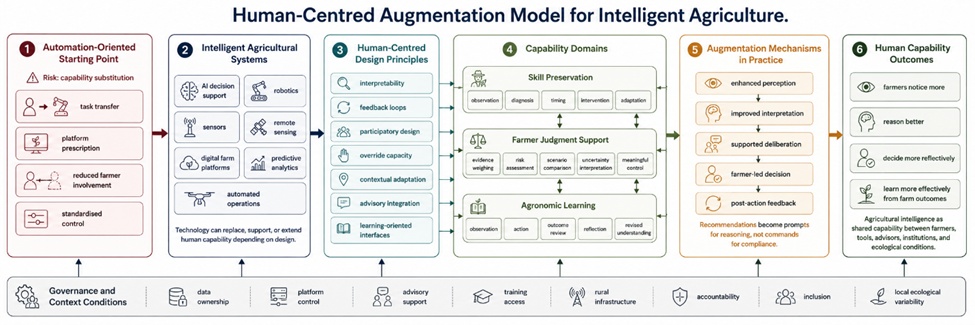
Figure 1. Human-Centred Augmentation Model for Preserving Skill, Judgment, and Agronomic Learning in Intelligent Agriculture.
The first domain, skill preservation, concerns whether intelligent systems maintain and extend farmers’ ability to observe, diagnose, time, intervene, and adapt. The second domain, farmer judgment support, concerns whether systems improve deliberation, risk assessment, and decision control. The third domain, agronomic learning, concerns whether systems create feedback loops that help farmers understand causes, consequences, and changing conditions. These domains are shaped by boundary conditions such as data ownership, platform control, political economy, and power asymmetries in digital agriculture [21].
The fourth domain, human-centred design principles, connects the other domains by specifying how systems should be built and evaluated. Interpretability supports skill because farmers can see how system outputs relate to farm evidence. Override capacity supports judgment because farmers remain able to adapt or reject recommendations. Technological frames among industry and governance actors influence whether smart farming is implemented as farmer-centred augmentation or as externally controlled optimisation [22].
The model proposes seven mechanisms through which intelligent agriculture can become augmentative: interpretability, feedback loops, participatory design, override capacity, contextual adaptation, advisory integration, and learning-oriented interfaces. Responsible transition pathways are needed because agricultural contexts are diverse and cannot be governed through a single universal digital future [23]. Reflexive loops across project, institutional, and system levels are also needed so that digital agriculture research and development can adjust when technologies create unintended effects [24]. Table 2 presents the proposed human-centred augmentation model for preserving skill, judgment, and agronomic learning in intelligent agriculture.
Table 2. Proposed Human-Centred Augmentation Model for Intelligent Agriculture: Skill Preservation, Farmer Judgment, Agronomic Learning, Design Principles, Feedback Mechanisms, and Boundary Conditions
Model domain | Core construct | Augmentation mechanism | Capability pathway | Boundary condition | Evaluation question |
Skill preservation | Farmer ability to observe, diagnose, time, intervene, and adapt | Skill rehearsal, transparent reasoning, task sharing, contextual prompts | Farmers retain and extend practical expertise while using intelligent tools | Unequal access, platform dependence, reduced hands-on experience | Does the system help farmers practise and improve expertise? |
Farmer judgment support | Capacity to weigh evidence, interpret context, assess risk, and decide | Interpretable decision support, uncertainty communication, scenario comparison, override capacity | Farmers make better-informed decisions without losing agency | Opaque algorithms, excessive prescription, weak contextual fit | Does the system support deliberation rather than compliance? |
Agronomic learning | Continuous revision of knowledge through observation, action, outcome, and reflection | Feedback dashboards, outcome tracking, advisory integration, experimentation support | Farmers learn from data, decisions, and farm results over time | Outputs without explanation, reduced experimentation, loss of ecological attention | Does the system deepen understanding of farm processes? |
Human-centred design | Design orientation that protects autonomy, inclusion, usability, and local relevance | Co-design, participatory testing, accessible interfaces, transparency, local adaptation | Systems fit real farm work and diverse user capabilities | Exclusion of farmers, poor usability, narrow developer assumptions | Were farmers and advisors involved meaningfully in design and testing? |
Feedback loop | Connection between recommendation, farmer action, observed result, and revised model | Post-action review, comparative records, learning histories, adaptive analytics | Decisions become learning opportunities rather than isolated outputs | Data gaps, weak interoperability, limited advisory support | Can users trace how outcomes inform future recommendations? |
Advisory integration | Connection between digital tools and human advice systems | Advisor dashboards, shared interpretation, extension support, peer learning | Farmers receive support in interpreting and adapting digital outputs | Fragmented knowledge networks, commercial lock-in, loss of trusted advice | Does the system strengthen knowledge exchange? |
Governance condition | Institutional and political-economic setting of digital agriculture | Data rights, accountability rules, responsible innovation routines, inclusive governance | Augmentation is supported beyond individual farm adoption | Power asymmetry, unclear responsibility, data extraction | Are responsibility, control, and benefits fairly distributed? |
Agricultural technology firms, machinery providers, and platform developers should evaluate intelligent systems using capability-focused criteria alongside technical performance. Responsible innovation for precision agriculture requires attention to design, evaluation, adoption, inclusion, and the consequences of technology use in real farming contexts [25]. Practical protocols should include skill-preservation audits, interpretable decision support, uncertainty communication, farmer override mechanisms, and learning feedback dashboards. Such protocols would help developers ask whether systems improve farmer capability rather than merely automate tasks.
Farm advisors, extension organisations, farmer cooperatives, and policymakers have a central role in making augmentation practical. Trustworthy AI in agriculture and food systems requires clearer responsibility across developers, institutions, researchers, users, and governance actors [26]. Advisory integration can help farmers interpret system outputs, compare options, and connect digital recommendations to local agronomic knowledge. Policy can support this by promoting transparency, data portability, training, independent advice, and accountability for automated or AI-enabled recommendations.
Future research should empirically test augmentation outcomes across different farming systems, scales, crops, livestock sectors, and socio-economic settings. Studies should examine how intelligent systems affect skill over time, including deskilling, reskilling, learning transfer, farmer confidence, and decision autonomy. Research on inclusion in agricultural robotics development shows the importance of asking who participates, how they are included, and whose needs shape technological futures [27]. Comparative and longitudinal work is needed to determine when digital tools preserve situated expertise and when they quietly displace it.
This article has developed a human-centred conceptual model for shifting from automation to augmentation in agriculture. The model argues that intelligent farming should not be evaluated only by labour substitution, efficiency, prediction accuracy, or productivity gains. Its deeper test is whether digital systems preserve farmer skill, strengthen judgment, and deepen agronomic learning. Automation can be valuable when it is embedded in arrangements that keep farmers capable, informed, and meaningfully in control. The future of agricultural intelligence should therefore be built around technologies that extend human capability while respecting the situated expertise through which farming remains adaptive, responsible, and learnable.
None
None
None
None
Open Access The author(s) retain copyright. This article is licensed under the Creative Commons Attribution-NonCommercial-ShareAlike 4.0 International License. It may be shared and adapted for non-commercial purposes with appropriate attribution, an indication of changes, and distribution of adaptations under the same license. Third-party material may be subject to separate terms identified in its credit line. View the license at https://creativecommons.org/licenses/by-nc-sa/4.0/.
 Agro Intelligence Research Press