Digital food systems promise to connect farms, processors, logistics providers, retailers, regulators, and consumers through continuous data exchange. In this vision, production conditions, quality records, traceability events, safety alerts, inventory signals, and sustainability indicators move across the food chain as shared informational infrastructure. Yet the operational reality remains far less integrated, with food data often fragmented across systems that cannot easily communicate. The central problem is that existing debates frequently treat interoperability as a technical matter of software connection, data standards, or platform implementation. Such accounts understate the systemic, organizational, and political conditions that make data exchange difficult even when digital technologies are available. The result is a persistent gap between the promise of farm-to-fork data continuity and the practical experience of disconnection. This article develops a theory of data frictions in digital food systems. Data frictions are conceptualised as points of resistance, incompatibility, and disconnection that interrupt data flow between heterogeneous food system actors. The objective is to explain why interoperability fails across farms, processors, retailers, and regulators despite growing investment in digital agriculture, traceability systems, blockchain platforms, and data governance frameworks. The article adopts a conceptual theory-building approach based on a synthesis of 26 peer-reviewed journal articles published between 2017 and 2025. It draws on information systems, food supply chain management, agricultural data governance, platform studies, and organizational theory. The synthesis does not present new empirical data but uses existing evidence to construct a theoretical explanation of interoperability failure. The theory identifies four interrelated categories of data friction: technical, semantic, organizational, and political. These frictions manifest differently across the farm-processor-retailer-regulator nexus but jointly undermine coordination, traceability, accountability, and digital transformation. The article argues that data frictions are not peripheral glitches but structural features of digital food systems, requiring governance innovation, shared standards, and incentive alignment across the chain.
Digital food systems are increasingly imagined as integrated information environments in which data travel continuously from production to processing, distribution, retail, regulation, and consumption. Smart farming research has shown how sensors, farm management systems, and analytics can generate high-volume agricultural data, while broader food-system architectures envision these data as part of connected farm-to-fork infrastructures [1]. However, the existence of data-generating technologies does not guarantee data mobility, because digital agriculture often remains distributed across locally optimized tools, proprietary platforms, and actor-specific databases [2].
The central puzzle motivating this article is why food system data do not flow seamlessly despite the availability of cloud platforms, IoT architectures, traceability tools, and blockchain-enabled infrastructures. IoT-based food and farm systems show the potential for integrated architectures, yet case-based research also reveals that integration depends on alignment among devices, software services, data models, and organizational processes [3]. Farm management information systems similarly face obstacles related to data entry, usability, compatibility, and integration, suggesting that digital fragmentation is not merely a temporary implementation problem [4].
This article introduces the concept of data frictions to explain the persistent gap between technological possibility and operational interoperability. Data frictions refer to the points of resistance, incompatibility, and disconnection where data flows slow down, become distorted, lose meaning, or fail to move between actors. Digital twin research in smart farming illustrates the importance of linking physical operations with digital representations, but it also implies that such linkage depends on trusted, structured, and interoperable data relationships across organizational boundaries [5].
The aim of this article is to develop a theory of data frictions in digital food systems, with particular attention to farms, processors, retailers, and regulators. Rather than treating interoperability as a purely technical issue, the article theorises it as a multi-dimensional problem shaped by technical infrastructures, semantic meanings, organizational routines, and political control over data. The article proceeds by reviewing theoretical foundations, defining data frictions, analysing interoperability failure across actor interfaces, examining standards and platforms, and proposing a model of antecedents, mechanisms, and consequences [6, 7].
Information systems integration provides the first theoretical foundation for understanding data frictions because it directs attention to how heterogeneous systems are connected, coordinated, and governed. In food and farm contexts, integration is complicated by the coexistence of sensor networks, farm software, enterprise systems, logistics records, quality databases, and regulatory reporting tools [3]. Reference architecture work on farm management information systems shows that interoperability requires not only technical connectivity but also coherent architectural principles that can be reused across diverse operational settings [8].
Interoperability also has technical, semantic, and organizational dimensions that cannot be reduced to common file formats or application programming interfaces. Semantic interoperability is especially important in food supply chains because the same data field may carry different meanings for producers, processors, retailers, auditors, and regulators [9]. Research on semantic data analysis in food supply chains demonstrates that the value of shared data depends on whether actors can interpret exchanged information consistently and use it in coordinated decision-making [10].
A third theoretical foundation comes from platform governance, data governance, and the political economy of digital infrastructures. Digital platforms can reduce coordination costs by creating shared interfaces, yet they can also concentrate control over standards, access rights, and data visibility [7]. Data governance research therefore becomes essential for explaining how ownership, accountability, stewardship, and decision rights shape whether food system actors share data, restrict data, or redesign data flows to protect their own strategic interests [6].
Data frictions are defined here as the systemic points of resistance that prevent data from moving cleanly, meaningfully, and accountably across digital food systems. They include technical incompatibilities among databases and devices, semantic mismatches in product and process meanings, organizational misalignment in routines and incentives, and political struggles over data access and control. Big data research in agriculture has already shown that data volume and analytical capacity do not automatically produce value unless data can be collected, integrated, interpreted, and governed across practical use contexts [1, 2].
Technical data frictions arise when systems cannot exchange data because of incompatible formats, fragmented architectures, missing identifiers, weak connectivity, or insufficient interface design. These frictions are visible in farm management information systems, where software tools may support local operational needs while remaining difficult to connect with external processor, retailer, or certification systems [4]. Architecture-oriented studies suggest that such frictions can be reduced through reference architectures and reusable design principles, but they cannot be eliminated unless the wider chain adopts compatible integration logics [8, 11].
Semantic and organizational data frictions emerge when actors exchange data but attach different meanings, priorities, or decision rules to the same informational objects. Food traceability systems, for example, may capture product movement, quality status, batch identity, or safety evidence differently depending on whether the user is a supplier, processor, retailer, or regulator [12]. Blockchain and traceability studies show that shared ledgers may improve visibility, but they still depend on agreement about what should be recorded, who verifies it, and how records are interpreted when food safety or quality disputes arise [13, 14].
Political data frictions arise because food system actors do not merely exchange neutral information; they exchange data that can create commercial advantage, regulatory exposure, liability, or dependence on dominant platforms. Agricultural data-sharing studies show that trust, transparency, benefit-sharing, and privacy concerns strongly influence whether farmers and other actors are willing to share operational data [15-17]. For this reason, data frictions must be analysed across the farm-processor-retailer-regulator chain as structural features of digital food systems rather than isolated failures of software adoption [18, 19].
Interoperability failure in digital food systems is most visible at actor interfaces, where data generated for one operational purpose must be reused by another actor under different technical, commercial, and regulatory conditions. At the farm-to-processor interface, sensor records, input histories, field-level production data, and harvest information often originate in farm management tools that are not designed around processor enterprise systems [4]. Even when farms adopt IoT-based architectures, data exchange depends on whether the receiving actor can interpret field identifiers, quality indicators, and timing records in compatible formats [3].
At the processor-to-retailer interface, data frictions shift from field-level production data to batch records, product codes, quality attributes, storage conditions, and logistics events. Traceability research shows that supply chain visibility depends on reliable links between product identity, process history, and movement records, yet these links can weaken when actors use inconsistent coding systems or record different levels of detail [12]. Blockchain-oriented studies demonstrate that shared records may increase visibility, but they do not automatically resolve disagreements about what counts as valid evidence or who is responsible for verifying it [14, 20].
At the retailer-to-regulator interface, interoperability failure becomes a problem of accountability because data must support inspection, recall, compliance, and public safety decisions. Food supply chain visibility studies show that traceability requires not only data capture but also institutional arrangements that make data available, interpretable, and usable during time-sensitive incidents [21]. Table 1 categorises the types and sources of data frictions and their manifestations across different food system actors.
Table 1. Types and Sources of Data Frictions Across Farms, Processors, Retailers, and Regulators
Data friction type | Main source of friction | Farm-level manifestation | Processor-level manifestation | Retailer-level manifestation | Regulator-level manifestation | Theoretical implication |
Technical friction | Incompatible systems, formats, databases, identifiers, and interfaces | Farm management software stores field, sensor, and input data in formats that cannot be directly reused downstream | ERP, quality management, and batch systems cannot easily absorb heterogeneous farm data | Inventory and product platforms receive incomplete or inconsistent upstream records | Inspection and safety databases cannot link product events across the chain | Data availability does not equal data mobility |
Semantic friction | Conflicting meanings, taxonomies, units, product definitions, and quality categories | Production events are recorded using locally meaningful labels and agronomic categories | Quality and transformation data are reclassified according to processing logic | Product, shelf-life, and consumer-facing categories differ from upstream records | Regulatory categories require legally meaningful and auditable definitions | Data exchange fails when shared fields lack shared meaning |
Organizational friction | Misaligned routines, responsibilities, capabilities, and workflow priorities | Data entry is treated as an administrative burden rather than part of chain coordination | Processing staff prioritise internal efficiency over external data completeness | Retailers demand visibility but may not adapt internal routines to upstream constraints | Regulators require evidence that firms may not routinely generate in usable form | Interoperability depends on routines as much as technology |
Political friction | Strategic control over data access, ownership, visibility, and platform dependence | Farmers hesitate to share data that may expose productivity, compliance, or bargaining weaknesses | Processors restrict data to protect commercial relationships and liability exposure | Retailers use data visibility to strengthen supply chain control | Regulators seek accountability while firms may limit disclosure | Data frictions express power relations across the food system |
Compound friction | Interaction among technical, semantic, organizational, and political barriers | Local data practices become difficult to translate into chain-wide records | Internal systems absorb data selectively and reshape it for firm-specific use | Data gaps are normalized as operational exceptions | Accountability is weakened by incomplete and non-comparable records | Interoperability failure is systemic rather than isolated |
The actor-interface view shows that interoperability failure is not evenly distributed across the food chain. Farms often carry the burden of data generation, processors translate raw and semi-structured data into operational records, retailers demand visibility for inventory and assurance, and regulators require legally meaningful traceability evidence [13]. These differences mean that the same dataset can be technically present but functionally unusable, creating a theory of interoperability failure centred on broken translation between actors rather than simple absence of technology [9, 10].
Standards are frequently presented as the solution to data frictions because they can stabilise identifiers, event structures, product classifications, and exchange formats. In principle, common standards reduce technical and semantic uncertainty by making food chain data more comparable across organizations [9]. Yet standards also require adoption, maintenance, interpretation, and governance, so their effectiveness depends on whether actors have incentives and capabilities to implement them consistently [6].
Platforms can also reduce frictions by providing shared dashboards, data repositories, traceability modules, and integration services across multiple supply chain actors. Digital agriculture platforms are often positioned as mechanisms for scaling data-enabled innovation, but they also raise concerns about privacy, security, ownership, and dependence on platform operators [22]. Platform governance theory suggests that such infrastructures coordinate participants by controlling interfaces and rules, yet this coordination can create new asymmetries over who sees, edits, monetizes, or withholds data [7].
Data silos emerge when standards and platforms are adopted in ways that reinforce actor-specific control rather than chain-wide interoperability. Smart farming and digital agriculture research shows that farms, advisers, technology vendors, processors, retailers, and public agencies may each develop their own digital systems around different operational priorities [18, 23]. These silos persist because local optimization can be rational for individual actors even when it produces systemic inefficiency for the wider food chain [1].
The political economy of standards therefore matters as much as their technical design. Blockchain adoption studies in agri-food supply chains show that interoperability barriers are linked to costs, stakeholder readiness, trust, governance, scalability, and perceived benefits, not only to ledger technology [24, 25]. When dominant firms or platforms shape standards around their own data interests, technical friction may decrease while political friction increases because weaker actors become more dependent on infrastructures they do not control [19].
The first consequence of data frictions is coordination loss across planning, production, logistics, quality assurance, and inventory management. When farm data cannot be connected with processor demand signals or retailer inventory systems, the chain loses opportunities for synchronized decision-making [3]. This undermines the promise of digital agriculture because data-driven tools produce value only when information can move across the operational boundaries where decisions are actually interdependent [5].
The second consequence is weakened traceability during quality failures, contamination events, or recall situations. Traceability requires the ability to reconstruct product histories across actors, but data frictions create breaks in the chain of evidence through missing identifiers, inconsistent event records, and uneven verification practices [12, 20]. Blockchain and transparency research shows that digital ledgers can support traceability, but only if upstream data are trustworthy, complete, and semantically aligned before they enter the system [13, 14].
The third consequence is an accountability gap in which responsibility becomes difficult to assign because the evidence base is fragmented. Regulators may require auditable information about origin, handling, transformation, and distribution, while firms may hold partial records in systems that were not designed for cross-actor accountability [21]. Transparency and traceability research in agri-food supply chains shows that visibility depends on interconnected governance arrangements, not simply on the accumulation of more data [26].
The fourth consequence is that data frictions can erode the business case for digitalization itself. If data sharing increases workload, creates liability exposure, or benefits powerful downstream actors more than upstream contributors, then actors may rationally limit participation in shared data systems [15, 17]. This creates a self-reinforcing cycle in which weak trust reduces data sharing, reduced sharing weakens interoperability, and poor interoperability lowers confidence in digital food system transformation [16].
The proposed theoretical model begins with three antecedent conditions: actor heterogeneity, competing standards, and weak cross-chain data governance. Actor heterogeneity refers to differences in technological capability, organizational routines, data literacy, commercial position, and regulatory exposure across farms, processors, retailers, and regulators [18]. Competing standards and weak governance intensify this heterogeneity by allowing local systems to evolve without sufficient alignment around shared identifiers, meanings, and decision rights [6, 8].
These antecedents generate four forms of data friction: technical, semantic, organizational, and political. Technical frictions obstruct system-to-system exchange, semantic frictions obstruct shared interpretation, organizational frictions obstruct routine use, and political frictions obstruct willingness to share or disclose data [9, 16]. The theoretical claim is that interoperability failure occurs when these frictions interact, because solving one friction type may leave others intact or even intensify them [25].
Figure 1 presents the proposed theoretical model of data frictions in digital food systems. It shows how actor heterogeneity, competing standards, and weak cross-chain data governance generate technical, semantic, organizational, and political frictions across farm–processor–retailer–regulator interfaces, leading to interoperability failure, coordination loss, traceability weakness, and accountability gaps.
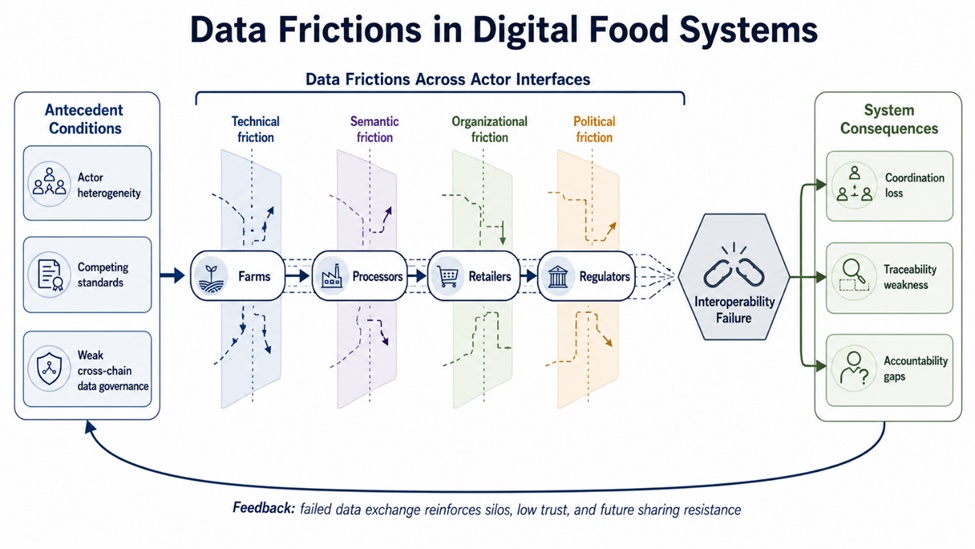
Figure 1. A systems-flow model of data frictions and interoperability failure in digital food systems
Interoperability failure then produces two main classes of consequence: coordination loss and accountability gaps. Coordination loss appears when actors cannot synchronize production, processing, logistics, quality assurance, and retail response using shared information [1, 5]. Accountability gaps appear when traceability evidence is incomplete, fragmented, or controlled by actors whose incentives do not fully align with public safety, sustainability, or regulatory transparency [12, 26].
The model also includes feedback loops because failed coordination and weak accountability reshape future data-sharing incentives. When actors experience data sharing as costly, risky, or strategically uneven, they may retreat into local systems or platform-controlled silos, thereby reproducing the antecedents of future friction [19, 22]. Table 2 presents the proposed theoretical model of data frictions and interoperability failure.
Table 2. Proposed Theoretical Model of Data Frictions in Digital Food Systems: Antecedents, Mechanisms, and Consequences
Model component | Core theoretical construct | Definition in digital food systems | Principal mechanism | Expected consequence | Illustrative actor interface |
Antecedent 1 | Actor heterogeneity | Variation in technological capacity, routines, data literacy, risk exposure, and bargaining power across food system actors | Heterogeneous actors generate, classify, and value data differently | Misalignment between local data practices and chain-wide data requirements | Small farms sharing production data with processors |
Antecedent 2 | Competing standards | Coexistence of multiple coding systems, identifiers, platform schemas, and reporting formats | Actors adopt standards that fit their own systems but not necessarily the whole chain | Fragmented identifiers and inconsistent event records | Processors translating supplier records into internal ERP categories |
Antecedent 3 | Weak data governance | Absence of clear cross-chain rules for ownership, access, stewardship, verification, and accountability | Data rights and responsibilities remain ambiguous or contested | Selective sharing, restricted visibility, and low trust | Retailers requesting traceability data from suppliers |
Mechanism 1 | Technical data friction | Inability of systems to connect, exchange, or reuse data without manual transformation | Interfaces, databases, and formats are incompatible | Data delays, duplication, and manual reconciliation | Farm software connected to processor quality systems |
Mechanism 2 | Semantic data friction | Inability of actors to interpret exchanged data consistently | Terms, units, categories, and evidence thresholds differ | Misclassification, ambiguity, and loss of decision relevance | Product and batch data moving from processor to retailer |
Mechanism 3 | Organizational data friction | Inability of routines, roles, and capabilities to support shared data use | Data work is unevenly distributed and weakly embedded in workflows | Low adoption, incomplete records, and operational workarounds | Supplier compliance reporting to retailer platforms |
Mechanism 4 | Political data friction | Strategic resistance to data sharing due to power, liability, privacy, or commercial concerns | Actors restrict access, negotiate visibility, or depend on dominant platforms | Data hoarding, platform dependence, and accountability disputes | Firm-to-regulator data disclosure during food safety events |
Outcome 1 | Interoperability failure | Breakdown of meaningful and actionable data exchange across actor boundaries | Multiple friction types compound across the chain | Loss of farm-to-fork data continuity | Multi-actor traceability and recall systems |
Outcome 2 | Coordination loss | Reduced ability to synchronize operational decisions across the food chain | Incomplete or delayed data weaken planning and response | Waste, inefficiency, missed demand signals, and disrupted logistics | Processor-retailer inventory and quality coordination |
Outcome 3 | Accountability gap | Reduced ability to verify responsibility, compliance, and corrective action | Evidence becomes fragmented, inaccessible, or contested | Weakened food safety assurance, sustainability reporting, and regulatory oversight | Retailer-regulator and processor-regulator reporting |
Proposition 1 is that the number and diversity of data standards used in a food chain are positively associated with the frequency of interoperability failures. This proposition follows from research showing that integration depends on shared architectures, consistent semantics, and reusable data structures rather than isolated digital tools [8, 10, 11]. The implication is that standard proliferation may appear to increase digital maturity while actually expanding the translation burden between farms, processors, retailers, and regulators.
Proposition 2 is that organizational data frictions mediate the relationship between misaligned actor incentives and coordination failures. Agricultural data-sharing research indicates that trust, transparency, privacy, and perceived benefit-sharing shape whether actors contribute data to shared systems [15-17]. Therefore, even technically interoperable systems may fail to improve coordination when actors perceive data sharing as costly, unfair, or strategically dangerous.
Proposition 3 is that platform dominance reduces technical frictions while increasing political frictions over data control. Platform infrastructures can simplify interfaces and improve visibility, but platform governance research shows that control over rules, access, and participation can redistribute power among actors [7, 22]. In digital food systems, this means that a dominant platform may improve data exchange efficiency while also intensifying dependence, selective visibility, and disputes over ownership or accountability [6, 19].
This article has developed a theory of data frictions to explain why digital food systems remain fragmented despite the expansion of data-generating technologies. The core contribution is to shift attention from the availability of data and digital tools to the points of resistance where data lose mobility, meaning, usability, or legitimacy. By distinguishing technical, semantic, organizational, and political frictions, the theory provides a structured vocabulary for diagnosing interoperability failure across farms, processors, retailers, and regulators.
The argument is that data frictions are not peripheral glitches that can be solved by software alone. They are structural features of multi-actor food systems in which heterogeneous organizations pursue different operational goals, use different standards, and face different incentives for sharing or withholding information. A truly integrated digital food system therefore requires not only better interfaces but also stronger governance arrangements, shared semantic infrastructures, and fairer distribution of the costs and benefits of data exchange.
Future research should test the proposed propositions across different food chains, technologies, regulatory contexts, and platform arrangements. Empirical studies can examine when data frictions are reduced, when they are displaced to weaker actors, and when they reappear as political disputes over control and accountability. Policy and managerial practice should move beyond narrow interoperability projects and address the governance conditions that determine whether data can become a shared resource for coordination, safety, sustainability, and public trust.
None
None
None
None
Open Access The author(s) retain copyright. This article is licensed under the Creative Commons Attribution-NonCommercial-ShareAlike 4.0 International License. It may be shared and adapted for non-commercial purposes with appropriate attribution, an indication of changes, and distribution of adaptations under the same license. Third-party material may be subject to separate terms identified in its credit line. View the license at https://creativecommons.org/licenses/by-nc-sa/4.0/.
 Agro Intelligence Research Press