Artificial intelligence is increasingly positioned as a transformative force for climate-smart agriculture, promising simultaneous gains in productivity, efficiency, and sustainability. Across agricultural policy, innovation systems, and digital farming markets, AI is presented as a solution to climate uncertainty, resource scarcity, labour pressures, and food-security demands. This review examines that promise through a critical lens. The dominant narrative surrounding AI-enabled climate-smart agriculture often treats optimization as a neutral technical process. Yet algorithmic systems do not merely improve farming decisions; they also define what counts as efficiency, which outcomes are prioritised, and whose knowledge becomes authoritative. This raises important questions about power, agency, and sustainability. The objective of this critical review is to interrogate the politics of AI in climate-smart agriculture. It synthesises evidence on the tensions between productivity, efficiency, sustainability, farmer agency, data sovereignty, and governance. The review asks how algorithmic optimization reshapes agricultural futures and who benefits from this transformation. The review draws on peer-reviewed articles published across agricultural innovation, sustainability science, digital agriculture, artificial intelligence, and critical data studies. Rather than reporting new empirical data, it develops a critical synthesis of existing debates and identifies conceptual gaps in current scholarship. The review finds that algorithmic farming is not simply a technical evolution of precision agriculture. It is a contested political terrain in which sustainability goals, commercial interests, data infrastructures, and farmer autonomy are negotiated. A critical research agenda is needed to ensure that AI contributes to equitable, democratic, and ecologically resilient agricultural futures.
Agriculture is increasingly positioned at the centre of intersecting crises involving climate change, food insecurity, biodiversity loss, labour instability, and resource depletion. Within this context, climate-smart agriculture has become a prominent framework for aligning productivity, adaptation, and mitigation, while digital technologies are increasingly promoted as tools for managing climatic uncertainty and farm-level complexity [1]. The rise of smart farming, big data analytics, and machine learning has intensified expectations that agriculture can become more precise, responsive, and sustainable through data-driven decision-making [2, 3]. This convergence has created a powerful narrative in which AI appears as a necessary response to climate-stressed food systems.
The dominant promise of AI-enhanced agriculture rests on the idea that better data and better models can produce better farming decisions. Machine learning systems are used to classify crop stress, predict yield, optimise irrigation, detect pests, guide pesticide application, and support automated farm management [4, 5]. Precision agriculture and smart farming are therefore framed as optimization paradigms that reduce waste, increase productivity, and improve environmental performance [6]. However, these claims often depend on a narrow understanding of sustainability as measurable efficiency rather than as a broader social, ecological, and political condition.
A critical review is necessary because optimization is never merely technical. The design of digital agriculture systems reflects assumptions about what should be measured, which risks should be prioritised, whose expertise matters, and what forms of farming are considered modern or legitimate [7, 8]. Studies of Agriculture 4.0 and responsible innovation show that digital farming can reconfigure relations among farmers, technology providers, agribusiness firms, researchers, and policymakers [9, 10]. The politics of algorithmic farming therefore lies not only in the deployment of AI tools but also in the infrastructures and institutions that determine how agricultural futures are imagined.
This review examines artificial intelligence in climate-smart agriculture as a political and economic force rather than a neutral technical upgrade. It asks how AI contributes to the optimization logic of farming, how this logic produces tensions between productivity and sustainability, and how digital agriculture reshapes farmer agency, equity, and data power. The review proceeds by situating climate-smart agriculture as a digital transformation context, analysing AI as an optimization system, examining sustainability tensions, and developing a critical synthesis of algorithmic farming [6, 8]. It concludes by identifying research gaps and proposing a future agenda for more democratic, justice-oriented, and ecologically grounded agricultural AI.
Climate-smart agriculture emerged as a policy and development framework intended to align three goals: increasing agricultural productivity, strengthening adaptation to climate change, and reducing or avoiding greenhouse-gas emissions where possible. In practice, this framework has often been translated into programmes that seek scalable, measurable, and fundable interventions for agricultural transformation [1]. The appeal of CSA lies partly in its integrative language, which appears to reconcile food production, climate adaptation, and environmental responsibility. Yet this same flexibility can obscure conflicts among competing goals and create space for technological solutions to be presented as politically uncomplicated.
Digitalization has become increasingly embedded within CSA because it promises to make climate risks calculable and farm decisions more efficient. Smart farming systems, big data platforms, remote sensing, and predictive analytics are presented as ways to improve decision quality under uncertainty [2, 3]. Climate variability can be translated into data streams, while farm management becomes organised around forecasts, dashboards, alerts, and algorithmic recommendations. This transformation shifts CSA from a broad sustainability framework toward a data-intensive mode of agricultural governance.
The integration of digital technologies into CSA also changes the meaning of “smartness” in agricultural development. Rather than referring only to ecological adaptation, smartness increasingly implies connectivity, automation, data extraction, and algorithmic optimization [6, 8]. Digital advisory systems and agricultural knowledge infrastructures may support farmers, but they can also centralise expertise in platforms, models, and external service providers [11]. This raises the question of whether digital CSA empowers farmers to respond to climate change or subtly replaces situated knowledge with externally designed decision systems.
The marriage of digital transformation and climate-smart agriculture depends on a strong assumption: that more data and more precise modelling will produce more sustainable outcomes. Critical scholarship complicates this assumption by showing that technological intensification may reproduce existing inequalities, narrow definitions of sustainability, and concentrate power in corporate or institutional actors [7, 12]. Responsible innovation perspectives argue that digital agriculture must be assessed not only by technical performance but also by purpose, inclusion, accountability, and social consequences [9, 10]. CSA therefore provides a crucial setting for examining how AI-driven optimization becomes legitimised through the language of climate necessity.
Artificial intelligence in agriculture is commonly associated with machine learning, computer vision, robotics, predictive analytics, IoT-enabled monitoring, and decision-support systems. These technologies process data from sensors, satellites, drones, machinery, weather stations, and farm-management platforms to generate recommendations or automate actions [4, 5]. Their appeal lies in the promise of converting complex farming environments into manageable patterns, classifications, and forecasts. In this sense, agricultural AI extends the broader smart-farming ambition of making agricultural production more measurable, predictable, and controllable [2].
The optimization logic of AI depends on simplifying agroecosystems into variables that can be monitored, modelled, and acted upon. Yield, moisture, disease pressure, input use, machinery movement, and labour efficiency become computational objects that can be ranked, predicted, and optimised [3, 13]. This can generate useful improvements, especially when farmers face uncertainty, limited information, or resource constraints. Yet the same process can privilege variables that are easy to quantify while marginalising ecological relationships, tacit knowledge, long-term soil health, and community-based understandings of resilience.
Precision agriculture is often presented as a sustainability pathway because it can reduce unnecessary input use and improve resource targeting. However, the optimization paradigm may also reinforce a narrow view of farming in which efficiency becomes the dominant criterion for decision-making [6, 14]. When algorithmic systems are designed to maximise yield, minimise costs, or optimise input timing, they may treat broader ecological and social consequences as secondary or external. This reveals a core tension: AI may improve certain decisions while narrowing the moral and ecological horizon within which decisions are made.
The neutrality of algorithmic optimization must therefore be questioned. AI systems encode assumptions about risk, productivity, efficiency, and acceptable trade-offs, while their deployment is shaped by ownership structures, platform design, market incentives, and governance arrangements [7, 11]. Studies on digital agriculture ethics and responsible innovation show that algorithmic tools can redistribute authority away from farmers and toward data infrastructures, software providers, and agribusiness platforms [10, 15]. The central issue is not whether AI can improve agriculture, but whether its optimization logic can be governed in ways that protect farmer agency, ecological complexity, and democratic control.
Figure 1 illustrates how AI-enabled climate-smart agriculture converts climate, farm, and sustainability challenges into an algorithmic optimization pathway that reshapes agricultural decision-making, farmer agency, and power relations.
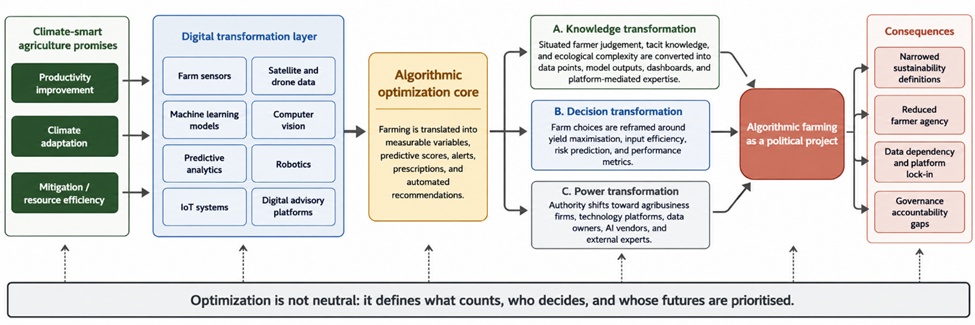
Figure 1. Algorithmic Optimization Pathway in Climate-Smart Agriculture: From Climate-Smart Promises to Political and Governance Consequences
AI-enabled climate-smart agriculture is often justified through the claim that productivity, efficiency, and sustainability can be advanced together. Smart farming systems promise to increase output while reducing unnecessary inputs, and this promise is central to the appeal of precision agriculture as a climate-compatible modernization pathway [6]. Yet the literature shows that these goals are not always mutually reinforcing, because efficiency gains may intensify production rather than reduce overall ecological pressure [14]. The politics of optimization begins at this point, where a technical claim about improved decision-making becomes a broader claim about sustainable transformation.
Algorithmic farming can make input use more precise, but precision does not automatically produce sustainability. AI-based irrigation, pesticide, and herbicide systems may reduce waste under some conditions, yet they can also reinforce input-dependent production models when the underlying objective remains yield maximisation [5]. Critical assessments of digital agriculture warn that data-driven systems may reproduce productivist assumptions by treating ecological complexity as a set of controllable variables [16]. This creates a risk that climate-smart agriculture becomes a new language for technological intensification rather than a pathway toward agroecological resilience.
The tension is especially visible in claims about resource efficiency. Big data and machine learning can support better timing, spatial targeting, and monitoring, but sustainability also depends on soil health, biodiversity, labour relations, local knowledge, and long-term adaptive capacity [3, 13]. These dimensions are difficult to represent in optimization models because they are relational, historical, and context-specific. When models privilege measurable farm outputs, they may undervalue slow ecological processes and social forms of resilience that cannot be easily converted into data points.
Sustainability tensions therefore arise not because AI is inherently harmful, but because algorithmic systems are usually designed around selective definitions of performance. Edge AI and digital advisory systems may support more responsive farming, but their benefits depend on whose objectives are encoded and how ecological uncertainty is governed [11, 17]. A critical review must therefore distinguish between efficiency as a technical improvement and sustainability as a broader social-ecological condition. Table 1 summarises the documented trade-offs and tensions between productivity, efficiency, and sustainability in AI-enabled climate-smart agriculture.
Table 1. Tensions Between Productivity, Efficiency, and Sustainability in Algorithmic Farming: Evidence from the Literature
Optimization domain | Dominant AI-enabled promise | Observed or theorised tension | Critical implication | Key literature base |
Yield prediction and productivity management | AI models are expected to forecast yield, identify stress, and support higher productivity under climate variability. | Yield-centred optimization may prioritise short-term output over soil regeneration, biodiversity, and diversified farming systems. | Productivity becomes the main indicator of success, while ecological resilience is treated as secondary or indirect. | Walter, Finger, Huber, Buchmann [6]; Liakos, Busato, Moshou, Pearson, Bochtis [4]; Rose, Wheeler, Winter, Lobley, Chivers [14] |
Precision input use | Sensors, computer vision, and predictive models are expected to reduce irrigation, pesticides, herbicides, and fertiliser waste. | Precision can improve targeting while preserving input-dependent production models and commercial input pathways. | Efficiency may stabilise rather than transform high-input agriculture. | Talaviya, Shah, Patel, Yagnik, Shah [5]; Tantalaki, Souravlas, Roumeliotis [13]; Visser, Sippel, Thiemann [16] |
Farm data analytics | Big data systems are expected to convert complex farm conditions into actionable insights. | Datafication privileges measurable variables and may exclude tacit, experiential, and place-based knowledge. | Farming knowledge shifts from situated judgement toward platform-mediated interpretation. | Wolfert, Ge, Verdouw, Bogaardt [2]; Kamilaris, Kartakoullis, Prenafeta-Boldú [3]; Klerkx, Jakku, Labarthe [8] |
Climate adaptation | AI is framed as a tool for managing climate uncertainty through prediction, warning, and advisory systems. | Climate risks may be narrowed into modelled probabilities, while structural vulnerability and unequal adaptive capacity remain under-addressed. | Adaptation becomes a technical forecasting problem rather than a political and distributive problem. | Dinesh, Zougmore, Vervoort, Totin, Thornton, Solomon, Shirsath, Pede, Lopez Noriega, Läderach, Körner, Hegger, Girvetz, Friis, Driessen, Campbell [1]; Smith, Sallu, Whitfield, Gaworek-Michalczenia, Recha, Sayula, Mziray [18] |
Sustainability assessment | Digital tools are expected to make sustainability measurable and manageable. | Sustainability indicators may be reduced to carbon, water, yield, or efficiency metrics, excluding social justice and ecological complexity. | Sustainability becomes a dashboard logic rather than a contested social-ecological goal. | Rose, Chilvers [9]; van der Burg, Bogaardt, Wolfert [10]; Dara, Hazrati Fard, Kaur [19] |
The social consequences of algorithmic farming are inseparable from questions of data ownership, platform control, and institutional authority. Farmers increasingly generate valuable operational data through machinery, sensors, farm-management software, and digital advisory platforms, yet they do not always control how these data are stored, analysed, monetised, or shared [20, 21]. This asymmetry creates a new layer of dependency in which farm knowledge becomes embedded in proprietary infrastructures. The question is not only whether farmers use AI, but whether they can meaningfully shape the systems that interpret their farms.
Equity concerns are particularly significant for smallholders, women farmers, and producers in the Global South. Digital agriculture systems often assume stable connectivity, technical literacy, capital availability, and institutional support, even though these conditions are unevenly distributed [12]. In low-income contexts, well-intentioned digital agriculture interventions may fail when design processes neglect local realities, social relations, or farmer priorities [22]. Climate-smart agriculture can therefore become exclusionary when access to algorithmic tools becomes a condition for participating in future-oriented farming systems.
Farmer agency is also affected when algorithmic recommendations begin to shape what counts as rational or responsible farm management. Automated systems can encourage farmers to trust model outputs, platform alerts, and advisory dashboards even when these tools simplify uncertainty or obscure their assumptions [16, 23]. In livestock and crop systems alike, responsible digital development requires attention to practicality, purpose, and effects rather than only technical capability [24]. Without such attention, AI may displace farmer judgement while presenting that displacement as efficiency.
Data power extends beyond individual farms into broader political-economic structures [25]. Corporate lock-ins, platform ecosystems, and proprietary analytics can concentrate authority among agribusiness and technology firms, creating new forms of dependency in digital agriculture [26]. Human-rights critiques warn that digital agriculture may threaten rights related to food, science, participation, and knowledge when governance mechanisms are weak [27]. In this context, data sovereignty is not an abstract principle but a condition for preserving farmer autonomy, democratic accountability, and equitable climate adaptation.
Algorithmic farming should be understood as a political project because it reorganises power through the language of technical improvement. Digital agriculture does not simply add tools to existing farming systems; it changes the relationships among farmers, agribusiness firms, technology providers, researchers, states, and development institutions [7]. Optimization becomes politically powerful because it appears neutral while shaping decisions about land, labour, inputs, risk, and value. The result is a form of agricultural governance in which technical systems increasingly define the boundaries of legitimate decision-making.
This review identifies optimization as a depoliticising logic. When farm decisions are translated into model outputs, recommendations, scores, or alerts, contested choices about sustainability, equity, and responsibility may appear as matters of technical calculation [11]. Ethical analyses of agricultural AI show that these systems raise questions about power, transparency, responsibility, and accountability that cannot be resolved through accuracy improvements alone [28]. Responsible AI in digital agriculture therefore requires more than better models; it requires scrutiny of institutional purposes and governance arrangements [19].
The politics of algorithmic farming also operates through knowledge hierarchy. Climate-smart agriculture and digital advisory systems often present expert models as scalable solutions, while local knowledge becomes data to be extracted, validated, or corrected [11, 18]. This does not mean that scientific or computational knowledge is irrelevant, but it does mean that knowledge integration must be democratic rather than extractive. Where farmers are treated primarily as data providers or end-users, algorithmic farming risks weakening the very adaptive capacities that climate-smart agriculture claims to strengthen.
A critical synthesis therefore reframes AI in climate-smart agriculture as a struggle over authority, value, and future agricultural pathways. Science-policy engagement can support climate action, but only if it recognises that technologies carry assumptions about whose futures matter and what forms of agriculture should be scaled [1]. The key issue is whether algorithmic systems will deepen corporate and institutional control or support plural, farmer-centred, and ecologically grounded transitions. Table 2 synthesises the politics of optimization across technical, social, and governance dimensions.
Table 2. The Politics of Optimization in Algorithmic Farming: A Multi-Dimensional Synthesis of Power, Agency, and Governance
Dimension | How optimization appears technically | Underlying political question | Risk if ungoverned | Critical governance direction |
Technical modelling | Farm complexity is converted into variables, predictions, classifications, and recommendations. | Who decides which variables matter and which outcomes should be optimised? | Ecological and social complexity may be reduced to measurable indicators. | Require transparent model objectives, uncertainty communication, and plural sustainability metrics. |
Data infrastructure | Sensors, platforms, drones, machinery, and advisory systems collect operational farm data. | Who owns, accesses, monetises, and governs agricultural data? | Farmers may become dependent on proprietary infrastructures and lose control over farm knowledge. | Establish farmer-centred data rights, consent mechanisms, and collective data governance. |
Farmer agency | AI systems provide recommendations intended to improve decision-making. | Do tools support farmer judgement or replace it with platform authority? | Decision autonomy may be eroded through automated recommendations and expert-system dependency. | Design systems that preserve contestability, explanation, override, and local adaptation. |
Sustainability framing | Efficiency, productivity, and resource targeting are used as proxies for sustainability. | Who defines sustainability, and which ecological or social values are excluded? | Sustainability may be narrowed to efficiency metrics and short-term performance. | Integrate agroecological, justice-based, and long-term resilience indicators. |
Market power | Digital agriculture is scaled through agribusiness, software, machinery, and platform ecosystems. | Who benefits economically from AI-enabled climate-smart agriculture? | Value may be captured by firms rather than farmers or rural communities. | Develop anti-lock-in policies, interoperability standards, and public-interest digital infrastructures. |
Governance and accountability | AI is governed through technical standards, ethics principles, or voluntary responsible innovation claims. | Who is accountable when algorithmic recommendations produce harm or exclusion? | Responsibility may be diffused across vendors, farmers, advisors, and institutions. | Build enforceable accountability frameworks, participatory oversight, and rights-based governance. |
A major gap in the literature is the limited integration of technical AI research with critical social science. Reviews of machine learning and big data in agriculture provide important insight into methods and applications, but they often focus more on performance, prediction, and implementation than on political economy or governance [4, 29]. Conversely, critical digital agriculture scholarship provides strong analyses of power and inequality, but it is not always connected to the technical design choices that shape algorithmic outcomes [7, 8]. Future research must bridge these fields rather than treating technical and social questions as separate domains.
A second gap concerns long-term sustainability outcomes. Many claims about AI-enabled agriculture rest on expected efficiency gains, but there is insufficient longitudinal evidence showing whether these gains translate into durable ecological benefits across diverse farming systems [14]. Research on imprecision, lock-in, and digital inequality suggests that algorithmic systems may generate unintended consequences that only become visible over time [16, 26]. The field therefore needs studies that assess not only short-term productivity or input savings, but also soil health, biodiversity, livelihood resilience, and institutional dependency.
A third gap involves the neglect of alternative agricultural futures. Much of the digital agriculture literature assumes that better algorithms, better data, and better platforms are the natural direction of agricultural modernization [2, 11]. However, climate adaptation may also require agroecological methods, collective knowledge systems, low-input strategies, and non-proprietary forms of innovation that are not centred on algorithmic optimization [18]. Critical research should therefore examine when AI is appropriate, when it is insufficient, and when non-algorithmic pathways may better support justice and sustainability.
The first priority for future research is to develop a political economy of agricultural AI. This agenda should examine how value is created and captured across farm-data ecosystems, how platform lock-ins develop, and how public policy shapes the ownership of digital agricultural infrastructures [20, 26]. It should also investigate how AI-enabled climate-smart agriculture affects smallholders, tenant farmers, women farmers, and producers in data-poor or infrastructure-poor contexts [12, 22]. Such research would move beyond adoption studies toward a deeper analysis of power, dependency, and distribution.
The second priority is participatory and farmer-centred design. Responsible innovation scholarship shows that digital agriculture must be evaluated through inclusion, purpose, practicality, and effects rather than technological novelty alone [9, 15, 24]. Participatory design should involve farmers not merely as users who test finished systems, but as co-governors who help define objectives, acceptable trade-offs, data rules, and accountability mechanisms. This would allow AI systems to support situated judgement rather than impose external optimization logics.
The third priority is governance for data sovereignty, accountability, and plural sustainability. Ethical AI recommendations in agriculture should be translated into enforceable institutional arrangements, including data rights, transparency requirements, contestability mechanisms, and public-interest infrastructures [10, 19, 27]. Comparative research is also needed to evaluate algorithmic and agroecological pathways side by side, rather than assuming that digital optimization is always the preferred route to climate resilience [18, 30]. A future research agenda should therefore ask not only how to make AI work better, but what kinds of agricultural futures AI is helping to build.
Figure 2 presents the critical governance agenda needed to redirect algorithmic farming from narrow optimization toward equitable, farmer-centred, and ecologically resilient climate-smart agriculture.
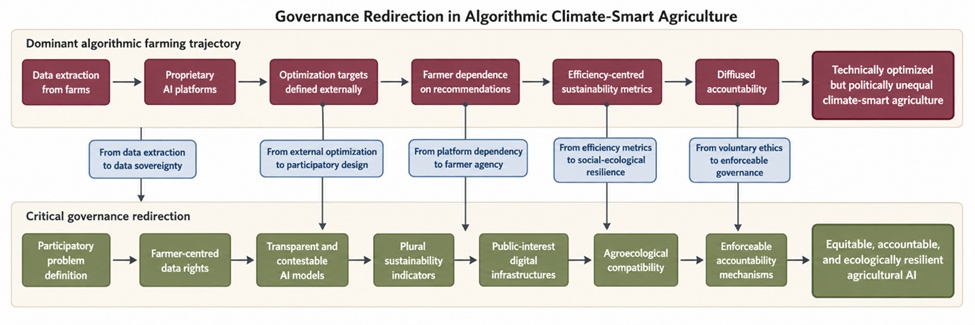
Figure 2. Redirecting Algorithmic Farming: A Critical Governance Agenda for Equity, Farmer Agency, Data Sovereignty, and Ecological Resilience
This review has argued that algorithmic farming is not a neutral technical evolution of climate-smart agriculture. AI systems shape what is measured, what is optimised, what is ignored, and who gains authority over agricultural decision-making. The politics of optimization is therefore central to understanding the future of farming under climate change.
The review shows that productivity, efficiency, and sustainability do not automatically align when mediated by algorithmic systems. AI can support better decisions, but it can also intensify productivist assumptions, narrow sustainability to measurable efficiency, and shift power from farmers toward platforms, firms, and expert infrastructures. These risks are especially important where digital agriculture is promoted as a universal solution without sufficient attention to equity, agency, and governance.
A more critical, interdisciplinary, and justice-oriented approach is needed. Researchers, policymakers, practitioners, and technology developers must engage directly with the politics of algorithmic farming rather than treating optimization as a purely technical matter. The future of AI in climate-smart agriculture should be judged not only by productivity gains, but by whether it supports democratic control, farmer sovereignty, ecological resilience, and equitable agricultural transformation.
None
None
None
None
Open Access The author(s) retain copyright. This article is licensed under the Creative Commons Attribution-NonCommercial-ShareAlike 4.0 International License. It may be shared and adapted for non-commercial purposes with appropriate attribution, an indication of changes, and distribution of adaptations under the same license. Third-party material may be subject to separate terms identified in its credit line. View the license at https://creativecommons.org/licenses/by-nc-sa/4.0/.
 Agro Intelligence Research Press