Machine learning is increasingly applied across agri-food systems to support prediction, classification, optimisation, monitoring, and decision-making. These applications now extend from farm-level production to processing, logistics, consumption, and food-waste management. As data-intensive agriculture expands, machine learning is often presented as an enabling technology for sustainable agri-food transitions. Despite this promise, the sustainability evidence base remains fragmented. Many studies report improvements in model accuracy, prediction performance, or operational decision support, but they do not always specify how these technical gains translate into environmental, economic, or social outcomes. This creates uncertainty about whether machine learning contributes to sustainability transitions directly, indirectly, or only under particular implementation conditions. This systematic review examines how machine learning contributes to sustainable agri-food transitions through environmental, economic, and social impact pathways. It focuses on the relationship between machine learning methods, agri-food applications, and sustainability-relevant outcomes rather than treating model performance as an end in itself. The review asks where evidence is strongest, where it remains indirect, and how different pathways vary across production, processing, distribution, consumption, waste reduction, and governance. The review finds that environmental and economic pathways are more developed than social and equity pathways. Evidence is strongest where machine learning supports precision input management, yield forecasting, irrigation decision support, operational efficiency, supply-chain analytics, and food-waste reduction. However, stronger longitudinal evaluation, causal assessment, life-cycle integration, participatory design, and equity-sensitive governance are needed before machine learning can be judged as a reliable driver of sustainable agri-food transitions.
Machine learning has become increasingly embedded in data-driven agriculture, where digital sensors, farm-management platforms, geospatial data, and connected equipment generate large and heterogeneous datasets. These infrastructures create the conditions for predictive analytics, monitoring, optimisation, and decision support across crop and livestock systems. Sustainable agri-food transitions therefore depend not only on algorithmic advances but also on data architectures that connect farm operations with environmental and organisational decision-making [1].
The agricultural machine learning literature now covers a wide range of applications, including crop monitoring, disease detection, yield prediction, soil and water management, robotics, livestock analytics, and farm decision support. This breadth indicates that machine learning is no longer a peripheral technical tool but a cross-cutting component of digital agriculture. A systematic sustainability review is needed because the same modelling techniques may support different environmental, economic, or social outcomes depending on context, data quality, and implementation design [2].
Deep learning has further expanded agricultural analytics by enabling image-rich and sensor-rich applications in plant detection, phenotyping, remote monitoring, and classification. These approaches are especially relevant to sustainability when they support earlier detection, more precise interventions, or improved monitoring of field conditions. However, technical performance alone is insufficient evidence of sustainability unless the pathway from prediction or classification to resource efficiency, resilience, or social benefit is made explicit [3].
The transition from smart farming toward Agriculture 5.0 places machine learning within a broader movement toward connected, adaptive, and human-centred agri-food systems. This transition framing requires attention to productivity, environmental stewardship, resilience, data governance, and stakeholder value rather than automation alone. Accordingly, this systematic review examines how machine learning contributes to sustainable agri-food transitions through environmental, economic, and social impact pathways, before synthesising evidence strengths, limitations, and future research needs [4].
The review scope covers peer-reviewed journal literature from 2017 to 2026 that links machine learning, artificial intelligence, predictive analytics, intelligent optimisation, or decision support to agriculture, food systems, or agri-food supply chains. It includes farm-level studies as well as post-harvest, logistics, demand, food-service, waste, and governance applications where sustainability relevance can be identified. This broader agri-food boundary is necessary because machine learning can influence sustainability not only through production efficiency but also through supply-chain performance and food-system coordination [5].
The review focuses on environmental, economic, and social impact pathways rather than technical model performance alone. Eligible studies were considered relevant when they provided enough information to classify the machine learning approach, the agri-food context, and at least one sustainability-related pathway. This classification logic reflects prior agricultural machine learning reviews that show the need to organise evidence by method, application domain, data type, and decision function rather than by algorithmic category alone [6].
The review is guided by four research questions. First, how is machine learning applied in agri-food sustainability contexts across production, supply chains, consumption, and waste reduction. Second, what environmental, economic, and social pathways are reported or implied; third, where is evidence strongest or weakest; and fourth, what research gaps remain for evaluating machine learning as a driver of sustainable agri-food transitions. These questions align with recent sustainable-agriculture machine learning reviews that call for stronger links between technical applications and sustainability outcomes [7]. Figure 1 presents the review’s pathway-based analytical framework, showing how machine learning functions connect with agri-food application domains and translate into environmental, economic, social, and governance-mediated sustainability outcomes.
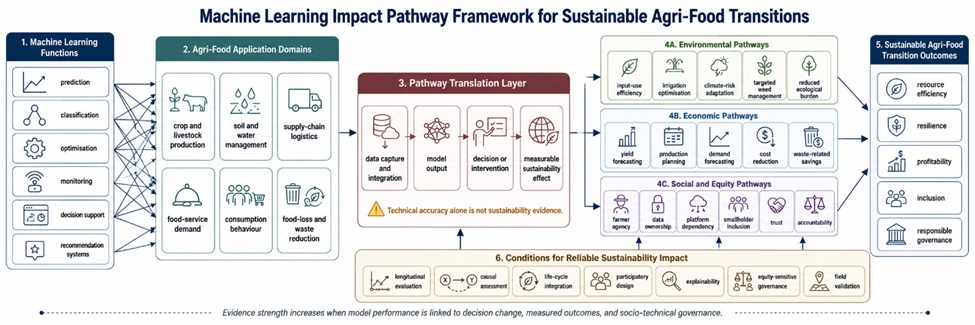
Figure 1. Machine Learning Impact Pathway Framework for Sustainable Agri-Food Transitions
The search strategy targeted peer-reviewed journal articles published between 2017 and 2026 that connected machine learning with sustainability-relevant agri-food systems. Search concepts included machine learning, artificial intelligence, precision agriculture, sustainable agriculture, climate-smart agriculture, food systems, agri-food supply chains, resource efficiency, food waste, smallholders, equity, and sustainability transitions. Yield-prediction studies were retained as a core search stratum because systematic evidence shows that crop-yield modelling is one of the most mature agricultural machine learning application areas and can support planning, productivity management, and environmental decision support when connected to sustainability pathways [8].
Eligibility screening required each study to meet four conditions: publication as a peer-reviewed journal article, inclusion within the 2017–2026 window, availability of DOI information, and clear relevance to machine learning or artificial intelligence in an agri-food context. Studies were excluded when they were conference papers, preprints, books, reports, theses, websites, generic machine learning papers without agri-food relevance, or agriculture papers without identifiable machine learning or sustainability relevance. Screening also considered data availability and implementation credibility because agricultural big-data studies show that data quality, interoperability, and deployment constraints affect whether machine learning claims can be translated into practical sustainability outcomes [9].
The final corpus was classified by machine learning method, agri-food context, sustainability dimension, evidence type, and reported impact pathway. The classification separated production-focused applications from supply-chain, food-service, waste, and governance studies, while also distinguishing environmental, economic, social, and cross-dimensional claims. AI-driven crop-production studies were included where they linked intelligent technologies to sustainable crop monitoring, soil and water management, disease detection, input optimisation, or related production decisions [10].
The study-selection logic was designed to avoid treating all machine learning performance claims as sustainability evidence. Instead, studies were retained only when a plausible and specific pathway could be identified between the method, the agri-food application, and an environmental, economic, or social outcome. Agri-food supply-chain studies were included because machine learning can influence sustainability through forecasting, logistics, demand planning, resilience, and post-harvest performance rather than farm production alone [11]. Table 1 summarises the study inclusion criteria, classification variables, and evidence structuring approach used in this review.
Table 1. Study Inclusion Criteria and Evidence Classification Framework for Machine Learning Applications in Sustainable Agri-Food Systems
Framework element | Specification used in this systematic review | Purpose for evidence integrity |
Time window | 2017–2026 | Captures recent machine learning and AI applications relevant to digital agri-food transitions. |
Publication type | Peer-reviewed journal articles only | Excludes reports, theses, websites, books, conference papers, preprints, and non-peer-reviewed material. |
Mandatory metadata | DOI required for every included article | Ensures traceability and formal scholarly publication status. |
Core thematic focus | Machine learning and AI applications linked to agriculture, food systems, agri-food supply chains, and sustainability outcomes | Ensures relevance to both technological and sustainability dimensions. |
Inclusion criteria | Studies linking ML, AI, predictive analytics, intelligent optimisation, or decision support to agriculture, food systems, agri-food supply chains, food waste, food security, or sustainability outcomes | Ensures every included article is relevant to both machine learning and agri-food sustainability. |
Exclusion criteria | Generic ML papers, agriculture papers without ML relevance, sustainability papers without ML relevance, non-journal outputs, studies outside the time window, and sources lacking DOI information | Prevents weak-fit references and unsupported sustainability claims. |
Classification variables | ML or AI method; agri-food context; sustainability dimension; evidence type; environmental, economic, social, or cross-dimensional pathway; evidence limitation | Enables comparison of pathways and identification of gaps. |
Final corpus | 31 peer-reviewed journal articles | Provides the fixed evidence base used throughout the manuscript. |
Evidence structuring approach | Classification based on method, application domain, and sustainability pathway rather than algorithm type alone | Supports systematic synthesis and cross-study comparison. |
Machine learning contributes to environmental sustainability most clearly where it supports precision input management. Studies on crop-yield prediction and nitrogen-status estimation show that machine learning can help infer crop condition and nutrient needs from data streams that would be difficult to interpret manually [12]. The environmental pathway is therefore not simply prediction, but the possibility of using prediction to reduce excessive fertiliser application, improve input timing, and support more site-specific nutrient decisions.
Water management represents another direct environmental pathway because irrigation decisions affect resource use, energy demand, and crop resilience. Machine-learning-enabled smart irrigation systems can combine sensor data, open-source technologies, and decision rules to support more responsive irrigation scheduling [13]. The sustainability claim is strongest when such systems are linked to water-saving decisions, although many studies still infer environmental benefit from improved control rather than measuring whole-system water footprints.
Climate adaptation is a third pathway, especially where machine learning connects yield modelling with climate-change impact assessment. By modelling crop responses under variable climatic conditions, machine learning can support planning for climate risk, production instability, and adaptive management [14]. However, the environmental evidence remains partly indirect when model performance is reported without subsequent assessment of adaptation outcomes, emissions implications, or resilience gains at farm or regional scale.
Precision weed management illustrates how artificial intelligence can support targeted intervention rather than uniform field treatment. Low-cost AI tools for weed detection and management can help distinguish where interventions are needed, creating a plausible route to reduced herbicide use, lower labour intensity, and improved operational efficiency [15]. The environmental pathway is credible, but it still requires field-level validation showing that targeted AI decisions consistently reduce chemical inputs and ecological burdens without shifting costs or risks elsewhere.
Economic sustainability pathways are most visible in yield forecasting, where machine learning can support production planning, input purchasing, marketing decisions, and farm-risk management. Deep neural networks for crop-yield prediction show how high-dimensional data can be used to improve estimates of expected production [16]. The economic claim is strongest when yield prediction informs decisions that affect profitability, but weaker when studies report predictive accuracy without measuring decision quality or financial outcomes.
Temporal deep-learning approaches extend this pathway by integrating spatial and sequential information into crop-yield prediction. CNN-RNN frameworks can support risk-oriented planning by capturing patterns across weather, soil, management, and time-dependent crop development [17]. These models may improve economic resilience by reducing uncertainty, although their value depends on whether forecasts are interpretable, timely, and usable by farmers, advisers, insurers, or supply-chain actors.
Food-service demand forecasting provides a more operationally direct economic pathway because inaccurate demand estimates can lead to overproduction, avoidable costs, and waste. Machine learning models for short-term demand forecasting in catering services connect prediction with resource allocation and food-waste reduction, making the sustainability pathway more tangible than in many farm-level prediction studies [18]. This evidence suggests that machine learning can improve economic and environmental performance simultaneously when decisions are closely coupled to forecast outputs.
Behavioural prediction and recommender systems extend economic pathways from production and operations into policy and consumption-facing interventions. Machine learning approaches to food-waste behaviour prediction can support targeted policy recommendations, helping decision-makers identify where intervention may reduce waste and associated costs [19]. Nevertheless, economic benefits remain difficult to generalise unless studies evaluate whether recommendations change behaviour, reduce losses, and deliver measurable savings across diverse food-system contexts.
Social sustainability pathways are less developed than environmental and economic pathways, but they are central to whether machine learning supports inclusive agri-food transitions. Social-science work on digital agriculture shows that smart farming and Agriculture 4.0 can reshape advisory systems, labour roles, skills, value-chain relations, and innovation networks [20]. These changes mean that machine learning should be assessed not only by technical effectiveness but also by how it redistributes decision authority, knowledge, and benefits.
Agricultural big-data analytics raises particular concerns about power, ownership, dependency, and control. When farm data are collected, processed, and monetised through digital platforms, machine learning can create asymmetries between farmers, technology providers, processors, retailers, and other value-chain actors [21]. The social pathway is therefore ambivalent: machine learning may support better decisions, but it may also deepen dependency if data governance, transparency, and bargaining power are not addressed.
The social and ethical impacts of agricultural AI include fairness, accountability, transparency, privacy, explainability, responsibility, and trust. Literature mapping of agricultural AI shows that these issues are not peripheral but integral to how AI systems affect farmers, consumers, workers, and institutions [22]. For sustainable agri-food transitions, social impact assessment should therefore examine who benefits, who bears risk, who can contest algorithmic decisions, and who has meaningful participation in system design.
Smallholder inclusion is a particularly important equity pathway because the benefits of digital agriculture depend on affordability, connectivity, skills, institutional support, and trust. Reviews of sustainable digital agriculture for smallholder farmers show that uneven infrastructure and capability can limit adoption and reinforce existing inequalities if digital tools are not designed for low-resource contexts [23]. Table 2 compares environmental, economic, and social impact pathways through which machine learning may support sustainable agri-food transitions.
Table 2. Machine Learning Impact Pathways for Sustainable Agri-Food Transitions: Environmental, Economic, and Social Dimensions, Evidence Types, and Reported Outcomes
Sustainability dimension |
Environmental |
Environmental |
Environmental |
Environmental and economic |
Economic |
Economic and environmental |
Economic, social, and environmental |
Social |
Social and equity |
Social and equity |
Across the reviewed corpus, precision agriculture provides the strongest cross-dimensional evidence base because it links sensing, prediction, classification, and decision support to practical farm-management tasks. Comprehensive reviews of machine learning for precision agriculture show that applications often combine environmental and economic pathways, such as input targeting, yield management, disease detection, irrigation decisions, and operational efficiency [24]. However, even in this mature area, sustainability evidence often remains closer to technical feasibility than to measured transition impact.
The synthesis also shows that machine learning can generate risks and externalities when agricultural AI is evaluated only through performance metrics. Responsible AI research in agriculture emphasises that sustainability claims must include systemic risks, unintended consequences, governance failures, and distributional effects [25]. This is especially important because an algorithm that improves prediction may still worsen dependency, exclude low-resource users, increase energy demand, or intensify production in ways that conflict with sustainability goals.
The evidence base is strongest when agri-food systems are treated as integrated chains rather than isolated production sites. Digitalization across the agri-food chain can connect production, processing, logistics, retail, consumption, and waste, enabling machine learning to support coordination across multiple sustainability leverage points [26]. At the same time, integration increases complexity because benefits in one part of the system may create trade-offs elsewhere, such as efficiency gains that depend on more intensive data extraction or infrastructure investment.
Responsible design and deployability are recurring conditions for turning machine learning into sustainability impact. Multi-criteria responsible AI approaches show that technical accuracy should be evaluated alongside human, ecological, social, and governance criteria, while edge AI research highlights how local inference may reduce latency, connectivity dependence, and resource burdens in agricultural settings [27, 28]. Table 3 synthesises the evidence base by linking machine learning methods, agri-food applications, sustainability outcomes, and evidence gaps.
Table 3. Evidence Synthesis Matrix for Machine Learning in Sustainable Agri-Food Transitions: Methods, Applications, Sustainability Outcomes, Evidence Strengths, and Research Gaps
ML or AI method category |
Supervised learning and regression |
Deep learning |
CNN-RNN and temporal models |
IoT-enabled ML systems |
AI-based detection systems |
Demand forecasting models |
Recommender and behavioural prediction systems |
Digital agriculture and advisory systems |
Responsible AI and governance approaches |
Edge AI |
A major research gap is the limited integration of ecological knowledge and human involvement into machine learning design for sustainable agriculture. Deep learning can identify patterns in complex agricultural data, but sustainable use requires ecological context, farmer knowledge, and human judgement to guide interpretation and implementation [29]. Future studies should therefore combine model development with participatory design, ecological validation, and decision-impact assessment rather than treating algorithmic accuracy as a sufficient outcome.
Responsibility and trust remain underdeveloped in agricultural AI and food-system technology research. Work on responsible AI in agriculture and food systems shows that accountability is difficult to assign when developers, platform providers, farmers, advisers, regulators, and supply-chain actors all shape system outcomes [30]. Future research should clarify who is responsible for data quality, model error, biased recommendations, failed interventions, and unintended sustainability trade-offs.
Food-loss and food-waste reduction is another important future direction because it links environmental, economic, and social sustainability across the agri-food chain. Machine learning solutions for sustainable farming and food-waste minimisation suggest opportunities for prediction, monitoring, storage management, logistics, and intervention targeting [31]. However, future work should move beyond proof-of-concept models toward field-validated systems that quantify waste reduction, cost savings, environmental benefits, and adoption barriers.
Across all pathways, the key research need is to move from technical performance metrics toward evidence of real transition effects. Future systematic studies should integrate life-cycle assessment, longitudinal field validation, causal evaluation, equity analysis, explainability, and governance assessment into machine learning research. This would allow agri-food machine learning to be evaluated not only as a predictive technology but as a socio-technical intervention with measurable sustainability consequences.
This systematic review synthesized journal articles on machine learning for sustainable agri-food transitions across environmental, economic, and social impact pathways. The review showed that machine learning is applied across production, supply chains, food-service operations, waste reduction, and governance contexts. It also showed that sustainability evidence varies substantially by pathway, application domain, and type of outcome assessed.
Machine learning can support sustainability when it improves input targeting, irrigation decisions, climate-risk anticipation, yield forecasting, demand planning, food-waste reduction, and decision support. Yet these contributions should not be assumed from predictive accuracy alone. Stronger evidence is needed to show whether machine learning produces measurable improvements in resource use, profitability, resilience, inclusion, accountability, and social benefit.
The future of machine learning in agri-food systems should be responsible, evidence-based, and impact-oriented. Researchers and practitioners need to connect algorithmic development with sustainability science, participatory governance, equity-sensitive design, and long-term evaluation. Only then can machine learning be assessed credibly as a contributor to sustainable agri-food transitions rather than merely as another layer of digital optimisation.
None
None
None
None
Open Access The author(s) retain copyright. This article is licensed under the Creative Commons Attribution-NonCommercial-ShareAlike 4.0 International License. It may be shared and adapted for non-commercial purposes with appropriate attribution, an indication of changes, and distribution of adaptations under the same license. Third-party material may be subject to separate terms identified in its credit line. View the license at https://creativecommons.org/licenses/by-nc-sa/4.0/.
 Agro Intelligence Research Press