Digital agriculture technologies are increasingly positioned as tools for strengthening food security through improved sensing, prediction, automation, decision support, and resource management. These technologies are promoted as ways to help agricultural systems respond to climate stress, resource constraints, production volatility, and disruptions across agri-food value chains. Their potential relevance extends from farm-level monitoring to broader food-system coordination. Evidence on digital agriculture is distributed across multiple technology domains, including artificial intelligence, Internet of Things systems, robotics, remote sensing, and decision-support platforms. Food-security implications are often reported indirectly through productivity, efficiency, sustainability, resilience, risk reduction, or decision-quality outcomes. This dispersion makes it difficult to judge where the evidence is strongest and where food-security claims remain underdeveloped. This umbrella review synthesises review-level evidence on digital agriculture technologies in relation to food-security pathways. It examines how the reviewed literature connects digital agriculture with food availability, access, utilisation, stability, resilience, sustainability, productivity, and agri-food decision-making. The article focuses on review evidence rather than primary empirical findings. The approach compares review-level evidence across technology domains, outcome pathways, implementation conditions, and evidence gaps. It gives particular attention to whether digital agriculture evidence demonstrates direct food-security relevance or supports more indirect pathways through resource efficiency, monitoring capacity, operational timeliness, or improved decision support. It also distinguishes technical potential from demonstrated system-level benefit. The contribution of this umbrella review is to clarify where digital agriculture evidence is most developed, where food-security links remain indirect, and what future research is needed to evaluate digital agriculture as a contributor to resilient and inclusive food systems. The synthesis shows that digital agriculture should be assessed not only by technical performance but also by its capacity to support equitable, sustainable, and context-sensitive food-security outcomes.
Food security is increasingly shaped by climate stress, land and water constraints, labour pressures, population growth, supply-chain disruption, and uneven access to agricultural innovation. Digital agriculture has emerged within this context as a broad sociotechnical transformation rather than a narrow collection of devices or software, because its effects depend on institutions, skills, business models, advisory systems, and data governance as well as technical capability [1]. Smart farming also depends on data flows, analytics, platforms, and governance arrangements that connect sensors, algorithms, decision tools, and farm operations [2]. These characteristics make digital agriculture relevant to food-security debates but also require careful evidence synthesis.
The review literature shows that digital agriculture now spans multiple research streams rather than a single technology field. Broad mapping of the digital agricultural revolution identifies diverse domains, including data infrastructures, automation, analytics, sensing, and platform-based services [3]. Review evidence also links digital agriculture with food-security and climate-related objectives through pathways such as productivity, resource efficiency, climate-risk mitigation, and sustainability [4]. This umbrella review therefore treats digital agriculture as a multi-domain evidence field whose food-security relevance must be assessed across technologies and outcomes.
A central challenge is that digital agriculture evidence is often organised by technology type rather than by food-security pathway. AI reviews commonly emphasise prediction, classification, and optimisation, while IoT reviews focus on sensing, connectivity, and real-time monitoring; robotics reviews often foreground automation and labour substitution, and remote-sensing reviews address spatial monitoring and early warning. This distribution makes it difficult to compare whether technologies contribute mainly to availability, access, utilisation, stability, resilience, or sustainability. The sociotechnical and data-system perspectives developed in digital agriculture scholarship help frame this challenge because they show that technological capability alone is insufficient to explain food-system impact [1, 2].
The aim of this umbrella review is to synthesise review-level evidence on AI, IoT, robotics, remote sensing, and decision-support systems in relation to food-security outcomes and pathways. The article first frames food security as a digital agriculture challenge, then explains the umbrella review scope and evidence-source logic. It next compares evidence across AI, IoT, remote sensing, robotics, automation, and decision-support systems before integrating findings into a cross-technology synthesis and future research agenda. This structure follows the mapped breadth of digital agriculture research while keeping the analysis focused on food-security relevance [3, 4].
Figure 1 presents the umbrella-review logic used to connect digital agriculture technology domains with food-security pathways, implementation conditions, and responsible system-level outcomes.
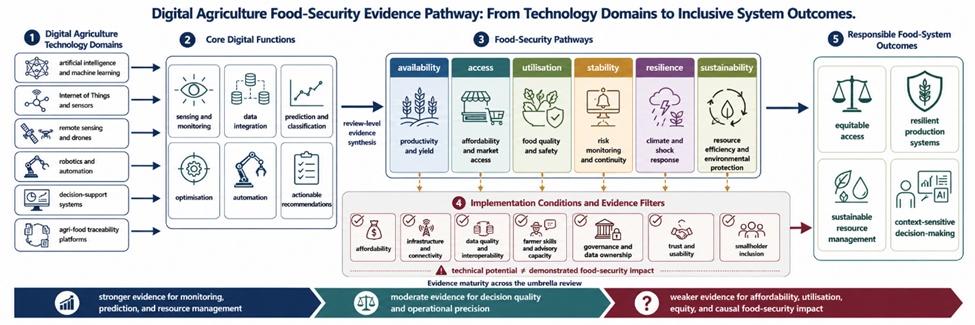
Figure 1. Digital Agriculture Food-Security Evidence Pathway: From Technology Domains to Inclusive System Outcomes
Food security in this review is understood through availability, access, utilisation, stability, resilience, and sustainability. Precision agriculture is especially relevant to availability because it targets productivity, input efficiency, and resource management in crop production systems [5]. Digital agriculture can also be linked to environmental sustainability when technologies support more efficient use of water, nutrients, land, energy, and other production resources [6]. However, the food-security relevance of these technologies depends on whether technical improvements translate into reliable, affordable, and context-appropriate benefits.
Digital agriculture may contribute to food security through improved production monitoring, climate adaptation, risk identification, post-harvest management, supply-chain visibility, and decision quality. For smallholder systems, review evidence emphasises that benefits depend on affordability, infrastructure, digital literacy, locally appropriate services, and inclusive digital ecosystems [7]. Adoption evidence further shows that agricultural technologies do not produce benefits automatically, because uptake is shaped by economic incentives, farm characteristics, institutional conditions, and perceived usefulness [8]. Food security should therefore be treated as an implementation-sensitive outcome rather than an assumed consequence of digital innovation.
The reviewed literature supports a cautious distinction between technical potential and food-security impact. Precision agriculture can improve the management of spatial variability, but food-security relevance depends on whether productivity and efficiency gains are accessible across diverse farming contexts [5]. Similarly, broad digital agriculture reviews connect digital tools with food-security and sustainability ambitions, yet they also imply that these benefits require enabling infrastructure, governance, and capacity-building [6]. An umbrella review must therefore evaluate not only what technologies can do but also where the review evidence demonstrates plausible pathways to food-system benefit.
Food security is also a socio-technical challenge because digital tools can reinforce inequalities when access, affordability, skills, and data power are unevenly distributed. Smallholder-oriented review evidence highlights the importance of locally meaningful services, farmer participation, and supportive institutional arrangements [7]. Adoption meta-analysis evidence reinforces this point by showing that technology uptake depends on multiple contextual factors rather than on technical merit alone [8]. For this reason, the manuscript interprets digital agriculture as a potential contributor to food security only when technology evidence is connected to equity, sustainability, resilience, and implementation conditions.
This umbrella review synthesises review-level evidence on digital agriculture technologies relevant to agriculture and agri-food systems. The scope includes AI, IoT, robotics, automation, remote sensing, sensors, decision-support systems, smart farming platforms, and integrated data-management approaches. Precision-agriculture review evidence helps classify technologies by sensing, data analysis, decision-making, and site-specific intervention functions [9]. Adoption review evidence is also included because real-world food-security relevance depends on whether technologies are usable, affordable, and implementable in agricultural contexts [10].
The evidence-source logic focuses on peer-reviewed review literature that clearly connects digital agriculture with agriculture, agri-food systems, or food-security-relevant outcomes. Big-data review evidence is central because it explains the analytical layer that connects digital sensing to prediction, optimisation, and management decisions [11]. Crop data-management review evidence is also important because digital agriculture depends on data pipelines, interoperability, storage, processing, and farm-level usability [12]. Together, these evidence sources allow the umbrella review to compare technologies not only by function but also by their role in wider digital agriculture systems.
The synthesis dimensions used in this article include technology domain, review type, agri-food context, food-security pathway, outcome category, implementation condition, and evidence limitation. This organisation prevents the review from treating all digital technologies as equivalent and helps distinguish direct food-security evidence from indirect productivity, efficiency, sustainability, or decision-quality evidence. It also supports comparison between technical reviews, adoption reviews, and data-system reviews, which often emphasise different aspects of the same digital transformation [9-12]. The result is a structured umbrella-review framework rather than a technology catalogue.
Eligibility logic was based on clear relevance to review-level digital agriculture evidence and to food-security-relevant pathways such as availability, access, utilisation, stability, resilience, and sustainability. Evidence was interpreted cautiously when a review supported a broader technology concept but did not directly evaluate food-security outcomes. This approach allowed the synthesis to include data, adoption, and precision-agriculture reviews while maintaining a food-security focus [9-12]. Table 1 summarises the umbrella review scope, evidence-source logic, eligibility criteria, and synthesis dimensions used to organise review-level evidence.
Table 1. Umbrella Review Scope and Evidence-Source Framework: Eligibility Logic, Review-Level Evidence Types, Digital Agriculture Domains, and Food-Security Mapping Dimensions
Framework element | Scope used in the umbrella review | Evidence-source logic | Food-security mapping function |
Review-level evidence focus | Peer-reviewed review literature on digital agriculture, precision agriculture, smart farming, data systems, adoption, and implementation | Prioritises synthesis articles that organise existing evidence rather than reporting new primary empirical data | Supports comparison across technology domains and avoids over-reliance on isolated technical findings |
Technology domains | AI, machine learning, IoT, sensors, robotics, automation, remote sensing, drones, DSS, digital advisory tools, and integrated smart-farming platforms | Includes technologies when they are clearly linked to agricultural production, agri-food systems, management, or decision-making | Maps each domain to availability, access, utilisation, stability, resilience, sustainability, or cross-dimensional outcomes |
Evidence types | Systematic reviews, meta-analyses, meta-reviews, evidence reviews, critical reviews, narrative reviews, survey reviews, and state-of-the-art reviews | Treats different review types as complementary but interprets conclusions according to their evidential strength and scope | Distinguishes stronger cross-review convergence from emerging, indirect, or context-dependent evidence |
Eligibility logic | Clear connection to digital agriculture and food-security-relevant outcomes, including productivity, resource efficiency, risk reduction, sustainability, resilience, or decision quality | Excludes sources that lack agriculture relevance, digital-technology relevance, review-level synthesis, or a clear food-security pathway | Ensures that food-security claims are based on plausible and clearly mapped evidence |
Synthesis dimensions | Technology function, agri-food context, evidence type, food-security pathway, implementation condition, limitation, and research gap | Allows evidence to be compared across domains rather than grouped only by technology label | Clarifies whether evidence supports direct food-security outcomes or indirect enabling conditions |
Interpretation rule | Technical performance is not treated as equivalent to food-security impact | Adoption, affordability, infrastructure, governance, and skills are considered alongside technology capability | Prevents overstatement and supports cautious umbrella-review conclusions |
Machine learning review evidence identifies agriculture as a major application domain for prediction, classification, detection, and optimisation tasks. The reviewed applications include yield prediction, disease detection, weed detection, animal production, soil management, crop quality assessment, and farm-management support [13]. This evidence is strongest when AI tools are used to interpret structured image, sensor, weather, soil, or production data for specific agronomic decisions. Its food-security relevance is most direct for availability and sustainability when prediction or detection improves production management.
Updated machine-learning review evidence shows that AI applications have expanded across crop, livestock, environmental, and operational contexts, but it also highlights persistent limitations in data availability, validation, transferability, and deployment readiness [14]. These limitations matter because food-security claims require more than successful model performance in controlled datasets. A model that detects disease, predicts yield, or classifies stress may support food availability only when it can be integrated into timely, trusted, and affordable farm decisions. The umbrella evidence therefore supports cautious interpretation: AI is a strong enabling technology, but its food-security contribution is mediated by context, data quality, and implementation.
IoT review evidence shows how connected sensors, devices, and communication systems can support agricultural monitoring and management across soil, water, climate, crop, livestock, and controlled-environment systems [15]. Systematic review evidence further indicates that IoT-based agriculture can enable real-time monitoring and management while facing challenges related to interoperability, cost, energy use, connectivity, data security, and scalability [16]. These findings connect IoT most clearly to availability, stability, resilience, and sustainability through improved situational awareness and resource management. However, the food-security value of IoT depends on whether data streams are converted into decisions that farmers and agri-food actors can actually use.
Remote-sensing meta-review evidence supports crop monitoring, yield forecasting, land-use assessment, vegetation analysis, and environmental-risk tracking across agricultural landscapes [17]. This evidence is especially relevant to stability and resilience because satellite and airborne monitoring can help identify drought stress, crop anomalies, land degradation, and production risks over large areas. Remote sensing also complements AI and IoT because spatial observations can be combined with ground data and models for more robust assessment. Table 2 compares review-level evidence on AI, IoT, and remote sensing in relation to food-security pathways.
Table 2. AI, IoT, and Remote Sensing Evidence for Food Security: Technology Functions, Review-Level Findings, Food-Security Pathways, and Evidence Limitations
Technology domain | Main technology functions | Review-level findings | Food-security pathways | Evidence limitations |
AI and machine learning | Prediction, classification, detection, optimisation, image analysis, risk analytics | Review evidence shows applications in yield prediction, crop and disease detection, weed detection, livestock monitoring, and farm management | Availability; Stability; Sustainability | Evidence often emphasises model performance more than field-level food-security outcomes |
Updated AI evidence | Multi-domain agricultural prediction and decision analytics | Expanded applications are reported across agricultural systems, but data quality, transferability, and deployment remain persistent concerns | Availability; Resilience; Sustainability | Many applications require stronger validation across crops, regions, farm sizes, and management contexts |
IoT and sensors | Real-time soil, water, climate, crop, livestock, and infrastructure monitoring | IoT supports continuous monitoring and can enable more responsive management decisions | Availability; Stability; Sustainability | Cost, connectivity, interoperability, energy, maintenance, and cybersecurity can restrict implementation |
Connected smart-farming systems | Sensor integration, communication networks, cloud platforms, automated alerts | Review evidence links IoT with smart farming and resource management but highlights scaling barriers | Availability; Resilience; Sustainability | Food-security effects are often indirect and depend on advisory capacity and decision uptake |
Remote sensing | Satellite monitoring, vegetation assessment, crop mapping, yield forecasting, drought and land-use monitoring | Meta-review evidence supports large-scale agricultural monitoring and environmental-risk assessment | Availability; Stability; Resilience; Sustainability | Ground validation, cloud cover, spatial resolution, and translation into local action remain important constraints |
Cross-technology integration | AI models using IoT and remote-sensing data | Integrated systems can improve monitoring, prediction, and decision support across scales | Cross-dimensional | Integration requires interoperable data systems, governance, skills, and locally useful decision interfaces |
Agricultural robotics review evidence positions autonomous machines as part of digital farming systems that can support labour substitution, precision operations, monitoring, and data collection [18]. This evidence is particularly relevant in contexts where labour availability, timeliness, safety, or repetitive tasks limit production reliability. Robotics may contribute to food availability when automated operations improve planting, weeding, spraying, harvesting, or monitoring at the right time. However, the evidence also implies that robotics should be assessed as part of broader digital farming systems rather than as isolated machines.
Field-robotics review evidence maps robotic platforms and operations for crop production tasks, including field navigation, weeding, spraying, monitoring, and harvesting support [19]. These applications can contribute to sustainability when they reduce unnecessary chemical use, improve operational precision, or support targeted intervention. They may also support resilience by reducing dependency on scarce labour for time-sensitive agricultural operations. Yet the review-level evidence remains more developed for technological capability than for direct food-security impact.
Economic review evidence shows that the viability of robots and automation in field crop production depends on cost structures, scale, labour conditions, ownership models, farm systems, and expected returns [20]. This matters for food security because a technology that is technically effective but economically inaccessible may widen gaps between farms rather than improve access or resilience. Robotics can support productivity and sustainability only when deployment models are financially and operationally realistic. The food-security pathway is therefore mediated by affordability, service provision, maintenance capacity, and institutional support.
State-of-the-art robotics review evidence highlights advances in perception, navigation, manipulation, control, and autonomous operation, while also identifying challenges related to safety, robustness, environmental variability, and system integration [21]. These constraints are central to umbrella-review interpretation because food-security benefits require reliable operation under diverse farm conditions. Across robotics reviews, the strongest evidence concerns task automation and technical feasibility, while broader claims about food availability, access, or resilience require more cautious wording [18-21]. Robotics should therefore be interpreted as a promising but unevenly deployable contributor to digital agriculture for food security.
Decision-support review evidence shows that DSS can translate data into actionable management for sustainable intensification, especially when they support decisions about inputs, timing, risk, and resource allocation [22]. This places DSS at the interface between digital data and food-security outcomes because information must influence decisions before it can affect productivity, sustainability, or resilience. Survey review evidence on agriculture 4.0 further shows that DSS span planning, monitoring, resource management, and risk-oriented decisions [23]. Their contribution is therefore not simply computational but organisational, advisory, and behavioural.
Decision-support evidence extends beyond farm-level management into agri-food value chains. Survey review evidence on agri-food 4.0 shows that digital technologies can influence supply-chain coordination, traceability, responsiveness, and information exchange across production, processing, distribution, and market systems [24]. Blockchain review evidence suggests that traceability technologies may support transparency and trust in agriculture and food supply chains, while implementation and governance constraints remain significant [25]. These findings connect DSS and digital platforms to food access, stability, sustainability, and risk reduction, but they do not justify assuming automatic improvements in affordability or nutrition.
The relationship between DSS evidence and food-security outcomes is strongest where decision tools support concrete management choices such as irrigation, fertilisation, pest control, planting, harvesting, storage, logistics, or climate-risk management. Review evidence on DSS for sustainable intensification supports the idea that decision tools can improve management quality when they are usable and aligned with farmer needs [22]. Agriculture 4.0 DSS evidence adds that integration, usability, data quality, and system complexity remain major challenges [23]. Thus, DSS should be evaluated by their influence on decisions and outcomes, not by the presence of digital dashboards alone.
Across farm and value-chain contexts, decision-support evidence highlights the importance of translating data into timely, trusted, and actionable recommendations. Agri-food 4.0 and traceability reviews show that digital systems can support coordination and transparency, but their food-security contribution depends on governance, interoperability, adoption, and equitable access [24, 25]. The umbrella evidence therefore links DSS most clearly to decision quality, risk reduction, supply-chain stability, and sustainability rather than to guaranteed food-security improvements. Table 3 maps robotics, automation, and decision-support evidence against food-security outcomes and implementation conditions.
Table 3. Robotics, Automation, and Decision-Support Evidence for Food Security: Application Areas, Outcome Pathways, Implementation Conditions, and Review-Level Uncertainties
Evidence domain | Application areas | Food-security outcome pathways | Implementation conditions | Review-level uncertainties |
Agricultural robotics | Planting, weeding, spraying, monitoring, harvesting, phenotyping, livestock and controlled-environment tasks | Availability through timely operations; Sustainability through precision intervention; Resilience through labour substitution | Capital access, service models, maintenance, technical support, farm scale, safety regulation | Stronger evidence for technical feasibility than for system-level food-security outcomes |
Field automation | Autonomous platforms, robotic implements, sensing-enabled machinery, targeted field operations | Availability and sustainability through operational precision and reduced losses | Field variability, navigation robustness, energy supply, training, repair capacity | Limited evidence on affordability and suitability for small and diverse farms |
Robotics economics | Cost-benefit assessment, labour substitution, ownership models, return on investment | Access and availability depend on affordability and viable deployment models | Farm size, labour markets, cooperative ownership, contractor services, policy incentives | Economic benefits may be unevenly distributed |
Farm DSS | Irrigation, fertilisation, pest control, planting, harvesting, risk alerts, resource allocation | Availability, Sustainability, Stability, Resilience | Data quality, usability, advisory support, farmer trust, local calibration | Decision uptake is often less evaluated than tool design |
Agri-food DSS and platforms | Supply-chain coordination, storage, logistics, traceability, market information, food-system monitoring | Access, Stability, Sustainability, risk reduction | Interoperability, governance, institutional capacity, value-chain participation | Food-access and affordability impacts remain indirect in many reviews |
Traceability systems | Blockchain and related digital ledgers for food-chain transparency | Stability and access through trust, information integrity, and accountability | Standards, governance, cost, digital infrastructure, stakeholder incentives | Evidence often focuses on potential rather than measured food-security outcomes |
Across review-level evidence, the strongest convergence appears around monitoring, prediction, resource management, and decision-support functions. Reviews integrating IoT, big data, and AI show that these technologies increasingly operate together across agriculture and food-industry systems rather than as separate tools [26]. AI application reviews support broad potential across agricultural functions, but they also require careful distinction between possible applications and proven food-security outcomes [27]. The umbrella synthesis therefore identifies digital agriculture as an enabling evidence field whose food-security value depends on how technology functions connect to real decisions and outcomes.
Sustainability-oriented AI review evidence shows promising links between artificial intelligence and more sustainable agricultural management, but it also indicates uneven evidence across contexts and outcomes [28]. IoT-based sustainable agriculture review evidence similarly connects monitoring and automation with resource efficiency, but implementation conditions remain important [29]. These findings suggest that sustainability is one of the more visible food-security pathways in digital agriculture reviews. However, direct evidence on access, utilisation, affordability, and distributional outcomes is less consistently developed.
AI and agri-food industry review evidence broadens the synthesis beyond farm production by showing that AI can influence processing, logistics, quality control, supply-chain decisions, and value-chain coordination [30]. This broader lens is important because food security depends not only on producing more food but also on maintaining stable, safe, affordable, and responsive food systems. When combined with AI, IoT, remote sensing, robotics, and DSS evidence, the review literature points toward a layered digital agriculture system: sensing generates data, analytics interpret it, automation acts on it, and decision support translates it into choices. The weakness is that many reviews still evaluate these layers separately rather than assessing integrated food-security outcomes.
Overall, the umbrella evidence supports a nuanced conclusion: digital agriculture has plausible food-security pathways, but the strength of evidence varies by technology, context, and outcome. Monitoring and prediction pathways are relatively well developed, while equity, affordability, utilisation, and causal food-security impacts remain less mature in the review literature [26-30]. Cross-cutting issues include data quality, interoperability, access, scalability, environmental trade-offs, user trust, governance, and smallholder inclusion. Table 4 synthesises the cross-review evidence on digital agriculture technologies, food-security pathways, evidence strength, and future research priorities.
Table 4. Umbrella Synthesis of Digital Agriculture for Food Security: Cross-Technology Evidence Patterns, Food-Security Pathways, Evidence Strengths, Evidence Gaps, and Future Research Priorities
Technology area | Main food-security pathways | Relative strength of review evidence | Key evidence gaps | Future research priorities |
AI and machine learning | Availability, Stability, Sustainability, Resilience | Stronger for prediction, detection, classification, and optimisation; weaker for direct food-security impact | Limited causal evaluation, weak transferability evidence, insufficient equity analysis | Validate AI tools across crops, regions, farm sizes, and food-security metrics |
IoT and sensor systems | Availability, Stability, Sustainability, Resilience | Strong for monitoring and resource-management potential; moderate for field-level outcome evidence | Cost, connectivity, interoperability, maintenance, energy and cybersecurity barriers | Study scalable IoT models for low-resource and smallholder contexts |
Remote sensing | Availability, Stability, Resilience, Sustainability | Strong for large-scale monitoring, crop mapping, and environmental-risk assessment | Translation of spatial intelligence into local decisions and food-security outcomes | Link remote-sensing indicators with early warning, advisory systems, and outcome evaluation |
Robotics and automation | Availability, Sustainability, Resilience | Strong for technical capability and task automation; weaker for inclusive deployment and food-security effects | Affordability, maintenance, safety, labour impacts, small-farm suitability | Evaluate service models, cooperative access, labour effects, and system-level productivity outcomes |
DSS and digital advisory systems | Availability, Stability, Sustainability, Access | Strong for decision-quality logic; moderate for demonstrated outcome pathways | Limited evidence on user trust, behaviour change, affordability, and long-term adoption | Measure how DSS changes decisions, resource use, risk management, and food-security outcomes |
Supply-chain and traceability tools | Access, Stability, Sustainability | Moderate for transparency and coordination potential; weaker for affordability and nutrition outcomes | Governance, standards, inclusion, costs, and distributional impacts | Connect traceability and platform evidence with access, affordability, safety, and resilience metrics |
Integrated digital agriculture | Cross-dimensional | Emerging cross-review convergence across sensing, analytics, automation, and decision support | Fragmented evaluation across technologies and scales | Build integrated assessment frameworks linking technology functions to food-security pathways |
Ethics-focused review evidence shows that smart farming raises unresolved questions about data ownership, privacy, power asymmetries, accountability, and fairness [31]. Responsible innovation review evidence adds that digital agriculture development should include stakeholder participation, socio-ethical assessment, and governance mechanisms rather than treating ethics as an afterthought [32]. These gaps are central to food security because inequitable data systems can concentrate benefits and risks unevenly across farmers, firms, and communities. Future research should therefore evaluate who controls digital agriculture systems, who benefits from them, and who may be excluded.
Review evidence on digitalisation and agricultural knowledge indicates that future research must address advisory capacity, knowledge co-production, farmer learning, and the changing role of agricultural expertise [33]. AI ethics and policy review evidence further points to the need for governance pathways that manage ethical risks while enabling socially beneficial deployment in agriculture [34]. These issues matter because food-security outcomes depend on trusted knowledge systems as much as on technical performance. Digital agriculture research should therefore integrate farmer experience, extension systems, policy design, and responsible AI governance.
Several evidence gaps cut across the reviewed literature, including limited longitudinal evaluation, weak causal evidence, insufficient equity analysis, and underdeveloped assessment in low-resource contexts. Smart-farming ethics and responsible innovation reviews show that fairness, participation, and governance should be assessed alongside technical capability [31, 32]. Knowledge-system and AI-policy reviews reinforce the need to evaluate digital tools through advisory capacity, user trust, institutional readiness, and public-interest outcomes [33, 34]. These gaps are especially important for food access, utilisation, affordability, and distributional resilience, which are less consistently measured than productivity or efficiency.
The future research agenda should connect digital agriculture more explicitly with food-security frameworks. Studies and reviews should compare technology options using common outcome metrics for availability, access, utilisation, stability, resilience, sustainability, affordability, and equity. Responsible innovation, data governance, and agricultural knowledge research should be integrated into technical evaluation so that digital agriculture is judged by its real contribution to resilient and inclusive food systems [31-34]. The next phase of evidence synthesis should move beyond whether digital tools work technically and ask whether they strengthen food security without widening existing inequalities.
This umbrella review synthesised review-level evidence on digital agriculture technologies for food security across AI, IoT, robotics, remote sensing, and decision-support systems. The synthesis shows that digital agriculture evidence is strongest where technologies improve monitoring, prediction, operational precision, resource management, and decision quality. These functions create plausible pathways to food-security outcomes, but they should not be treated as automatic evidence of improved food security.
AI, IoT, robotics, remote sensing, and decision-support systems can support food-security pathways when they are connected to availability, access, utilisation, stability, resilience, and sustainability outcomes. The reviewed evidence indicates that productivity, resource efficiency, risk monitoring, and management quality are more frequently addressed than affordability, nutrition, equity, and long-term resilience. This imbalance highlights the need for stronger outcome-oriented and context-sensitive evaluation.
Digital agriculture should be developed and assessed as a responsible, inclusive, and evidence-based component of food-system transformation. Its value for food security will depend on governance, affordability, infrastructure, knowledge systems, user trust, and equitable access. Future research and policy should ensure that digital agriculture strengthens resilient and sustainable food systems without deepening existing inequalities.
None
None
None
None
Open Access The author(s) retain copyright. This article is licensed under the Creative Commons Attribution-NonCommercial-ShareAlike 4.0 International License. It may be shared and adapted for non-commercial purposes with appropriate attribution, an indication of changes, and distribution of adaptations under the same license. Third-party material may be subject to separate terms identified in its credit line. View the license at https://creativecommons.org/licenses/by-nc-sa/4.0/.
 Agro Intelligence Research Press