Artificial intelligence is increasingly positioned as a driver of agri-food transformation through sensing, prediction, optimisation, automation, and decision support. Across farms, supply chains, advisory systems, and governance settings, AI-enabled tools are changing how agricultural information is gathered, interpreted, and translated into action. These changes create important opportunities, but they also raise deeper theoretical questions about what kind of intelligence agri-food systems should develop. Much discussion of agri-food AI emphasises productivity, efficiency, technical accuracy, and optimisation. Yet sustainable agri-food transformation cannot be judged only by whether AI increases yields, lowers costs, or accelerates decisions. It must also be evaluated by whether intelligent systems strengthen resilience, support equity, and respect ecological limits. This article develops a theory of sustainable intelligence in agri-food systems. Sustainable intelligence is defined as the AI-enabled capacity of agri-food systems to sense, interpret, learn from, and respond to changing conditions while balancing productivity, resilience, equity, and ecological care. The theory treats these four dimensions not as separate goals, but as interdependent constructs that must be continuously aligned. The article builds theory by integrating scholarship on digital agriculture, food-system sustainability, resilience thinking, equity, ecological responsibility, and responsible AI. It focuses on the mechanisms through which sensing, prediction, optimisation, feedback, participation, and governance can either mediate or intensify tensions among agri-food system goals. In doing so, it shifts attention from AI as a technical instrument to AI as a socio-technical balancing capacity. The proposed theory explains sustainable intelligence as an emergent property of data integration, adaptive feedback, participatory governance, ecological sensitivity, and accountability. It argues that AI-enabled agri-food systems become sustainable not when they maximise a single performance metric, but when they help actors recognise trade-offs, negotiate priorities, and preserve the conditions for just and ecologically responsible production. Sustainable intelligence therefore offers a theoretical foundation for agri-food futures that are productive, resilient, equitable, and ecologically caring.
AI-enabled agri-food systems increasingly depend on integrated sensing, data infrastructures, predictive analytics, decision support, automation, and platform-based coordination. Smart farming research shows that data-intensive agriculture reorganises how farms and value chains observe conditions, process information, and intervene in production processes [1]. This shift is not limited to individual technologies, because it changes the informational architecture through which agri-food decisions are made. The theoretical challenge is therefore to understand AI not only as a tool, but as a system-level capacity for shaping agri-food futures.
AI in agriculture is often framed through productivity, efficiency, optimisation, and competitiveness, especially where digital systems promise more precise use of land, labour, water, nutrients, and energy. Smart farming has been linked to sustainable agriculture when precision and monitoring are directed toward resource-sensitive management rather than yield expansion alone [2]. This distinction matters because productivity gains can either support sustainability or intensify extraction, depending on the goals embedded in the decision system. Sustainable agri-food transformation therefore requires evaluative criteria broader than technical performance.
Digital agriculture must also be theorised as a socio-technical transformation rather than a purely technical upgrade. Social science research on digital agriculture shows that smart farming, platformisation, data governance, advisory change, skills, power relations, and institutional arrangements shape how digital technologies are adopted and used [3]. These dynamics mean that AI-enabled agri-food systems cannot be understood only through algorithms or devices. They must be analysed through the relationships among technical capacities, social institutions, ecological contexts, and political-economic conditions.
The central gap addressed in this article is that productivity, resilience, equity, and ecological care are often discussed as separate objectives rather than as interdependent tensions requiring active balance. Agriculture 4.0 scholarship emphasises that digital transition pathways are diverse and that responsible management is needed to avoid narrow or exclusionary futures [4]. This article develops a theory of sustainable intelligence to explain how AI-enabled sensing, prediction, optimisation, feedback, participation, and governance can mediate tensions among competing agri-food goals. The argument proceeds by defining the theoretical foundations of sustainable intelligence, specifying its core constructs, analysing key tensions, identifying balancing mechanisms, and formulating research propositions.
The theoretical foundation of sustainable intelligence begins with the idea that digital agriculture can help design agricultural systems rather than merely optimise existing practices. Digital agriculture has been framed as a means of designing sustainable agricultural systems under biophysical, economic, and management constraints [5]. This design orientation shifts theory away from isolated tool adoption and toward the configuration of relationships among data, decisions, actors, and ecological conditions. Sustainable intelligence therefore starts from the premise that AI becomes meaningful when it helps agri-food systems choose among alternative futures, not simply when it predicts more accurately.
Resilience thinking adds a second foundation by directing attention to disturbance, uncertainty, adaptation, and transformation. Food-system resilience research defines resilience through the capacity of systems to maintain, recover, adapt, and reorient essential functions under shocks and stresses [6]. For agri-food AI, this means that intelligent systems should not only optimise performance under expected conditions. They should also help actors detect vulnerability, preserve adaptive options, and respond to climatic, biological, economic, and supply-chain disruption.
Responsible innovation provides a third foundation because AI-enabled agri-food transformation is shaped by values, participation, and accountability. Research on responsible innovation in smart farming argues that agricultural digitalisation raises questions about who is included, whose values are represented, and which futures are legitimised [7]. Sustainable intelligence therefore requires a normative account of how AI systems are imagined, designed, governed, and revised. Without such an account, digital agriculture can appear innovative while reinforcing unequal or ecologically harmful trajectories.
Socio-ethical governance is the fourth foundation because smart farming creates risks that are technical, institutional, and social at the same time. Work on socio-ethical challenges in smart farming shows that fragmented governance is insufficient for addressing responsibility, data control, actor inclusion, and practical consequences across agricultural contexts [8]. Sustainable intelligence therefore requires anticipatory governance capable of identifying trade-offs before they become locked into infrastructures. This establishes the need for a theory that links AI-enabled decision capacity to sustainability goals through feedback, participation, accountability, and contextual adaptation.
Sustainable intelligence is the AI-enabled capacity of agri-food systems to sense, interpret, learn from, and respond to changing conditions while balancing productivity, resilience, equity, and ecological care. Digital innovation scholarship in agriculture links sustainability and resilience, supporting the view that intelligent systems should be evaluated by their contribution to durable system performance rather than isolated efficiency [9]. In this theory, intelligence is not located only in algorithms or machines. It emerges from the alignment of data, models, human judgement, institutions, and ecological feedback.
Sustainable intelligence differs from technical intelligence because prediction accuracy, automation, and optimisation are necessary but insufficient. Machine-learning applications in agriculture show how heterogeneous data can be converted into actionable predictions across crop, livestock, soil, water, and management domains [10]. Yet predictions become sustainable only when they are interpreted within a balancing logic that considers who benefits, what risks are displaced, and which ecological processes are protected. The construct therefore separates the technical ability to infer from the socio-ecological capacity to guide responsible action.
The predictive layer of sustainable intelligence is expanded by deep learning, especially where agricultural systems generate visual, spatial, temporal, and sensor-based data that exceed manual observation. Deep-learning applications in agriculture demonstrate the capacity of AI to detect patterns in images and complex datasets, enabling new forms of crop monitoring, disease detection, and field interpretation [11]. However, the theory proposed here treats these capabilities as inputs into balancing processes, not as sufficient indicators of sustainability. A system may recognise patterns accurately and still fail to act sustainably if its objectives are narrow, its feedback is incomplete, or its governance excludes affected actors.
The four core constructs of sustainable intelligence are productivity intelligence, resilience intelligence, equity intelligence, and ecological-care intelligence. These constructs are connected by balancing mechanisms that include sensing, prediction, optimisation, feedback learning, participatory governance, and ecological constraint recognition. Updated research on machine learning in agriculture shows that AI applications span multiple management domains, supporting the claim that sustainable intelligence must operate across interconnected decisions rather than isolated tool functions [12]. Table 1 summarises the core theoretical constructs of sustainable intelligence in agri-food systems.
Table 1. Core Theoretical Constructs of Sustainable Intelligence in Agri-Food Systems: Productivity, Resilience, Equity, Ecological Care, Balancing Mechanisms, and Boundary Conditions
Construct | Definition within sustainable intelligence | Core agri-food question | AI-enabled contribution | Sustainability risk if isolated | Boundary condition |
Productivity intelligence | The capacity to improve output, quality, efficiency, and economic viability without reducing the system to yield maximisation. | How can food and agricultural outputs be improved without intensifying extractive production logics? | Yield prediction, input optimisation, labour support, automation, decision support, and operational planning. | Over-optimisation may narrow diversity, reduce redundancy, intensify input dependency, or privilege short-term returns. | Productivity gains must be evaluated against resilience, equity, and ecological-care outcomes. |
Resilience intelligence | The capacity to detect vulnerability, preserve adaptive options, and support recovery or reorientation under disturbance. | How can agri-food systems continue functioning under climatic, biological, economic, and supply-chain shocks? | Early-warning systems, risk modelling, scenario simulation, adaptive recommendations, and feedback learning. | Resilience may protect existing arrangements even when they are unjust or ecologically damaging. | Resilience must be normatively guided by sustainability, justice, and transformation goals. |
Equity intelligence | The capacity to recognise and reduce uneven access to data, infrastructure, skills, capital, benefits, and decision authority. | Who can access, shape, contest, and benefit from AI-enabled agri-food systems? | Participatory platforms, transparent decision support, inclusive advisory networks, and data-governance tools. | Digital systems may concentrate power, exclude smaller producers, or make farmers dependent on opaque platforms. | Equity requires distributive, procedural, and recognitional justice in design and governance. |
Ecological-care intelligence | The capacity to respect ecological limits and support soil health, biodiversity, water systems, climate stability, and resource cycles. | How can AI-enabled decisions protect ecosystem functions rather than merely reduce inputs? | Ecological monitoring, biodiversity-sensitive analytics, resource-cycle tracking, and context-aware recommendations. | Ecological processes may be simplified into narrow efficiency metrics or ignored when not easily measurable. | AI systems must include ecological feedback, local knowledge, and precaution where uncertainty is high. |
Balancing mechanisms | The processes that connect sensing, prediction, optimisation, feedback, participation, and governance across competing goals. | How can tensions among productivity, resilience, equity, and ecological care be made visible and negotiated? | Multi-objective optimisation, explainable decision support, adaptive feedback loops, and participatory governance. | Balancing may become symbolic if objectives, data, and accountability remain controlled by narrow interests. | Mechanisms must be transparent, contestable, context-sensitive, and linked to real decision authority. |
Boundary conditions | The contextual factors that determine whether AI supports or undermines sustainable intelligence. | Under what conditions does AI-enabled transformation become sustainable, exclusionary, fragile, or ecologically harmful? | Context modelling, governance design, uncertainty analysis, infrastructure assessment, and institutional learning. | Universal digital solutions may fail when social, ecological, and institutional contexts are ignored. | Sustainable intelligence depends on data quality, governance capacity, participation, ecological context, and accountability. |
Productivity intelligence in agri-food systems is primarily driven by AI-enabled prediction, automation, and optimisation of inputs and outputs. Precision agriculture research shows that digital technologies can increase yield efficiency, reduce input waste, and improve economic performance while lowering emissions intensity under certain conditions [13]. However, these productivity gains are not neutral in their systemic effects, because they reshape ecological interactions and production dependencies. Sustainable intelligence must therefore interpret productivity not as an isolated outcome but as a component within broader system stability.
Resilience intelligence introduces a different temporal and structural logic, focusing on the ability of agri-food systems to absorb shocks and maintain core functions. Food-system resilience research highlights that resilience includes persistence, adaptation, and transformation under disturbances such as climate volatility, market disruption, and biological stress [14]. When productivity-oriented AI systems optimise for short-term efficiency, they may reduce redundancy and diversity, weakening system adaptability. This creates a structural tension between efficiency-driven intelligence and resilience-preserving intelligence.
A further complication arises when resilience itself becomes a conservative force that protects undesirable system states. Research on undesirable resilience shows that systems can remain locked into unsustainable configurations even when they are stable and efficient in the short term [15]. In such cases, AI systems that optimise stability without normative guidance risk reinforcing harmful equilibria. Sustainable intelligence must therefore distinguish between adaptive resilience and lock-in resilience.
A theoretical synthesis emerges in which productivity and resilience are not opposing objectives but interacting dimensions of system intelligence. Sustainable intelligence requires AI systems that support efficient production while preserving ecological diversity, functional redundancy, and adaptive capacity under uncertainty. This balance cannot be achieved through optimisation alone but requires governance, feedback learning, and multi-objective evaluation embedded into system design.
Equity intelligence is a central dimension of sustainable intelligence because AI-enabled agri-food systems are shaped by uneven access to data, infrastructure, and decision-making power. Global analyses of data-driven farming reveal significant divides in who can access and benefit from digital agricultural technologies, particularly between regions, farm sizes, and institutional contexts [16]. These inequalities influence not only adoption but also the distribution of risks and benefits associated with AI-driven transformation. Sustainable intelligence must therefore incorporate equity as a structural property rather than an external ethical consideration.
Digital agriculture can reproduce or amplify inequalities when governance structures and platform architectures concentrate control over data and algorithms. Research on inequalities in digital agriculture shows that issues of power, access, and digital sovereignty shape how farmers engage with emerging technologies [17]. When AI systems are designed without attention to these dynamics, they risk reinforcing dependency and marginalisation. Equity intelligence therefore requires participatory design and governance mechanisms that redistribute informational and decision authority.
Ecological care extends sustainable intelligence beyond human-centered outcomes to include the health and integrity of ecological systems. Agroecological research emphasizes principles such as biodiversity, nutrient cycling, ecological synergies, and context-specific adaptation as foundations for sustainable food systems [18]. AI systems that ignore these principles may optimise production while degrading long-term ecological capacity. Sustainable intelligence must therefore embed ecological limits directly into its decision logic.
Digital technologies can also support ecological care when aligned with agroecological practices and observational needs. Research on digital agriculture and agroecology demonstrates that technological tools can enhance ecological understanding when used to support diversity-sensitive and context-aware management [19]. Table 2 explains how AI-enabled balancing mechanisms can mediate tensions among productivity, resilience, equity, and ecological care.
Table 2. AI-Enabled Balancing Mechanisms for Sustainable Intelligence: Data Functions, Decision Logics, Sustainability Trade-Offs, Governance Conditions, and Failure Risks
Mechanism | Data Function | Decision Logic | Sustainability Role | Potential Trade-Off | Governance Requirement |
Sensing systems | Continuous ecological and production monitoring | Real-time detection of variability and stress | Enables early identification of productivity and ecological risks | Over-reliance on measurable indicators may exclude tacit knowledge | Transparent data collection and contextual calibration |
Predictive analytics | Multi-source forecasting of yields, risks, and inputs | Probabilistic scenario anticipation | Supports proactive resilience and productivity planning | Model bias may reinforce dominant production regimes | Model accountability and validation across contexts |
Optimisation tools | Multi-variable input-output balancing | Efficiency maximisation under constraints | Reduces waste and improves resource efficiency | Can prioritise short-term gains over long-term stability | Multi-objective constraints including ecological thresholds |
Feedback systems | Continuous learning from outcomes | Adaptive adjustment of recommendations | Enhances resilience through learning loops | Feedback may be slow or distorted in unequal systems | Inclusive data feedback from diverse actors |
Participatory governance | Stakeholder-generated input and validation | Collective decision alignment | Improves equity and legitimacy of AI decisions | Risk of token participation without real influence | Shared decision authority and institutional support |
Explainable AI systems | Transparent model reasoning outputs | Interpretability of predictions and recommendations | Builds trust and supports accountability | Simplification may reduce predictive accuracy | Balance between interpretability and performance |
AI-enabled balancing mechanisms operate through the integration of sensing, prediction, optimisation, and governance functions across agri-food systems. Digital agricultural knowledge networks demonstrate that advisory systems increasingly connect farmers, experts, institutions, and platforms in continuous information exchange [20]. These networks create pathways through which AI outputs are interpreted, contested, and transformed into decisions. Sustainable intelligence depends on whether these pathways enable balanced or distorted decision-making.
Optimisation mechanisms in AI systems are particularly important because they directly influence how trade-offs between productivity and ecological outcomes are resolved. Research on AI applications for irrigation and agrochemical management shows that optimisation can reduce resource use while maintaining productivity when properly designed [21]. However, optimisation without constraint awareness may intensify environmental pressure or marginalise non-quantifiable values. Sustainable intelligence therefore requires multi-objective optimisation that incorporates ecological and social thresholds.
Decision-support systems provide another balancing mechanism by translating complex data into actionable choices under uncertainty. Agriculture 4.0 decision-support research highlights challenges in integrating heterogeneous data, aligning stakeholder goals, and managing uncertainty in real-world agricultural environments [22]. These systems become balancing tools only when they explicitly incorporate competing objectives rather than single-performance metrics. Otherwise, they risk simplifying complexity into narrow optimisation problems.
Remote sensing strengthens balancing capacity by providing continuous observational inputs that link ecological and production dynamics. Precision agriculture research shows that remote sensing technologies enable monitoring of crop conditions, soil variability, and environmental change at multiple scales [23]. This observational capacity is essential for adaptive feedback loops that connect AI predictions to real-world ecological conditions. Sustainable intelligence therefore depends on integrating sensing infrastructures with governance and decision systems capable of responding to ecological signals.
The proposed model of sustainable intelligence conceptualises agri-food systems as socio-technical-ecological configurations shaped by interacting intelligence dimensions. Digital agriculture futures research shows that competing policy narratives influence how technologies are developed and legitimised across governance scales [24]. These narratives shape whether AI systems prioritise productivity, sustainability, equity, or ecological care. Sustainable intelligence therefore emerges within contested futures rather than within neutral technological trajectories.
A central assumption of the model is that sustainability claims in agri-food systems are inherently political. Research on precision technologies and sustainability politics demonstrates that technological systems are embedded in power relations that shape whose interests are served and whose knowledge counts [25]. This implies that AI systems cannot be evaluated solely on technical performance. Their legitimacy depends on how they distribute benefits, risks, and decision authority.
The model integrates people, production, and planet as interconnected dimensions that must be jointly optimised rather than treated separately. Agriculture 4.0 research highlights the importance of aligning social, economic, and ecological objectives within digital transformation processes [26]. Sustainable intelligence is defined here as the capacity to maintain this alignment dynamically under changing conditions. It is not a fixed state but an evolving system property.
Figure 1 conceptualises sustainable intelligence as an AI-enabled socio-technical-ecological balancing capacity that links sensing, prediction, optimisation, feedback, participation, and governance to the continuous alignment of productivity, resilience, equity, and ecological care.
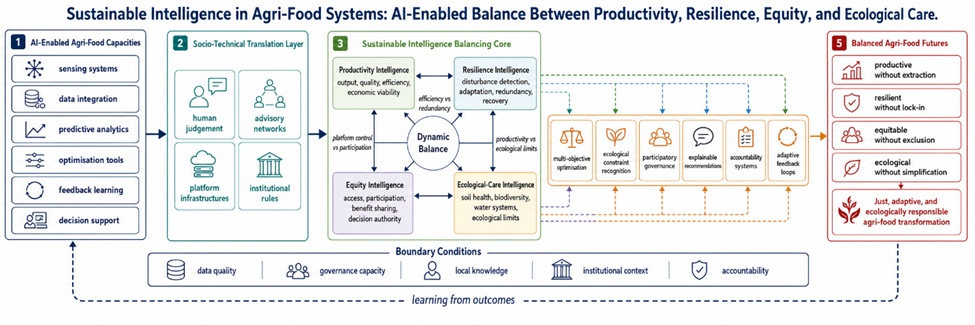
Figure 1. Sustainable Intelligence in Agri-Food Systems: AI-Enabled Balance Between Productivity, Resilience, Equity, and Ecological Care
Table 3 presents the proposed theoretical model of sustainable intelligence in agri-food systems.
Table 3. Proposed Theory of Sustainable Intelligence in Agri-Food Systems: Constructs, Relationships, Mechanisms, Boundary Conditions, and Research Propositions
Component | Description | Mechanism | Key Interaction | Risk if Misaligned | System Role |
Productivity intelligence | Enhances output efficiency and resource use | Prediction and optimisation | Interacts with resilience and ecological constraints | Over-extraction and ecological degradation | Performance enhancement |
Resilience intelligence | Maintains system function under disturbance | Adaptation and redundancy | Balances productivity and ecological stability | Lock-in of unsustainable systems | Stability and adaptability |
Equity intelligence | Ensures fair distribution of access and benefits | Participation and governance | Shapes legitimacy of all other constructs | Digital exclusion and power concentration | Justice and inclusion |
Ecological-care intelligence | Maintains ecological integrity and limits | Ecological feedback and constraints | Constrains productivity and informs resilience | Biodiversity loss and resource depletion | Ecological safeguarding |
Balancing mechanisms | Integrates competing objectives | Multi-objective optimisation and governance | Connects all intelligence constructs | Fragmented decision-making | System integration |
Feedback loops | Enable continuous learning | Data-driven adaptation | Link outcomes to future decisions | Reinforced bias and delayed correction | Adaptive learning |
Boundary conditions | Contextual constraints shaping system behaviour | Institutional and ecological context | Moderates all interactions | Universal solutions failing locally | Context sensitivity |
Sustainable intelligence suggests that AI-enabled agri-food systems are most effective when they integrate multi-objective evaluation across productivity, resilience, equity, and ecological care. Research indicates that digital agriculture can enhance sustainability when designed as a coordinated system rather than a collection of isolated tools [27]. This leads to the proposition that integrated governance and participatory design increase the likelihood of balanced outcomes. Future empirical work can test how different institutional arrangements influence this balance.
Another proposition concerns power and governance in digital agriculture systems. Research on the politics of digital agricultural technologies shows that data ownership, platform control, and institutional arrangements shape who benefits from digital transformation [28]. It follows that sustainable intelligence is more likely to emerge in contexts where governance structures distribute decision authority and ensure transparency. Empirical studies should examine how governance models affect equity and resilience outcomes.
A final proposition concerns the alignment between digitalisation and ecological transformation. Research on the interaction between digitalisation and ecologisation demonstrates that these processes can either reinforce or undermine each other depending on institutional and design choices [29]. Sustainable intelligence therefore depends on explicit alignment between technological systems and ecological principles. Future research should investigate conditions under which AI systems strengthen rather than weaken ecological regeneration.
This article developed a theory of sustainable intelligence in agri-food systems as an AI-enabled capacity to balance multiple sustainability dimensions. It argued that AI in agriculture should not be evaluated only through productivity, efficiency, or predictive accuracy, but through its ability to support systemic balance across productivity, resilience, equity, and ecological care. The theory positions AI as a socio-technical balancing infrastructure embedded in governance, ecology, and social relations.
Sustainable intelligence reframes agri-food transformation by emphasising that intelligence is not defined by optimisation alone but by the capacity to manage trade-offs under uncertainty. It highlights that agri-food systems are complex adaptive systems in which technological, ecological, and institutional dynamics are deeply intertwined. In this context, AI can either reinforce unsustainable trajectories or support more balanced and just forms of food production.
A forward-looking perspective suggests that sustainable intelligence offers a foundation for agri-food futures that are productive without being extractive, resilient without being exclusionary, and intelligent without losing ecological care.
None
None
None
None
Open Access The author(s) retain copyright. This article is licensed under the Creative Commons Attribution-NonCommercial-ShareAlike 4.0 International License. It may be shared and adapted for non-commercial purposes with appropriate attribution, an indication of changes, and distribution of adaptations under the same license. Third-party material may be subject to separate terms identified in its credit line. View the license at https://creativecommons.org/licenses/by-nc-sa/4.0/.
 Agro Intelligence Research Press