Artificial intelligence is increasingly embedded in agricultural decision support, farm platforms, automation, sensing, advisory systems, and data-driven management. These systems influence how farms interpret risk, allocate inputs, monitor environments, plan production, and respond to market and ecological uncertainty. As agricultural AI becomes more consequential, its governance must address not only technical performance but also the social conditions under which digital decisions are made, trusted, challenged, and revised. Agricultural AI governance is often framed around technical accuracy, transparency, regulatory compliance, or institutional oversight. While these are necessary, they are insufficient when farmers have limited influence over system design, data practices, model assumptions, recommendation logic, or dispute pathways. Governance weaknesses can produce exclusion, loss of autonomy, data misuse, algorithmic opacity, dependency on platforms, and digital decisions that affected users cannot meaningfully challenge. This article develops a participatory AI governance framework for agriculture centred on farmer voice, local knowledge integration, contestable digital decisions, and accountability safeguards. The framework treats governance as a socio-technical practice that connects design, deployment, monitoring, revision, and redress. It argues that responsible agricultural AI requires institutional mechanisms through which farmers and other affected actors can shape, interpret, evaluate, contest, and improve digital systems. The framework contributes to agricultural AI governance by showing how participation can strengthen legitimacy, trust, accountability, and contextual fit. It positions farmer voice as a condition of decision legitimacy, local knowledge as a condition of contextual accuracy, contestability as a condition of procedural fairness, and accountability safeguards as a condition of responsible institutional performance. Participatory governance is therefore presented as a practical foundation for agricultural AI that is more locally grounded, explainable, responsive, and accountable.
Digital agriculture is transforming farming through decision-support systems, automation, smart farming platforms, remote sensing, advisory tools, and predictive analytics. These technologies increasingly mediate decisions about input use, irrigation timing, pest management, livestock monitoring, environmental compliance, and production planning. Because digital agriculture reshapes relationships among farmers, advisors, technology providers, data infrastructures, and institutions, it must be governed as a socio-technical transformation rather than as a purely technical modernization process [1].
Artificial intelligence extends these governance challenges because algorithmic systems can classify farms, predict risks, recommend interventions, prioritise resources, and influence access to services. In agricultural contexts, such decisions may affect autonomy, fairness, responsibility, transparency, and trust. Agricultural AI therefore raises social and ethical governance questions that cannot be resolved only by improving model accuracy or technical efficiency [2].
A participatory governance approach is needed because agricultural AI systems operate within complex social, ecological, economic, and institutional settings. Responsible innovation thinking shows that smart farming should be shaped through anticipation, inclusion, reflexivity, and responsiveness rather than after-the-fact correction alone [3]. These principles are especially important when digital decisions influence livelihoods, land stewardship, rural labour, and the distribution of benefits from agricultural data.
The gap addressed in this article is that AI governance in agriculture is still often discussed through transparency, compliance, or expert oversight, while farmer participation, local knowledge, and contestability remain underdeveloped. Uneven engagement with digital farming demonstrates why farmers must not be positioned only as technology recipients or data sources but as actors with voice, knowledge, and decision rights [4]. The article develops a participatory AI governance framework structured around farmer voice and stakeholder inclusion, local knowledge integration, contestable digital decisions, and accountability safeguards.
Participatory AI governance in agriculture refers to the processes, institutions, safeguards, and decision rights through which farmers and other affected actors can shape, evaluate, challenge, and improve AI systems. It moves beyond ethical principle-setting by asking whether organisations have the practical readiness to enact participation, responsibility, and responsiveness in digital agriculture. Institutional readiness matters because participatory governance requires trained actors, supportive incentives, deliberative routines, and procedures for translating stakeholder concerns into design and oversight decisions [5].
Agriculture is a distinctive AI governance context because digital decisions interact with land, labour, ecological variability, farmer experience, market volatility, and rural institutions. A socio-cyber-physical view of digital agriculture shows that governance must connect data infrastructures, computational systems, farm machinery, advisory relationships, and human decision-making. Participatory AI governance must therefore distribute responsibility across social, cyber, and physical components rather than locating responsibility only in a model, platform, or individual user [6].
Participation also requires attention to resource inequality and context-specific constraints. In low-income and smallholder settings, responsible digital agriculture may be limited by connectivity gaps, literacy barriers, institutional fragility, dependency on external platforms, and weak mechanisms for farmer influence. Governance must therefore treat participation as a capacity-building and rights-protecting process, especially where farmers have limited bargaining power in digital innovation systems [7].
Participatory AI governance differs from one-way consultation because it gives affected actors meaningful influence over design, deployment, monitoring, revision, and redress. It asks who defines the problem, whose knowledge trains or validates the system, who benefits from the resulting decision, and who can contest harms or errors. In this article, agricultural AI governance is evaluated through four connected conditions: farmer voice, contextual knowledge, contestable decision pathways, and accountable safeguards [5].
Farmer voice is a central requirement for legitimate agricultural AI governance because farmers are not merely data providers, technology adopters, or passive recipients of automated recommendations. When smart farming systems collect farm data or generate recommendations, farmers need transparency about what data are used, how value is created, who benefits, and how risks are shared. Trustworthy participation therefore requires data-use transparency and benefit-sharing arrangements that make farmer concerns visible in governance decisions [8].
Stakeholder inclusion also depends on intermediary institutions that help farmers interpret, negotiate, and adapt digital systems. Farm advisory services can mediate between platform outputs and local decision-making by translating technical recommendations into practical, situated, and farm-relevant guidance. In participatory governance, advisors, extension organisations, cooperatives, and farmer associations can act as institutional bridges between AI developers and farm-level realities [9].
Farmer participation should be continuous and relational rather than confined to one-off consultation during product development. Digital livestock technology adoption shows that participation is shaped by expectations, performance, relationships, and ongoing support, which means governance must remain active after deployment. Agricultural AI systems should therefore include feedback channels, user panels, participatory evaluation, and revision routines that allow farmers to influence system improvement over time [10].
Stakeholder inclusion becomes more credible when farmers and other users help shape decision-support tools around practical needs, usability, and decision contexts. Involving stakeholders in agricultural decision-support design can improve user-centred development by clarifying the decisions that matter, the information users trust, and the formats that support action [11]. Table 1 summarises governance mechanisms for strengthening farmer voice and stakeholder inclusion in agricultural AI.
Table 1. Farmer Voice and Stakeholder Inclusion in Participatory Agricultural AI Governance: Governance Mechanisms, Actor Roles, Inclusion Conditions, and Risks of Exclusion
Governance mechanism | Main actor roles | Inclusion conditions | Governance contribution | Risks when weak |
Co-design workshops | Farmers, advisors, developers, researchers | Farmers participate before design choices become fixed; local priorities shape problem definition | Aligns AI objectives with farm realities, user needs, and practical decision contexts | Tokenistic design; systems solve developer-defined rather than farmer-defined problems |
Farmer advisory panels | Farmers, cooperatives, producer groups, platform providers | Panels include diverse farm sizes, production systems, genders, regions, and digital skill levels | Creates standing voice mechanisms for design review, deployment feedback, and governance oversight | Elite capture; narrow representation; exclusion of smallholders or less digitally connected farmers |
Extension-mediated participation | Extension agents, advisors, farmers, public institutions | Trusted intermediaries translate technical outputs and collect farmer concerns | Connects AI governance to existing rural advisory relationships and local decision practices | Overburdened advisors; weak feedback loops; dependence on intermediaries without decision authority |
Participatory data governance | Farmers, data stewards, platforms, cooperatives, regulators | Clear rules for consent, access, reuse, benefit-sharing, and withdrawal | Strengthens farmer control over data flows and improves trust in digital systems | Data extraction; unclear ownership; low trust; reluctance to share farm data |
Cooperative governance models | Farmer organisations, cooperatives, technology providers | Farmers have collective bargaining power and representation in platform decisions | Reduces dependency on individual negotiation and supports shared accountability | Platform dominance; weak collective capacity; unequal benefit distribution |
Feedback and grievance systems | Farmers, support teams, auditors, platform providers | Farmers can report errors, request explanations, and receive timely responses | Converts user experience into system improvement and procedural accountability | Unresolved errors; frustration; loss of trust; invisible harms |
Participatory evaluation | Farmers, advisors, researchers, technology providers | Evaluation includes usability, contextual fit, fairness, and livelihood effects | Moves assessment beyond technical performance toward farmer-relevant outcomes | Overreliance on accuracy metrics; weak assessment of real-world consequences |
Local knowledge is not a supplementary input to agricultural AI governance; it is a condition for contextual validity and legitimacy. Agricultural decisions depend on situated knowledge of soil variability, rainfall patterns, pest pressure, labour availability, farm history, market access, cultural practice, and risk tolerance. Participatory design in agricultural research-for-development shows that farmers can shape digital innovation goals, data practices, and use conditions when they are involved as knowledge partners rather than only as end users [12]. Local knowledge integration therefore requires governance routines that make farmer experience visible before models, indicators, and decision categories are stabilised.
Digital agricultural systems should be aligned with farmers’ situated capabilities, livelihood goals, and local meanings of development. Farmers engage with digital technologies through uneven resources, aspirations, constraints, and social relationships, so governance must ask whether AI systems expand or narrow practical capabilities. A capabilities perspective on coffee farmers’ digital engagement supports the claim that adoption cannot be understood without examining what farmers are actually able to do with digital tools in their local context [13]. Participatory governance should therefore evaluate whether AI recommendations are understandable, usable, and beneficial within farmers’ real decision environments.
Local knowledge integration also includes everyday digital practices that may appear mundane but organise important agricultural relationships. Spreadsheets, shared records, local coordination tools, and informal data routines can structure demand planning, farm logistics, buyer relationships, and community-based problem solving. Research on local farmers’ use of digital tools during disrupted food-system conditions shows that practical digital coordination can carry social, relational, and agronomic knowledge that formal AI systems may overlook [14]. Governance should therefore recognise that valuable knowledge is often embedded in ordinary work practices rather than only in platform datasets.
Integrating local knowledge improves not only model relevance but also legitimacy, trust, and accountability. When farmers contribute annotations, contextual feedback, validation judgments, and farm-specific interpretation, AI systems can become more responsive to the environments in which recommendations are used. Participatory design provides a governance pathway for connecting farmer knowledge to model revision, advisory interpretation, and digital-service accountability [12]. In this framework, local knowledge integration functions as the bridge between farmer voice and contestable digital decisions.
Contestable digital decisions are AI-supported recommendations, classifications, risk scores, or automated actions that affected users can question, interpret, correct, override, or appeal. In agriculture, contestability matters because algorithmic outputs may influence input use, credit access, insurance eligibility, market participation, environmental compliance, and farm strategy. Ethical and responsible AI recommendations for digital agriculture emphasise transparency, accountability, privacy, fairness, and robustness as necessary conditions for trustworthy AI-enabled decision-making [15]. These principles become governance safeguards only when they are translated into usable rights and procedures for affected farmers.
Precision agriculture can shift decision authority by embedding agronomic judgments in sensors, platforms, models, and automated recommendations. If farmers cannot understand or challenge these judgments, decision support may become decision control. Responsible innovation research on precision agriculture supports the need to clarify decision rights, user influence, and governance responsibilities when technologies reshape farming practice [16]. Participatory AI governance should therefore specify where farmers retain discretion, where advisors or experts review outputs, and where automated decisions require explicit human approval.
Contestability must be designed into agricultural AI systems rather than treated as an exceptional complaint procedure after harm occurs. Contestable AI by design shows that systems can be structured to make automated outputs open to challenge through explanation, interaction, revision, and institutional response [17]. For agricultural AI, this means interfaces should show the basis of recommendations, allow farmers to add contextual information, record disagreements, and trigger review when outputs appear inaccurate or harmful. Contestability is therefore both a design principle and a governance obligation.
Meaningful contestability requires accessible procedures through which affected users can question, dispute, and seek correction of algorithmic decisions. Conceptual work on contesting algorithmic decisions shows that contestability depends on more than information disclosure; it also requires procedural pathways, institutional responsiveness, and the possibility of meaningful change [18]. In agriculture, this implies grievance channels, audit trails, human review, correction mechanisms, and documented outcomes when farmers challenge digital recommendations. Table 2 outlines how local knowledge integration and contestability can strengthen the legitimacy of digital agricultural decisions.
Table 2. Local Knowledge Integration and Contestable Digital Decisions in Agricultural AI: Knowledge Inputs, Decision Points, Contestation Pathways, Safeguards, and Accountability Requirements
Governance area | Knowledge inputs | Decision points affected | Contestation pathway | Safeguard requirement | Accountability requirement |
Model design | Farmer experience, agronomic history, local risk indicators | Problem definition, feature selection, target outcomes | Farmers challenge assumptions before deployment | Participatory design review | Documented response to farmer concerns |
Data collection | Soil observations, pest reports, livestock behaviour, labour constraints | Data categories, sampling routines, data quality judgments | Farmers flag missing or misleading data | Consent, access, correction, and withdrawal rules | Named data steward or accountable organisation |
Recommendation generation | Local weather interpretation, crop-stage knowledge, market timing | Input advice, irrigation timing, disease alerts, production planning | Farmers request explanation or human review | Explainable interface and traceable recommendation logic | Provider records explanation requests and responses |
Advisory interpretation | Extension advice, farmer goals, cooperative knowledge | Translation of digital output into farm action | Advisor-mediated review of contested outputs | Trained intermediaries and escalation protocols | Shared responsibility between provider and advisory institution |
Automated or semi-automated action | Machine settings, platform triggers, compliance alerts | Machinery operation, alerts, resource allocation, eligibility decisions | Farmer override or appeal mechanism | Human-in-the-loop control and audit trail | Clear liability for harmful or inaccurate outputs |
System revision | Feedback logs, errors, farmer annotations, seasonal outcomes | Model updates, interface redesign, governance rule revision | Participatory evaluation and correction cycle | Version control and transparent change records | Evidence that contestation leads to system improvement |
Accountability safeguards in agricultural AI must address data ownership, access, consent, control, and farmers’ reluctance to share data. Smart farming depends on data flows across platforms, machinery, advisors, input firms, insurers, processors, and public institutions, but farmers may not know how their data are reused or monetised. Research on farmers and their data shows that legal and institutional conditions shape whether farmers trust data-sharing arrangements and whether they feel able to retain control [19]. Participatory governance therefore requires explicit data rights and accessible mechanisms for data correction, restriction, and withdrawal.
Trustworthy farm data sharing also depends on institutional arrangements that reduce power imbalances between farmers and data-using organisations. Codes of conduct and data-sharing agreements can help, but they must be understandable, enforceable, and connected to real accountability mechanisms. Work on trust in farm data sharing shows that governance frameworks must address not only formal rules but also farmers’ perceptions of fairness, control, and institutional reliability [20]. Data governance should therefore be treated as a continuing relationship rather than a one-time consent transaction.
Smart-farming ethics highlights broader safeguard needs around data ownership, privacy, power distribution, responsibility, and the social consequences of digitalisation. Agricultural AI can create risks when platforms concentrate control, when automated outputs are difficult to interpret, or when liability is unclear after harmful recommendations. Ethical analysis of smart farming supports the view that governance must address impacts on human life, social relations, and agricultural power structures rather than focus narrowly on technical performance [21]. Accountability safeguards should therefore connect algorithmic auditability with institutional responsibility and farmer protection.
A participatory safeguard system should clarify who is responsible when AI-generated decisions are inaccurate, harmful, exclusionary, or difficult to interpret. Technology providers should be accountable for model documentation, system monitoring, cybersecurity, and correction of technical failures, while advisors and institutions should be accountable for how recommendations are interpreted and deployed. Farmers should have accessible channels to request explanations, report errors, and challenge decisions without excessive cost or technical burden [20]. Effective accountability therefore links providers, farmers, advisors, cooperatives, regulators, and food-system actors through shared but clearly specified responsibilities.
The proposed participatory AI governance framework begins by mapping actors, data flows, interfaces, and decision points across the smart-farming data chain. Big-data research in smart farming shows that agricultural digital systems involve multiple actors, including farmers, technology providers, advisors, processors, public institutions, and data intermediaries [22]. Governance should therefore identify who generates data, who accesses it, who transforms it into recommendations, who acts on outputs, and who is affected by consequences. This mapping creates the basis for assigning decision rights, oversight duties, and accountability obligations.
The framework includes four interdependent dimensions: farmer voice and stakeholder inclusion, local knowledge integration, contestable digital decisions, and accountability safeguards. These dimensions should be applied across diverse Agriculture 4.0 transition pathways rather than assuming that all farming systems will follow the same digital trajectory. Work on diversity and responsibility in Agriculture 4.0 supports a governance approach that recognises multiple futures, uneven capacities, and different social implications of technological change [23]. The framework therefore treats participation as an adaptive governance condition rather than a universal checklist.
The framework operates across design, deployment, monitoring, revision, and redress stages. During design, farmer voice shapes problem definitions and local knowledge informs data and model choices; during deployment, advisory interpretation and user feedback support contextual use. During monitoring and revision, contestation records, audit trails, and participatory evaluation show whether systems remain fair, usable, and accountable. Research on socio-ethical challenges in smart farming supports the need to integrate fragmented concerns into a comprehensive responsible innovation approach [24].
The framework also includes anticipatory governance because digital agriculture decisions can become locked into platforms, infrastructures, contracts, and routines before their social effects are fully understood. Foresight can help governance actors examine alternative futures, identify emerging risks, and revise innovation pathways before they become difficult to change [25]. In the proposed framework, anticipation is connected to farmer voice, local validation, contestability, and institutional accountability rather than treated as a separate planning exercise. Table 3 presents the proposed participatory AI governance framework for agriculture.
Table 3. Proposed Participatory AI Governance Framework for Agriculture: Farmer Voice, Local Knowledge Integration, Contestable Decisions, Accountability Safeguards, and Implementation Logic
Framework dimension | Governance purpose | Design-stage mechanism | Deployment-stage mechanism | Monitoring and revision mechanism | Redress and accountability mechanism |
Farmer voice and stakeholder inclusion | Ensure affected actors influence agricultural AI priorities and governance choices | Co-design, deliberative forums, farmer advisory panels | Extension-mediated participation, cooperative governance, user feedback channels | Participatory evaluation of usability, fairness, and livelihood effects | Representation in oversight bodies and formal response to farmer concerns |
Local knowledge integration | Align AI systems with situated agronomic, ecological, social, and economic realities | Farmer annotation, contextual data definition, locally relevant indicators | Advisory interpretation, adaptive recommendation settings, local validation | Seasonal review, farmer feedback logs, contextual performance assessment | Correction of misleading assumptions and revision of model rules |
Contestable digital decisions | Make AI-supported decisions explainable, challengeable, and revisable | Contestability-by-design requirements, explainable interfaces, decision-right mapping | Human review, override options, accessible explanation requests | Audit trails, dispute records, error correction analysis | Appeal processes, grievance channels, documented remedies |
Accountability safeguards | Assign responsibility for data practices, model behaviour, and institutional consequences | Data-sharing agreements, procurement standards, privacy and security requirements | Role-specific responsibility for providers, advisors, cooperatives, and users | Independent audits, risk monitoring, cybersecurity checks, bias assessment | Liability clarification, corrective action plans, external oversight |
Implementation logic | Connect participation, knowledge, contestability, and accountability across the AI lifecycle | Governance readiness assessment and stakeholder mapping | Capacity-building, training, and transparent deployment protocols | Continuous learning loops and governance audits | Institutionalised redress, public reporting where appropriate, and system revision |
Figure 1 illustrates how participatory agricultural AI governance links farmer voice, local knowledge integration, contestable digital decisions, and accountability safeguards across the full AI lifecycle.
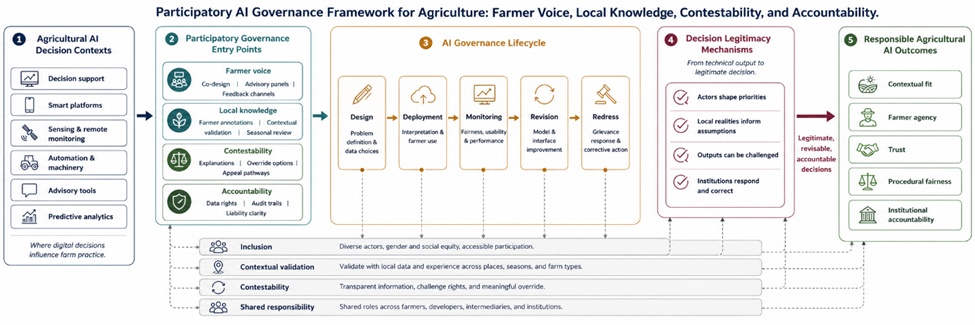
Figure 1. Participatory AI Governance Framework for Agriculture: From Farmer Voice to Contestable and Accountable Digital Decisions
Implementation risks arise when participatory governance is adopted symbolically but not institutionally supported. Uneven data infrastructure, connectivity, digital skills, and platform access can exclude farmers and regions from the benefits of data-driven farming. The global divide in data-driven farming shows that agricultural AI can reproduce inequality when data capacity and digital infrastructure are concentrated among better-resourced actors [26]. Managers and policymakers should therefore treat inclusion as an infrastructure, capacity, and governance challenge rather than as a communication issue alone.
Weak governance can also redistribute labour, control, and benefits in ways that intensify rural inequalities. Agricultural automation and digital platforms may change who performs farm work, who controls decision-making, and who captures value from data-enabled systems. Research on automated pastures and the digital divide shows that agricultural technologies can reshape labour and rural communities, making social safeguards essential to responsible implementation [27]. Technology firms, cooperatives, extension organisations, and public institutions should therefore assess labour impacts, dependency risks, and unequal benefit distribution before scaling agricultural AI systems.
Managerial recommendations should also engage farmer counter-narratives rather than treating digital transformation as linear progress. Everyday counter-narratives of Agriculture 4.0 show that farmers may question dominant innovation stories, reinterpret technologies, or resist assumptions about what counts as agricultural improvement [28]. Practical governance should include participatory design protocols, local validation practices, farmer feedback channels, contestability mechanisms, governance audits, explainability requirements, data-sharing agreements, and accountability safeguards. These mechanisms help ensure that agricultural AI remains responsive to those affected by digital decisions rather than only to technology providers, investors, or institutional performance metrics.
This article developed a participatory AI governance framework for agriculture centred on farmer voice, local knowledge integration, contestable digital decisions, and accountability safeguards. The framework positions farmers and other affected actors as governance participants who can shape digital systems, contribute situated knowledge, challenge outputs, and hold institutions accountable. It shows that participatory governance is not an optional addition to agricultural AI but a condition for legitimacy, contextual fit, and responsible decision-making.
Agricultural AI cannot be responsibly governed through technical performance, transparency claims, or institutional compliance alone. Accuracy and explainability matter, but they do not ensure that farmers have meaningful influence, that local realities are represented, or that harmful decisions can be challenged. Governance must therefore create practical mechanisms for inclusion, contextual validation, contestation, redress, and shared responsibility.
Participatory governance offers a foundation for agricultural AI that is more legitimate, accountable, locally grounded, and responsive to those affected by digital decisions. It can help prevent exclusion, opacity, dependency, and unchallengeable automation while strengthening trust and institutional learning. Future agricultural AI systems should be evaluated not only by what they predict or optimise, but also by whether they support farmer agency, respect local knowledge, and remain open to challenge and correction.
None
None
None
None
Open Access The author(s) retain copyright. This article is licensed under the Creative Commons Attribution-NonCommercial-ShareAlike 4.0 International License. It may be shared and adapted for non-commercial purposes with appropriate attribution, an indication of changes, and distribution of adaptations under the same license. Third-party material may be subject to separate terms identified in its credit line. View the license at https://creativecommons.org/licenses/by-nc-sa/4.0/.
 Agro Intelligence Research Press