Agri-food supply chains are increasingly exposed to overlapping disruptions arising from climate variability, geopolitical instability, pandemic effects, price volatility, labour shortages, and changing consumer demand. These pressures have intensified interest in resilience-oriented technologies that can help supply chains anticipate disruption, absorb shocks, adapt operations, and recover service continuity. Artificial intelligence has emerged as a prominent candidate because it can transform fragmented supply chain data into forecasts, alerts, recommendations, and operational decisions. This systematic review examines how artificial intelligence is being applied to strengthen agri-food supply chain resilience. The review focuses on four functional domains: forecasting, traceability, risk detection, and decision support. It asks whether current AI applications merely improve isolated technical tasks or whether they provide demonstrable evidence of resilience improvement across agri-food supply systems. The review follows a systematic design informed by PRISMA reporting principles and structured literature review procedures. A corpus of 32 peer-reviewed journal articles published between 2017 and 2025 was synthesised. The selected studies cover AI forecasting models, blockchain-enabled traceability, quality and safety monitoring, logistics optimisation, supply chain decision support, and review-methodology guidance. The synthesis shows that forecasting research is technically advanced, especially in price prediction, demand forecasting, and quality-sensitive perishable supply chain management. Traceability and risk detection studies show strong growth around blockchain, IoT, big data, computer vision, and food safety monitoring. Decision support research connects AI to resilience more directly, but most evidence remains conceptual, model-based, or function-specific rather than validated through real disruption events. The review concludes that AI has substantial potential to support agri-food supply chain resilience, but the evidence base remains fragmented. Existing studies tend to focus on single functions such as forecasting accuracy, provenance visibility, or routing efficiency, while system-level resilience outcomes are rarely measured. Future research should therefore move from isolated AI applications toward integrated, empirically validated, resilience-focused agri-food intelligence systems.
Agri-food supply chain resilience refers to the capacity of production, processing, logistics, retail, and governance systems to maintain or restore food availability, quality, safety, and affordability under disruption. Recent reviews show that artificial intelligence is increasingly positioned as a resilience-building mechanism because it can support sensing, prediction, coordination, and response across complex food networks [1]. This interest is reinforced by evidence that digitalisation can help food supply chains respond to disruptive events when organisations develop information-processing capability, operational flexibility, and adaptive routines [2]. In this review, resilience is treated not as a general aspiration but as an operational property that should be linked to measurable outcomes such as reduced waste, improved recovery, continuity of supply, and better disruption response.
Artificial intelligence is relevant to agri-food supply chains because these systems generate heterogeneous data from farms, markets, warehouses, transport assets, sensors, documents, and consumer transactions. Studies of AI adoption in agri-food and supply chain management show that machine learning, deep learning, optimisation, blockchain integration, and intelligent decision support are being applied to distribution efficiency, forecasting, quality monitoring, and traceability [3, 4]. Broader supply chain reviews similarly indicate that AI can support demand sensing, risk analytics, supplier assessment, inventory decisions, and logistics coordination [5, 6]. The central issue is therefore not whether AI can be applied, but whether its application improves the resilience of agri-food supply chains in ways that are observable and transferable.
The review is organised around four functional domains that recur across the literature. Forecasting studies examine demand, price, yield, spoilage, quality, and operational workload prediction using machine learning and time-series methods [7, 8]. Traceability studies examine blockchain, distributed ledgers, provenance records, and food safety documentation across agricultural and food value chains [9, 10]. Risk detection and decision support studies address quality deviations, contamination risks, temperature control, logistics routing, and resilience-oriented decision frameworks [11-13]. These domains provide a practical structure for assessing how AI contributes to anticipatory, absorptive, adaptive, and recovery capacities.
The article asks three guiding questions. First, what AI techniques are used for forecasting, traceability, risk detection, and decision support in agri-food supply chains? Second, what evidence links these applications to resilience outcomes rather than narrow technical performance alone? Third, what research gaps prevent the field from moving toward integrated, system-level resilience intelligence? The remaining sections define the review scope, describe the search and selection process, synthesise evidence across the four domains, and develop a forward-looking research agenda based on the 32 selected studies [14, 15].
The scope of this review is limited to peer-reviewed journal articles published between 2017 and 2025 that examine AI, machine learning, blockchain-enabled intelligence, computer vision, IoT-supported analytics, optimisation, or decision support in relation to agri-food or food supply chain functions. This boundary includes studies that directly address agri-food supply chain resilience, as well as studies that examine functional capabilities relevant to resilience, such as forecasting, traceability, temperature management, food safety monitoring, and logistics optimisation [11, 12, 16]. It also includes systematic and structured reviews where they provide methodological grounding or map AI and digital technologies in agri-food and supply chain settings [1, 17]. The review excludes books, theses, policy documents, websites, conference papers, and non-peer-reviewed material.
The first research question asks what AI techniques are used across the four focal domains. Forecasting studies include deep learning, machine learning, clustering frameworks, and time-series models applied to prices, demand, sales, and quality-sensitive food logistics [18-20]. Traceability and risk detection studies include blockchain, big data analytics, livestock-product traceability, and intelligent quality monitoring for perishable products [21-23]. Decision support studies include routing optimisation, AI-enabled resilience frameworks, and broader supply chain AI adoption models [13, 24, 25]. This question is descriptive but necessary because the field is technologically diverse and terminology is inconsistent.
The second and third research questions are evaluative and agenda-setting. The second question asks whether AI applications demonstrate resilience outcomes such as faster recovery, waste reduction, continuity of supply, improved responsiveness, cost reduction, or better safety assurance, rather than only reporting predictive accuracy or technical feasibility [13, 26]. The third question asks which gaps remain in integrating forecasting, traceability, risk detection, and decision support into coherent resilience systems [5, 6]. Together, these questions allow the review to move beyond cataloguing technologies toward assessing whether AI is advancing agri-food supply chain resilience as a system-level capability.
The review followed a structured search strategy informed by PRISMA 2020 and SPAR-4-SLR principles, which emphasise transparent identification, screening, eligibility assessment, and evidence synthesis [14, 15]. Searches were designed to capture studies on artificial intelligence, agri-food supply chains, resilience, forecasting, traceability, risk detection, decision support, blockchain, food safety, and optimisation. The target time window was 2017–2025, reflecting the period in which AI, blockchain, IoT, and digital supply chain resilience research became prominent in agri-food scholarship. The search prioritised journals in agricultural systems, production research, food control, logistics, information management, supply chain management, and sustainability-oriented technology research.
The search strings combined terms for artificial intelligence, machine learning, agri-food supply chain resilience, forecasting, food traceability, risk detection, food safety, decision support, optimisation, disruption, and systematic review. Studies were retained when they examined AI or AI-adjacent digital intelligence in agri-food or food supply chains, or when they provided directly relevant supply chain AI or systematic review methodology. For example, studies on blockchain traceability were included because traceability is a core resilience capability in food safety and provenance response [9, 10]. Studies on general AI in supply chain management were included only when they offered transferable concepts for resilience, decision support, or supply chain intelligence [5, 6].
The screening process applied inclusion and exclusion criteria sequentially. Included articles had to be peer-reviewed journal publications, published between 2017 and 2025, written in English, and relevant to at least one focal domain of forecasting, traceability, risk detection, decision support, or review methodology. Excluded records included non-journal publications, conference papers, policy reports, books, theses, non-peer-reviewed manuscripts, and studies without a clear supply chain or agri-food relevance. After screening, the final corpus contained 32 studies, including direct agri-food supply chain AI papers, food traceability papers, forecasting studies, quality-monitoring studies, decision support studies, and review-methodology articles.
The final corpus was narratively synthesised rather than statistically pooled because the studies differed substantially in research design, data type, AI method, application domain, and outcome definition. Table 1 summarises the systematic search strategy, inclusion/exclusion criteria, and the final corpus of selected studies. The synthesis classified studies by functional domain, AI technique, data source, decision target, and resilience relevance, following systematic review guidance on transparent categorisation and evidence mapping [14, 15]. This approach made it possible to compare technical evidence, operational relevance, and resilience contribution across heterogeneous studies.
Table 1. Systematic Review Search Strategy and Study Selection: Databases, Search Strings, Screening Results, and Final Study Characteristics
Review element | Specification used in this systematic review | Resulting contribution to the corpus |
Review time window | Peer-reviewed journal articles published from 2017 to 2025 | Ensured coverage of recent AI, blockchain, IoT, and resilience-oriented agri-food supply chain research |
Core conceptual focus | Artificial intelligence for agri-food supply chain resilience, including anticipation, absorption, adaptation, and recovery from disruption | Anchored the review around resilience rather than technology adoption alone |
Functional domains | Forecasting, traceability, risk detection, and decision support | Provided the four-domain structure used for evidence synthesis |
Main search concepts | Artificial intelligence, machine learning, agri-food supply chain, food supply chain, resilience, forecasting, traceability, blockchain, food safety, risk detection, decision support, optimisation, disruption, systematic review | Captured both direct agri-food studies and transferable supply chain AI studies |
Targeted journal areas | Agricultural systems, food control, production research, logistics, information management, supply chain management, sustainability, and technology management | Prioritised peer-reviewed outlets relevant to agri-food systems, AI, and resilience |
Inclusion criteria | English-language peer-reviewed journal articles; 2017–2025; clear relevance to AI, digital intelligence, forecasting, traceability, risk detection, decision support, or review methodology in agri-food or supply chain contexts | Produced a focused evidence base suitable for systematic synthesis |
Exclusion criteria | Books, theses, reports, websites, conference papers, arXiv manuscripts, non-peer-reviewed items, and studies lacking supply chain or agri-food relevance | Removed sources outside the article type and evidence boundary |
Screening logic | Title and abstract screening followed by full-text relevance assessment against the four functional domains and methodology category | Reduced broad AI and food technology literature to a resilience-relevant corpus |
Final study corpus | 32 peer-reviewed journal articles | Formed the complete evidence base for Sections 6–10 |
Main study categories | Agri-food AI and resilience studies; blockchain and traceability studies; forecasting and price/demand prediction studies; food safety and quality monitoring studies; decision support and resilience framework studies; systematic review methodology papers | Enabled structured comparison across technical, operational, and methodological evidence |
Synthesis method | Narrative systematic synthesis with classification by AI technique, data source, decision target, and resilience relevance | Supported analytical interpretation without claiming new empirical results |
Key limitation of the corpus | High heterogeneity in methods, sectors, data sources, and outcome measures | Limited direct comparability and prevented quantitative meta-analysis |
Forecasting is the most technically mature AI application area in the reviewed agri-food supply chain literature. The evidence includes agricultural commodity price prediction, food and beverage sales forecasting, general supply chain demand forecasting, and perishable-product quality prediction [7, 8, 20, 27]. These studies show that machine learning and deep learning can improve forecasting accuracy when sufficient historical, transactional, market, environmental, and operational data are available. However, the forecasting literature often evaluates model performance statistically rather than assessing whether forecasts lead to more resilient decisions during supply chain disruption.
Price forecasting studies are particularly prominent because agri-food markets are exposed to volatility, seasonality, weather shocks, and policy-sensitive supply-demand shifts. Deep learning approaches have been used to forecast agricultural prices, with studies showing the value of neural architectures for capturing nonlinear patterns in commodity markets [7, 18]. Machine learning frameworks have also been applied to agricultural commodity price prediction, demonstrating the usefulness of feature engineering, historical market data, and algorithmic comparison for improving predictive reliability [8]. Systematic evidence on staple crop price forecasting further confirms that model selection depends heavily on data availability, forecasting horizon, crop type, and market context [17].
Demand and sales forecasting research links AI more directly to supply chain planning because forecasts influence procurement, production, inventory, distribution, and waste prevention. Machine learning demand forecasting has been associated with improved supply chain performance when predictions are integrated into planning routines rather than treated as isolated analytics outputs [27]. Deep clustering frameworks for food and beverage sales forecasting illustrate how AI can identify demand patterns across product segments and support more differentiated planning [20]. Yet the review finds that many forecasting studies stop at predictive accuracy and do not evaluate downstream effects on service levels, recovery time, or resilience under actual disruption.
Forecasting for perishability and quality-sensitive logistics extends the resilience contribution of AI because errors in temperature, timing, and routing can rapidly translate into waste, food safety risk, or service failure. AI-based temperature management models show how machine learning can support safety and quality control in perishable food supply chains by identifying optimal temperature conditions and reducing quality deterioration risks [12]. Table 2 classifies the forecasting models and their application domains in agri-food supply chains. Across the corpus, forecasting evidence is strongest at the model-development level but weaker at the level of implementation, decision integration, and resilience outcome measurement.
Table 2. AI-Based Forecasting Models in Agri-Food Supply Chains: Model Types, Data Sources, Forecasting Targets, and Performance
Forecasting domain | Representative studies | AI or analytical approach | Main data sources | Forecasting target | Reported performance focus | Resilience relevance |
Agricultural commodity price forecasting | Manogna, Venkatachalam, Chakraborty, Reddy and Suresh [19]; Mohanty, Lenka, Mishra and Behera [20] | Deep learning, machine learning, comparative predictive modelling | Historical commodity prices, market variables, time-series data | Future agricultural commodity prices | Prediction accuracy, error reduction, model comparison | Supports anticipation of market volatility and procurement risk |
Cherry price forecasting and advisory support | Shaheen, Qureshi, Iqbal, Khan, Ali and Ahmed [21] | Deep learning-enabled forecasting and advisory decision support | Product price histories and market-relevant features | Cherry price movements and advisory guidance | Forecasting accuracy and advisory usefulness | Supports producer and trader decisions under price uncertainty |
Staple crop price forecasting | Theofilou, Mamalis and Theodoridis [23] | Systematic review of machine learning price forecasting | Published forecasting studies, crop price datasets, market indicators | Staple crop prices | Comparative evidence on model types and data needs | Identifies forecasting evidence relevant to food affordability and supply planning |
Demand forecasting and supply chain performance | Feizabadi [24] | Machine learning demand forecasting linked to performance analysis | Demand histories, supply chain performance variables, organisational data | Demand levels and planning requirements | Relationship between forecasting and supply chain performance | Supports anticipatory inventory and capacity planning |
Food and beverage sales forecasting | Mitra, Saha and Tiwari [25] | Deep clustering frameworks | Sales records, product-level demand patterns, business data | Product sales volumes | Forecast accuracy and segmentation quality | Supports differentiated production, replenishment, and waste reduction |
Perishable food quality and temperature forecasting | Eze, Kirby, Attridge and Ajmal [18] | Machine learning-based optimal temperature management | Temperature records, safety and quality control data, perishable supply chain conditions | Optimal temperature and quality preservation conditions | Safety, quality, and control performance | Supports spoilage reduction and continuity of safe supply |
Broader AI forecasting within supply chains | Toorajipour, Sohrabpour, Nazarpour, Oghazi and Fischl [28]; Pournader, Ghaderi, Hassanzadegan and Fahimnia [29] | Systematic review of AI supply chain applications | Published supply chain AI studies | Demand, risk, supply, logistics, and operational forecasts | Taxonomy and application mapping | Provides transferable foundations for integrated agri-food resilience forecasting |
Digital food supply chain resilience forecasting | Pal, Ganguly and Chaudhuri [4]; Tortorella, Gloet, Samson, Kurnia, Fogliatto and Anzanello [5] | Digital transformation and resilience analysis | Organisational, digitalisation, and supply chain resilience evidence | Disruption-sensitive planning and flexibility | Resilience capability and digital transformation relationships | Connects forecasting capability to resilience routines and adaptive response |
Traceability is the second major AI-adjacent domain in the reviewed literature, with blockchain acting as a central enabling technology for recording provenance, transactions, certifications, and custody changes across food supply chains. Blockchain studies argue that distributed ledgers can improve transparency, reduce information asymmetry, and strengthen accountability from production to distribution [9, 10]. Food traceability research also highlights the importance of immutable records for origin verification, recall management, and consumer trust [28]. From a resilience perspective, traceability matters because it can shorten the time needed to identify risk sources and coordinate corrective action.
Blockchain-enabled food traceability is supported by several studies that examine adoption, implementation, and use cases. Modelling work on blockchain-enabled traceability in agricultural supply chains shows that technological capability must be matched by organisational readiness and supply chain collaboration [30]. A food distribution use case illustrates how blockchain can improve knowledge of product movement, although operational value depends on the completeness and reliability of recorded data [29]. Content-analysis evidence on blockchain adoption in food supply chains further shows that implementation challenges include interoperability, governance, cost, stakeholder participation, and trust in data entry processes [21].
Risk detection studies broaden traceability by focusing on food safety, quality deviation, contamination, fraud, and perishable-product deterioration. Reviews of blockchain in food safety argue that traceability systems can strengthen safety assurance when combined with reliable monitoring, standards, and verification mechanisms [22]. Livestock-product traceability research similarly shows the value of blockchain for managing safety and authenticity concerns in animal-derived food supply chains [23]. Big-data-based source tracing methods demonstrate how dynamic information processing can support quality and safety risk identification across food supply chains [31].
AI-enabled quality monitoring adds another layer by detecting deviations before they become system-level disruptions. Intelligent detection, monitoring, and control methods for fresh fruits and vegetables show how sensors, computer vision, analytics, and control systems can preserve quality along the supply chain [11]. Machine learning classification of lamb carcasses demonstrates that AI can support meat traceability by linking classification, origin, and product characteristics in a quality assurance system [32]. Across these studies, the main limitation is that traceability and risk detection are often evaluated as technical or informational improvements, while their effects on recovery time, recall efficiency, market continuity, and resilience outcomes remain under-measured.
Decision support systems represent the domain where AI most directly connects data and prediction to operational action. In agri-food and broader supply chain settings, decision support can support inventory planning, distribution routing, supplier selection, temperature control, quality management, and disruption response [13, 24]. A fresh food distribution study using an artificial bee colony algorithm shows how route optimisation can reduce quality loss by improving delivery decisions [24]. Such optimisation studies are important because resilience depends not only on sensing disruption but also on choosing actions that preserve supply, quality, and cost performance.
The clearest resilience-oriented contribution in the corpus is the AI-based decision-making framework for building supply chain resilience. This work explicitly links AI techniques to resilience-building processes and shows that algorithmic decision support can help organisations anticipate, respond to, and recover from supply chain disruptions [13]. Related systematic reviews of AI in supply chain management show that AI has been applied to planning, procurement, logistics, risk management, and performance improvement [5, 6]. However, the translation of these general supply chain insights into agri-food contexts requires attention to perishability, biological variability, safety regulation, fragmented actors, and uneven digital capability.
Agri-food-specific decision support is also reflected in research on AI influence on distribution network efficiency and agri-food supply chain performance. Evidence suggests that AI can improve agri-food supply chain performance when it enhances distribution network efficiency, but this relationship depends on organisational capability and the quality of operational integration [4]. Research on AI-enabled information processing also indicates that resilience benefits are mediated by organisational mindfulness and flexibility, meaning that AI alone is insufficient without adaptive managerial routines [3]. These findings suggest that resilience outcomes arise from socio-technical systems rather than from algorithms operating in isolation.
The resilience outcomes reported across the corpus include cost reduction, waste reduction, quality preservation, improved responsiveness, increased visibility, and better planning reliability, but few studies measure recovery time or performance under real disruption events. Table 3 synthesises the decision support systems and the resilience outcomes reported. The table shows that most evidence is indirect, model-based, or capability-oriented rather than derived from longitudinal evaluation of actual disruptions [2, 26]. This limits the strength of causal claims about AI-driven resilience while still indicating strong potential for decision-support integration.
Table 3. AI-Enabled Decision Support and Resilience Outcomes in Agri-Food Supply Chains: System Types, Decision Domains, and Measured Resilience Impacts
Decision support domain | Representative studies | System type | Decision domain | Reported or implied resilience outcome | Strength of resilience evidence |
Fresh food distribution routing | Katiyar, Khan and Kumar [26] | Metaheuristic optimisation using artificial bee colony algorithm | Delivery route optimisation for fresh food | Reduced quality loss and improved delivery planning | Moderate technical evidence; limited real-disruption validation |
Supply chain resilience framework | Belhadi, Kamble, Fosso Wamba and Queiroz [27] | AI-based decision-making framework | Anticipation, response, and recovery decisions | Improved resilience capability and disruption response logic | Strong conceptual alignment; limited agri-food-specific empirical testing |
Agri-food distribution efficiency | El Bhilat, El Jaouhari and Hamidi [3] | AI-enabled performance and mediation model | Distribution network efficiency and supply chain performance | Better performance through improved distribution efficiency | Relevant agri-food evidence; resilience inferred through performance |
AI-enabled information processing | Smyth, Scott, Fosso Wamba and Dennehy [2] | AI-enabled information processing model | Organisational mindfulness and flexibility | Enhanced resilience through sensing, interpretation, and adaptive response | Strong resilience framing; dependent on organisational mediators |
Digital transformation for food supply resilience | Pal, Ganguly and Chaudhuri [4]; Tortorella, Gloet, Samson, Kurnia, Fogliatto and Anzanello [5] | Digital transformation and resilience capability models | Organisational adaptation, flexibility, and disruption response | Improved resilience capability under disruptive events | Strong conceptual and mixed-method relevance; not limited to one AI tool |
Perishable food safety and quality control | Eze, Kirby, Attridge and Ajmal [18] | Machine learning temperature management model | Temperature control and quality preservation | Reduced safety risk and quality deterioration | Strong technical relevance; operational resilience not fully measured |
Food quality and safety source tracing | Song, Huo, Li, Chu and Sun [15] | Big-data-based dynamic source tracing | Source identification and safety risk management | Faster identification of quality and safety problems | Strong traceability logic; resilience outcomes mostly implied |
General supply chain AI decision support | Toorajipour, Sohrabpour, Nazarpour, Oghazi and Fischl [28]; Pournader, Ghaderi, Hassanzadegan and Fahimnia [29] | AI application taxonomies and decision-support mapping | Planning, logistics, procurement, risk, and coordination | Transferable AI capabilities for resilient supply chain decision-making | Broad evidence base; agri-food specificity varies |
The overall evidence indicates that AI for agri-food supply chain resilience is technically active but operationally uneven. Forecasting studies demonstrate strong methodological development, especially in price, demand, sales, and perishable quality prediction [7, 8, 20]. Traceability studies show rapid growth in blockchain and digital provenance systems, particularly for safety, authenticity, and transparency [9, 10, 22]. Decision support studies provide the most explicit link to resilience, but the number of applications validated in real agri-food disruption settings remains limited [13].
A major synthesis finding is that forecasting is often disconnected from downstream decision systems. Price and demand models can generate accurate predictions, but many studies do not show how these forecasts are embedded in procurement, inventory, routing, or recovery decisions [18, 19, 27]. This creates a gap between predictive intelligence and actionable resilience. To become resilience tools, forecasting systems must be linked to decision rights, operating thresholds, contingency actions, and feedback mechanisms that update decisions during disruption.
Traceability and risk detection systems are similarly strong in visibility but weaker in resilience evaluation. Blockchain and source-tracing studies demonstrate that food supply chains can become more transparent, auditable, and accountable [28-31]. Quality monitoring and product classification studies show that AI can detect or manage product-specific risks before they escalate [11, 32]. Yet few studies quantify whether these systems reduce recall duration, prevent wider contamination, maintain market access, or accelerate recovery after a safety event.
Figure 1 presents an integrated synthesis model showing how AI-enabled forecasting, traceability, risk detection, and decision support collectively support agri-food supply chain resilience.
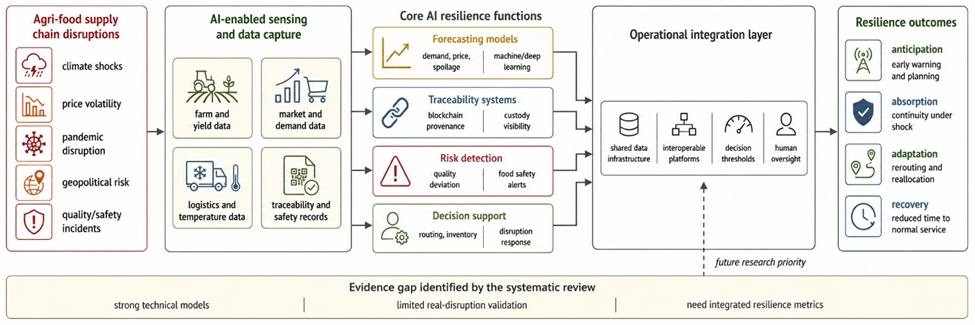
Figure 1. Integrated AI Architecture for Agri-Food Supply Chain Resilience: Connecting Forecasting, Traceability, Risk Detection, and Decision Support to Anticipation, Absorption, Adaptation, and Recovery Outcomes
The evidence also suggests geographic and sectoral concentration. Many studies focus on structured supply chains, formal markets, fresh produce, livestock products, or commodity contexts where data are available and digital systems can be deployed [12, 17, 23]. This produces useful evidence but leaves less formal, fragmented, smallholder-heavy, and infrastructure-constrained agri-food chains underrepresented. As a result, the current evidence base may overstate feasibility in high-data environments while underexploring resilience needs in supply chains most vulnerable to disruption [1, 16].
The first major research gap is the lack of system-level resilience studies. Current research often examines forecasting accuracy, traceability transparency, routing performance, or temperature control as separate outcomes [8, 12, 24]. Although these functions contribute to resilience, they do not by themselves demonstrate whether an agri-food supply chain can anticipate, absorb, adapt to, and recover from disruptions. Future studies should therefore define resilience outcomes explicitly and measure impacts such as recovery time, service continuity, food loss, safety-event containment, cost stability, and availability under disruption scenarios [13].
The second gap is the absence of integrated multi-AI architectures across supply chain functions. Forecasting models, blockchain traceability systems, quality monitoring tools, and decision support frameworks are usually developed independently, despite the fact that resilience requires coordination across sensing, prediction, diagnosis, decision, and response [5, 9, 11, 27]. Future research should investigate how price forecasts, demand forecasts, provenance data, risk alerts, and logistics optimisation can be combined into integrated agri-food resilience platforms. This would move the field from isolated tools toward intelligence systems capable of supporting coordinated action.
The third gap concerns inclusiveness and context sensitivity. The reviewed literature gives less attention to smallholders, informal intermediaries, low-resource logistics systems, and regions where digital infrastructure, data quality, and institutional coordination are limited [1, 16]. AI systems that assume continuous data, interoperable platforms, and mature governance may not work in fragmented agri-food supply chains. Future research should prioritise low-resource design, participatory implementation, explainable decision support, and governance arrangements that distribute benefits rather than concentrating them among digitally advanced actors.
The fourth gap concerns evaluation, ethics, and governance. AI-enabled traceability and decision support can improve transparency and coordination, but they can also introduce data ownership disputes, surveillance concerns, exclusion risks, and algorithmic dependence [21, 25]. Systematic reviews of AI and supply chain applications show that adoption depends not only on technical performance but also on trust, organisational readiness, capability development, and responsible implementation [5, 6]. A forward-looking agenda should therefore combine real-world validation, cross-functional integration, resilience metrics, governance analysis, and inclusive design so that AI strengthens food supply systems rather than merely digitising existing vulnerabilities.
This systematic review shows that artificial intelligence is becoming an important but still under-utilised tool for agri-food supply chain resilience. The strongest evidence lies in forecasting, traceability, quality monitoring, and optimisation, where AI can improve anticipation, visibility, and operational decision-making. However, the evidence remains fragmented because most studies examine specific functions rather than integrated resilience performance across the supply chain.
The review also shows that resilience cannot be produced by algorithms alone. AI contributes to resilience only when predictions, traceability records, risk alerts, and recommendations are embedded in organisational routines, decision rights, coordination mechanisms, and feedback processes. This means that future agri-food AI research must move beyond technical accuracy and evaluate whether systems improve supply continuity, reduce waste, manage safety risk, and support recovery during real disruptions.
The field now needs a shift from siloed AI applications to integrated, resilience-focused agri-food intelligence systems. Such systems should combine forecasting, traceability, risk detection, and decision support while remaining inclusive, context-sensitive, transparent, and empirically validated. Rigorous research in real supply chain contexts is essential if AI is to become a credible foundation for resilient food systems rather than a collection of promising but disconnected digital tools.
None
None
None
None
Open Access The author(s) retain copyright. This article is licensed under the Creative Commons Attribution-NonCommercial-ShareAlike 4.0 International License. It may be shared and adapted for non-commercial purposes with appropriate attribution, an indication of changes, and distribution of adaptations under the same license. Third-party material may be subject to separate terms identified in its credit line. View the license at https://creativecommons.org/licenses/by-nc-sa/4.0/.
 Agro Intelligence Research Press