Climate stress is reshaping the operational conditions under which agricultural decisions are made. Drought, heat, flooding, salinity, and increasingly variable weather patterns intensify uncertainty around irrigation, fertilisation, pest management, crop selection, and yield planning. Precision agriculture has therefore become a central domain in which artificial intelligence is expected to support adaptive, data-driven decision-making. This systematic review examines how artificial intelligence decision models are used in precision agriculture under climate stress. The review focuses on three connected dimensions: the model families used to support decisions, the data sources on which these models depend, and the sustainability outcomes that are reported. The objective is to clarify whether current evidence supports the claim that artificial intelligence can deliver more resilient and sustainable agricultural management. The review synthesises peer-reviewed journal articles published. The study selection followed a PRISMA-oriented logic, using predefined search strings, inclusion criteria, and screening stages to identify relevant work on machine learning, deep learning, remote sensing, sensor-based agriculture, irrigation optimisation, yield prediction, crop disease detection, and sustainability assessment. No new empirical field data were generated. The evidence base shows rapid expansion in machine learning and deep learning applications, especially for yield prediction, irrigation management, crop monitoring, plant disease detection, and smart farming decision support. Satellite imagery, UAV data, IoT sensors, weather variables, soil information, and farm-management records appear as the dominant data sources. However, the review also identifies uneven attention to climate stress conditions, limited integration of long-term climate projections, and inconsistent reporting of sustainability outcomes.The review concludes that artificial intelligence for precision agriculture under climate stress is technically promising but methodologically fragmented. Most studies emphasise model accuracy, yield improvement, or input optimisation, while fewer evaluate environmental trade-offs, social impacts, farmer livelihoods, or long-term resilience. A more rigorous, transparent, and sustainability-centred research agenda is needed to move the field beyond predictive performance toward climate-resilient agricultural decision systems.
Climate stress has intensified the need for agricultural systems that can make more precise, timely, and adaptive decisions under environmental uncertainty. Precision agriculture has been framed as a response to this challenge because it links field variability, digital data, and operational decision-making across irrigation, fertilisation, crop protection, and yield management. The expansion of smart farming and agricultural data systems has created new possibilities for monitoring crops and environments at higher spatial and temporal resolution [1]. At the same time, the growing use of artificial intelligence raises questions about whether technical optimisation actually translates into resilient and sustainable agricultural outcomes.
Artificial intelligence has entered precision agriculture through machine learning, deep learning, ensemble modelling, computer vision, remote sensing analytics, and decision support systems. Reviews of machine learning in agriculture show that these methods are increasingly used for yield prediction, crop status estimation, disease detection, irrigation control, and input management [2-4]. Deep learning has further expanded the ability to process imagery, sensor streams, and complex agricultural patterns, particularly in crop monitoring and disease diagnosis [5, 6]. These developments suggest a shift from descriptive agricultural data systems toward predictive and prescriptive decision models.
The relevance of artificial intelligence becomes especially pronounced under drought, heat stress, flooding, salinity, and climate variability, where agricultural decisions must be adjusted to changing biophysical conditions. Remote sensing has become central to this shift because satellite and UAV-derived data can capture vegetation indices, canopy status, water stress, and disease signals across large areas [7, 8]. Irrigation scheduling, crop yield prediction, and smart farming decision support increasingly combine weather, soil, crop, and management data to support decisions under uncertain conditions [9, 10]. However, the evidence remains uneven in how explicitly it connects model outputs to climate stress, farmer decision-making, and sustainability outcomes.
This review systematically examines artificial intelligence for precision agriculture under climate stress through three organising questions: what decision models are used, what data sources feed these models, and what sustainability outcomes are reported. This framing is necessary because existing reviews often focus either on model techniques, digital agriculture infrastructure, remote sensing applications, or specific tasks such as irrigation or disease detection [11, 12]. By integrating model families, data sources, climate stress applications, and sustainability evaluation, this review provides a structured synthesis of the evidence base. The article proceeds from scope definition and study selection to thematic synthesis, sustainability assessment, evidence integration, and future research directions.
The review is limited to peer-reviewed journal articles published between 2017 and 2024 that examine artificial intelligence or data-driven decision models in precision agriculture. The focus is on operational and management decisions, including irrigation scheduling, yield forecasting, fertiliser application, crop disease detection, crop monitoring, smart farming systems, and climate-sensitive decision support. Studies on agricultural big data, remote sensing, machine learning, deep learning, and artificial intelligence were included when they contributed to understanding decision models, input data, or sustainability claims [1, 3, 13]. Broader digital agriculture papers were considered only when they had a clear connection to artificial intelligence, precision farming, or climate-relevant agricultural decisions.
The scope excludes purely conceptual policy discussions, non-peer-reviewed reports, conference papers, theses, books, and studies that did not address agriculture-related decision modelling. It also excludes articles focused only on hardware design or generic sensor engineering unless they connected data acquisition to AI-enabled agricultural decisions. This boundary is important because precision agriculture includes many digital technologies, but not all of them constitute decision models or sustainability-oriented AI systems [11, 14]. The review therefore concentrates on studies where models, data, and decision outputs can be linked to crop, soil, water, climate, or sustainability management.
Three research questions guide the synthesis. First, what artificial intelligence model families are used in precision agriculture under climate stress, and for which operational decisions are they applied? Second, what data sources are used to train, validate, or operate these models, and how are issues of spatial resolution, temporal frequency, integration, and data quality addressed? Third, what sustainability outcomes are reported, and are they evaluated in terms of environmental, economic, and social performance rather than model accuracy alone? [9, 10, 15]
The search strategy was designed to identify literature at the intersection of artificial intelligence, precision agriculture, climate stress, data sources, decision modelling, and sustainability outcomes. Search terms combined technology concepts such as artificial intelligence, machine learning, deep learning, decision support systems, remote sensing, smart farming, and precision agriculture with application terms such as irrigation, drought, yield prediction, crop disease, climate variability, sustainability, water use efficiency, nitrogen, and profitability. The search logic was informed by established review practices in agricultural AI and smart farming, where heterogeneous terminology often requires combining model, data, and application keywords [3, 5, 12]. The review therefore used multiple search strings to capture both broad AI-in-agriculture studies and more specific climate-stress decision applications.
The screening process followed a PRISMA-oriented sequence of identification, title and abstract screening, eligibility assessment, and final inclusion. Studies were screened for publication year, peer-reviewed journal status, relevance to agricultural decision modelling, use of artificial intelligence or closely related data-driven modelling methods, and connection to precision agriculture or climate-sensitive management. Systematic reviews and comprehensive review papers were retained when they mapped model families, data sources, or sustainability-relevant applications, while empirical modelling papers were retained when they provided concrete evidence on model use and decision outputs [8, 10, 16]. This approach produced a corpus that combines methodological mapping with application-specific evidence.
Inclusion criteria required that each article address at least one of the review’s three core dimensions: AI model family, agricultural data source, or sustainability outcome. Articles on crop yield prediction, irrigation optimisation, disease detection, agricultural remote sensing, smart farming decision support, and digital agriculture were included when they contributed evidence relevant to climate-stressed precision agriculture [7, 9, 17]. Exclusion criteria removed studies outside agriculture, studies without a clear AI or data-driven modelling component, non-journal outputs, and papers without sufficient relevance to decision-making or sustainability. This ensured that the final corpus remained focused on decision models rather than general agricultural digitalisation.
The final corpus comprised peer-reviewed journal articles published, with strong representation from Computers and Electronics in Agriculture, Sensors, Remote Sensing, Environmental Research Letters, Scientific Reports, IEEE Access, and related agricultural AI journals. The corpus includes foundational reviews of big data, machine learning, and deep learning in agriculture; systematic reviews of yield prediction and smart irrigation; and recent papers on smart farming, climate-yield modelling, and sustainability-oriented AI [1, 5, 10, 15, 18].
The reviewed literature shows that supervised machine learning remains the dominant modelling family in precision agriculture because many decision tasks are framed as classification, regression, ranking, or forecasting problems. Yield prediction, nitrogen status estimation, disease detection, and irrigation scheduling commonly rely on algorithms such as random forests, support vector machines, gradient boosting, and other supervised learners that convert field, weather, soil, and crop observations into actionable predictions [2, 3]. This dominance reflects the availability of labelled agronomic datasets and the operational appeal of predictive accuracy. However, it also means that many AI systems remain dependent on historical training data that may not fully capture future climate stress conditions.
Deep learning occupies a second major strand of the evidence base, especially where image-rich and high-dimensional data sources are available. Convolutional neural networks, recurrent neural networks, and hybrid CNN-RNN designs are used for crop disease detection, yield prediction, vegetation monitoring, and crop-status interpretation from images or temporal data streams [6, 19]. Plant disease studies show the strength of deep learning in visual diagnosis, while broader agricultural reviews show its expansion into remote sensing and smart farming analytics [20, 21]. Yet deep learning models often require large, well-labelled datasets, which may limit transferability in smallholder, data-scarce, or climate-vulnerable production contexts.
Remote sensing data form the most visible data source across the corpus, particularly satellite imagery, UAV observations, vegetation indices, canopy reflectance, and spatially explicit environmental variables. Remote sensing reviews show that these data are valuable for monitoring crop stress, plant diseases, pests, and field variability, while meta-review evidence confirms their central role in agricultural applications [7, 8, 17]. Sensor and IoT data add another layer by providing soil moisture, weather, crop condition, and equipment-level information for decision support systems [11, 14]. Table 1 classifies the AI model families and data sources used in precision agriculture under climate stress.
Table 1. AI Model Families and Data Sources in Precision Agriculture Under Climate Stress: Model Types, Input Data, and Application Domains
AI model family | Typical methods in the reviewed corpus | Main data sources | Main precision agriculture applications | Climate-stress relevance |
Supervised machine learning | Random forest, support vector machine, gradient boosting, regression models, classification models | Yield records, soil variables, weather data, crop traits, management records | Yield prediction, nitrogen status estimation, crop classification, input optimisation | Useful for drought-sensitive yield forecasting and climate-responsive input decisions |
Deep learning | Convolutional neural networks, recurrent neural networks, CNN-RNN hybrids, image-based classifiers | Satellite imagery, UAV imagery, crop images, temporal weather and crop data | Plant disease diagnosis, crop monitoring, yield forecasting, vegetation-status mapping | Strong for stress detection but dependent on large labelled datasets |
Ensemble modelling | Stacked models, model averaging, ensemble forecasts, hybrid crop-model and machine-learning approaches | Crop model outputs, weather data, soil information, historical yield data | Yield forecasting, nitrate-loss prediction, climate-yield analysis | Useful for improving robustness under climate variability |
Remote-sensing AI | Image classification, vegetation-index analytics, object detection, spatial prediction | Sentinel data, Landsat data, UAV imagery, multispectral imagery, vegetation indices | Crop condition monitoring, disease and pest detection, water-stress assessment | Central for drought, heat, and field-scale stress monitoring |
Irrigation decision models | Machine-learning irrigation schedulers, smart irrigation decision support, predictive control approaches | Soil moisture sensors, evapotranspiration estimates, weather forecasts, crop water demand data | Irrigation scheduling, water-use optimisation, precision water allocation | Directly relevant to drought, water scarcity, and adaptive irrigation |
Smart farming decision support | Integrated AI systems, farm management platforms, advisory systems, agriculture 4.0 decision support | IoT sensors, farm records, weather stations, machinery data, remote sensing layers | Farm-level planning, input management, crop monitoring, operational recommendations | Connects climate stress information to practical decision outputs |
Hybrid AI and crop modelling | Coupled machine learning and process-based crop models | Crop simulation outputs, weather scenarios, soil data, management data, yield observations | Climate-yield forecasting, risk assessment, scenario analysis | Promising for integrating climate variability and biophysical constraints |
Review and synthesis evidence | Systematic reviews, comprehensive reviews, meta-reviews | Published study corpora, bibliographic evidence, reported model and data characteristics | Mapping model families, data types, applications, and gaps | Identifies fragmentation in climate-stress and sustainability evaluation |
The corpus also reveals model homogenisation around data-rich tasks, particularly yield forecasting, crop disease detection, and irrigation control. Smart farming reviews emphasise the growing integration of artificial intelligence, digital platforms, and agricultural data management, but they also show that high-quality data infrastructure is unevenly distributed across regions and farming systems [13, 22]. Recent reviews of smart farming and precision agriculture highlight the opportunity for AI-enabled integration, yet they also confirm that many systems remain technically sophisticated but weakly connected to farmer-facing decision contexts [18, 23]. This suggests that data availability, rather than climate vulnerability alone, strongly shapes where AI decision models are developed and tested.
Figure 1 illustrates how climate-stressed precision agriculture converts satellite, drone, sensor, weather, soil, and farm-management data into AI-enabled decision outputs for irrigation, yield forecasting, crop protection, fertiliser management, and adaptive farm planning.
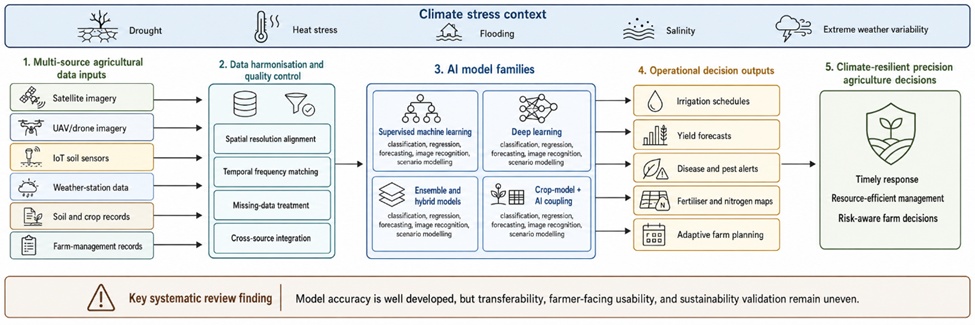
Figure 1. AI Decision Architecture for Precision Agriculture Under Climate Stress: From Multi-Source Data Inputs to Farm-Level Decision Outputs
Drought is the most prominent climate stress in the reviewed corpus because it directly affects irrigation, yield stability, crop water demand, and water-use efficiency. Smart irrigation reviews show that AI models are used to estimate irrigation timing, water requirements, and decision thresholds by combining soil moisture, weather, evapotranspiration, and crop-condition data [9, 24]. Machine-learning approaches to irrigation scheduling are particularly important where climate variability makes fixed irrigation calendars unreliable [15]. These studies position AI as a tool for adaptive water management, although many remain focused on technical scheduling accuracy rather than broader water governance or basin-level sustainability.
Yield forecasting under climate variability represents a second major application area. Machine learning studies show that weather, soil, crop, and management data can be combined to forecast maize and other crop yields, while ensemble and hybrid approaches can improve prediction performance under variable environmental conditions [25, 26]. Coupling machine learning with crop models is especially relevant because it links data-driven prediction with biophysical understanding of crop growth and climate response [16]. However, the reviewed evidence often treats yield as the primary decision outcome, leaving questions about resilience, farmer income stability, and environmental trade-offs less developed.
Heat stress, flooding, salinity, and extreme weather appear less consistently than drought and yield variability, even though they are central to climate-stressed agriculture. Studies examining climate change and crop yield modelling show that machine learning can help identify spatial and temporal patterns in crop response to changing climatic conditions [27, 28]. Yet many precision agriculture applications do not explicitly model climate extremes as stressors; instead, they use weather variables as predictors within broader yield, disease, or irrigation models. This creates a gap between climate-aware prediction and truly climate-stress-specific decision support.
The decision outputs produced by AI models are usually practical and operational, including irrigation schedules, yield forecasts, disease-risk labels, crop monitoring alerts, fertiliser recommendations, and field-level management zones. Decision support system literature shows that Agriculture 4.0 applications increasingly aim to translate model outputs into farm-management recommendations [11]. AI optimisation of irrigation, pesticides, and herbicides also demonstrates how predictive models can be connected to input-use decisions [29]. Nevertheless, the evidence base provides limited detail on how farmers interpret these outputs, whether recommendations are adopted, or how decision authority is distributed between models, platforms, advisers, and producers.
Environmental sustainability outcomes are most often represented through water saving, irrigation efficiency, nitrogen management, crop health monitoring, and reduced chemical input use. Studies on maize yield and nitrate loss demonstrate that machine learning can be used to predict both production and environmental loss outcomes, making it possible to connect yield decisions with nitrogen-related sustainability concerns [25]. Precision irrigation studies similarly frame AI as a way to improve water-use efficiency, especially under drought or water scarcity [9, 24]. However, environmental outcomes such as soil carbon, biodiversity, ecosystem services, and landscape-level resilience remain much less visible in the reviewed evidence.
Economic outcomes are usually reported through yield prediction, productivity improvement, input-cost reduction, and operational optimisation. Crop yield prediction reviews show that machine learning models are commonly evaluated through accuracy metrics and yield-estimation performance, while recent work links yield forecasting to sustainability and future research needs [10, 30]. Smart farming and AI implementation studies also suggest potential gains in profitability and resource efficiency through better decisions [18, 29]. Yet direct evaluation of profitability, farmer risk exposure, or long-term economic resilience is far less common than technical model validation.
Social sustainability outcomes are the weakest dimension of the corpus. Although agricultural big data and smart farming reviews acknowledge farmer decision-making, data governance, and digital transformation, most AI studies do not evaluate farmer livelihoods, food security, labour implications, or equity in access to data-driven tools [1, 14]. This is a significant limitation because climate stress often affects the most resource-constrained producers most severely. Table 2 synthesises the sustainability outcomes reported and the evaluation approaches used.
Table 2. Sustainability Outcomes and Evaluation Patterns in AI-Driven Precision Agriculture: Environmental, Economic, and Social Indicators
Sustainability dimension | Outcomes reported in the reviewed corpus | Common evaluation approach | Main limitation identified |
Water sustainability | Irrigation efficiency, water-use optimisation, crop water demand estimation, drought-responsive scheduling | Soil moisture prediction, evapotranspiration modelling, irrigation timing accuracy, simulation-based comparisons | Often evaluated at plot or model level rather than basin, watershed, or long-term water-system level |
Nutrient sustainability | Nitrogen status estimation, nitrate-loss prediction, fertiliser optimisation | Prediction accuracy, crop nitrogen status classification, nitrate-loss estimation | Limited integration of nutrient outcomes with yield, soil health, and downstream ecological impacts |
Crop health sustainability | Disease detection, pest monitoring, crop stress identification | Image classification accuracy, remote-sensing detection performance, diagnostic sensitivity | Strong technical performance but limited validation under diverse field, climate, and management conditions |
Productivity and yield | Yield prediction, yield stability, crop performance forecasting | Regression accuracy, forecast error, model comparison, ensemble evaluation | Yield often treated as the dominant success metric, overshadowing broader sustainability trade-offs |
Economic sustainability | Input-cost reduction, profitability potential, operational efficiency | Inferred from reduced irrigation, fertiliser, pesticide, or herbicide use | Few studies directly measure farm income, profitability, or financial risk under climate stress |
Social sustainability | Food security, farmer livelihoods, decision support, digital inclusion | Mostly discussed conceptually in reviews rather than empirically measured | Rarely operationalised with indicators, field validation, or farmer-centred assessment |
Resilience outcomes | Adaptation to climate variability, improved decision timing, stress monitoring | Climate-yield modelling, remote-sensing monitoring, predictive analytics | Limited long-term, multi-site, and climate-scenario validation |
Integrated sustainability | Combined environmental, economic, and social performance | Occasional multi-objective framing in reviews and decision-support literature | Few studies use holistic sustainability assessment frameworks or trade-off analysis |
Evaluation patterns across the corpus remain heavily weighted toward model performance rather than sustainability performance. Accuracy, root mean square error, classification precision, recall, or prediction reliability are commonly used to demonstrate model value, especially in disease detection, yield prediction, and remote-sensing analytics [6, 8, 31]. While these metrics are necessary, they do not by themselves demonstrate that an AI system improves sustainability under climate stress. A sustainability-centred evaluation would require linking model outputs to environmental outcomes, farm economics, farmer agency, and long-term resilience.
Figure 2 shows the review’s central sustainability gap: AI models are commonly validated through accuracy and prediction metrics, while environmental, economic, social, and long-term resilience outcomes remain unevenly measured.
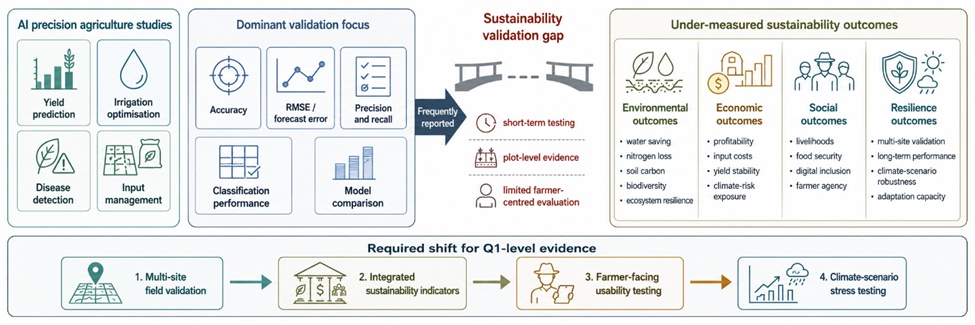
Figure 2. Sustainability Validation Gap in AI-Driven Precision Agriculture: From Technical Performance Metrics to Environmental, Economic, and Social Outcomes
The overall evidence picture is one of rapid technical expansion combined with uneven sustainability validation. Reviews of machine learning, deep learning, and smart farming confirm that AI methods are widely applicable across agricultural decision domains, but they also show that the field is still organised around discrete tasks rather than integrated climate-resilient decision systems [3, 5, 12]. Remote sensing and image-based learning have become particularly influential because they provide scalable data for monitoring crop status, disease, and field variability [7, 17]. This has strengthened the technical foundation of precision agriculture but has not fully resolved the problem of translating predictions into validated sustainability outcomes.
A dominant pattern is the concentration of AI around yield, irrigation, disease detection, and crop monitoring. Yield prediction studies demonstrate clear methodological progress, including ensemble models, CNN-RNN frameworks, and crop-model coupling [16, 19, 26]. Irrigation-focused literature similarly shows a move toward adaptive scheduling and digital farming solutions [9, 15, 24]. Yet the sustainability scope remains narrow because improvements are usually inferred from more accurate prediction or input optimisation rather than measured through comprehensive environmental, economic, and social indicators.
Another pattern is the dependence on data-rich settings and relatively standardised data sources. Agricultural AI studies frequently rely on satellite imagery, UAV imagery, weather records, soil variables, and historical yield data, while farmer-generated data and local knowledge are far less visible [1, 8, 13]. This produces a structural bias toward regions and farming systems with stronger digital infrastructure. Consequently, the evidence base may overstate the generalisability of AI decision models for climate-stressed agriculture in low-resource settings.
The corpus also indicates a methodological divide between predictive modelling and decision implementation. Decision support system studies describe the importance of connecting AI outputs to farm management, but many model-centred papers stop at prediction rather than testing how recommendations alter real decisions [11]. Climate-yield studies show that machine learning can help assess climate impacts, yet precision agriculture studies often do not integrate future climate projections into operational decision models [27, 28]. This leaves the field with strong predictive capacity but weaker evidence on implementation, adoption, governance, and long-term sustainability performance.
The first major gap concerns model generalisability under climate stress. Many models are trained and evaluated on historical or site-specific data, even though future agricultural decisions will increasingly occur under climate conditions that differ from past observations [27, 28]. Future research should therefore test models across regions, crops, seasons, stress conditions, and management systems rather than relying on single-site or short-term validation. Hybrid modelling that combines machine learning with crop simulation may be especially useful because it can improve interpretability and climate-scenario relevance [16].
The second gap concerns data equity and representativeness. Smart farming and agricultural big-data studies show that AI depends on integrated, high-quality data infrastructures, but these infrastructures are not equally available across farms, regions, and production systems [1, 14, 22]. Smallholders, rainfed farms, and climate-vulnerable regions may therefore be underrepresented in model development. Future studies should examine not only data accuracy and resolution but also who generates data, who controls it, and whose farming conditions are represented in AI decision systems.
The third gap concerns sustainability assessment. The reviewed evidence shows stronger attention to water, yield, and input efficiency than to biodiversity, soil carbon, food security, farmer livelihoods, and distributional outcomes [9, 25, 30]. Future research should move from single-indicator optimisation toward multi-dimensional sustainability evaluation that captures trade-offs among environmental protection, economic viability, and social wellbeing. This requires combining agronomic metrics with sustainability science, participatory evaluation, and longer-term field validation.
The fourth gap concerns real-world implementation and farmer-facing decision use. AI decision models must be tested not only for predictive accuracy but also for usability, trust, interpretability, cost, institutional fit, and consequences for farmer autonomy [11, 18, 29]. Future research should include implementation studies, participatory design, explainable decision support, and comparative evaluation of AI recommendations against conventional advisory systems. A more mature research agenda would therefore treat artificial intelligence as part of a socio-technical decision ecology rather than as a purely technical optimisation engine.
This systematic review shows that artificial intelligence has become a major technical pathway for precision agriculture under climate stress. Across the reviewed literature, AI models are used to support irrigation scheduling, yield prediction, crop monitoring, disease detection, nitrogen management, and smart farming decision support. The evidence base demonstrates substantial methodological progress, especially in machine learning, deep learning, remote sensing analytics, and hybrid modelling.
At the same time, the review finds that the field remains empirically narrow and sustainability-thin. Many studies prioritise predictive accuracy, yield improvement, or input optimisation, while fewer provide robust evidence on environmental trade-offs, social outcomes, farmer livelihoods, or long-term resilience. Climate stress is often present through weather variables or drought-related applications, but less often through explicit modelling of heat, flooding, salinity, extreme events, or future climate scenarios.
The next stage of research should move beyond isolated prediction tasks toward integrated, climate-resilient, and equity-sensitive agricultural decision systems. This requires stronger multi-site validation, more representative data, participatory design, transparent evaluation, and holistic sustainability assessment. Artificial intelligence can contribute to sustainable precision agriculture, but only if its development is guided by rigorous evidence, real-world decision relevance, and a broader understanding of agricultural resilience.
None
None
None
None
Open Access The author(s) retain copyright. This article is licensed under the Creative Commons Attribution-NonCommercial-ShareAlike 4.0 International License. It may be shared and adapted for non-commercial purposes with appropriate attribution, an indication of changes, and distribution of adaptations under the same license. Third-party material may be subject to separate terms identified in its credit line. View the license at https://creativecommons.org/licenses/by-nc-sa/4.0/.
 Agro Intelligence Research Press