Intelligent agriculture increasingly uses artificial intelligence, sensors, remote sensing, automation, modelling, and decision-support systems to monitor and manage agricultural production. These tools can strengthen observation, prediction, and coordination across farms and landscapes. Yet their contribution to agricultural transformation depends on the ecological aims toward which they are designed and governed. Regenerative agriculture requires more than improved efficiency or narrower optimisation of inputs. It calls for soil restoration, biodiversity protection, ecological feedback, and long-term system health. Intelligent systems therefore need to be evaluated not only by productivity gains, but also by their capacity to support ecological recovery. This article develops a conceptual framework for regenerative intelligence in agriculture. Regenerative intelligence is defined as the AI-supported capacity of agricultural systems to monitor, interpret, and support soil restoration, biodiversity protection, and long-term system health through adaptive and ecologically accountable decision pathways. The framework explains how sensing, ecological analytics, modelling, decision support, monitoring, feedback, and governance can contribute to regenerative agricultural transformation. It also clarifies that AI-supported agriculture is not automatically regenerative. Its regenerative value depends on ecological indicators, farmer participation, responsible governance, biodiversity sensitivity, soil-health interpretation, and sustained learning from ecological outcomes.
Intelligent agriculture has expanded through AI-enabled analytics, sensors, remote sensing, digital platforms, predictive modelling, automation, and decision-support systems. These systems promise greater precision in observing crops, soils, water, and farm operations. However, regenerative agriculture begins from the restoration of soil and ecosystem-service functions rather than from digital optimisation alone [1]. This article therefore approaches intelligence in agriculture as an ecological and governance question, not only as a technical capability.
A central challenge is that regenerative agriculture is defined through different combinations of practices, processes, and outcomes. Some definitions emphasise soil health, while others foreground biodiversity, carbon, water, farm profitability, or broader social-ecological renewal. This variability makes it necessary to specify the framework dimensions through which regenerative intelligence is evaluated [2]. Without such specification, digital tools may claim regenerative relevance without demonstrating how they support restoration, biodiversity protection, or system health.
The conceptual gap addressed here is that AI-supported agricultural systems are often framed around productivity, precision, input efficiency, and optimisation, while regenerative claims require agronomic and ecological grounding. Regenerative agriculture cannot be assumed to deliver soil or biodiversity benefits unless its mechanisms and outcomes are carefully defined and assessed [3]. The same caution applies to AI, which may intensify extractive management if it is designed only to maximise yield or short-term efficiency. Regenerative intelligence must therefore distinguish between optimisation that merely increases control and intelligence that supports ecological recovery.
This article develops a framework for regenerative intelligence in agriculture centred on soil restoration, biodiversity protection, long-term system health, ecological feedback, and governance-enabled adaptive management. It draws on agroecological transition thinking because regenerative intelligence requires redesign of relationships among soils, crops, biodiversity, farmers, technologies, and institutions rather than simple input substitution [4]. The framework explains how AI-supported sensing, modelling, interpretation, decision support, monitoring, and learning can be aligned with regenerative aims. It also identifies boundary conditions under which intelligent agriculture may fail to become regenerative. Figure 1 illustrates the conceptual shift from productivity-oriented intelligent agriculture toward regenerative intelligence centred on soil restoration, biodiversity protection, ecological feedback, and long-term system health.
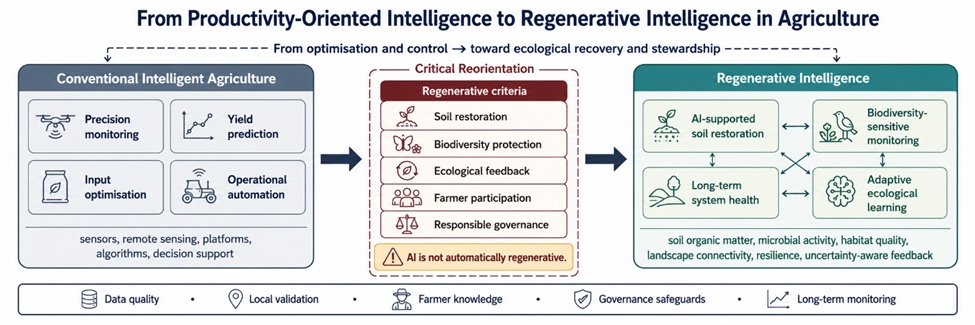
Figure 1. From Productivity-Oriented Intelligence to Regenerative Intelligence in Agriculture.
Regenerative intelligence can be defined as the AI-supported capacity of agricultural systems to sense, interpret, and respond to ecological conditions in ways that restore soil, protect biodiversity, and strengthen long-term system health. This definition builds on the capacity of smart-farming systems to integrate large and heterogeneous data streams across farm operations, environmental conditions, and management decisions [5]. However, the defining feature of regenerative intelligence is not data volume or computational sophistication. It is the alignment of data, analytics, and decisions with ecological recovery.
Regenerative intelligence differs from productivity-oriented intelligence because it evaluates digital systems by their contribution to restoration rather than optimisation alone. Digital agriculture is best understood as a socio-technical arrangement involving farmers, advisors, platforms, institutions, infrastructures, and knowledge practices [6]. For this reason, regenerative intelligence cannot be reduced to algorithmic prediction or automated control. It must include the social conditions through which ecological data are interpreted, trusted, contested, and translated into management action.
The concept also requires responsible innovation because AI-supported agriculture may redistribute power, data access, decision authority, and ecological risk. Smart farming systems need anticipatory, inclusive, reflexive, and responsive governance if they are to serve farmer-centred and public ecological goals [7]. In regenerative intelligence, responsible innovation is not an external ethical add-on. It is a governance condition that determines whether digital tools support ecological stewardship or reinforce narrow commercial and productivity metrics.
Regenerative intelligence connects regenerative agriculture, agroecology, ecological monitoring, adaptive management, and digital decision support. Agroecological principles emphasise diversity, recycling, resilience, co-creation of knowledge, and social values, all of which help prevent AI-supported agriculture from becoming a purely optimisation-oriented system [4]. The framework therefore treats intelligence as a relational capacity distributed across ecological indicators, farmer knowledge, technological infrastructures, and institutional safeguards. AI becomes regenerative only when it strengthens the capacity of farms and landscapes to learn from ecological feedback and adjust management toward recovery.
Soil restoration is the foundational dimension of regenerative intelligence because soil condition mediates nutrient cycling, water retention, carbon storage, microbial activity, erosion control, and biological function. Soil quality must be interpreted through biological, chemical, and physical indicators rather than through a single measurement or isolated productivity signal [8]. AI-supported soil restoration should therefore begin by asking which soil functions are being restored, how they are measured, and how management decisions respond to observed change. This prevents soil intelligence from becoming a narrow exercise in variable-rate input control.
Soil health is best understood as the functional capacity of soil to support ecosystem services, plant growth, biodiversity, and environmental regulation. This framing matters because a soil-health dashboard can mislead if it privileges easily measured indicators while neglecting biological activity, structure, or long-term function [9]. Regenerative intelligence should therefore integrate soil organic matter, aggregate stability, infiltration, nutrient cycling, microbial indicators, erosion risk, and carbon dynamics. Its purpose is to interpret soil as a living ecological system rather than as a passive production substrate.
AI-supported sensing, digital soil mapping, predictive analytics, and decision support can help identify spatial variability in soil condition and target restoration practices more precisely. Machine learning can support digital soil mapping, but its outputs require validation, uncertainty awareness, and careful interpretation before being translated into management action [10]. In regenerative intelligence, soil maps should inform cover cropping, reduced disturbance, organic amendment planning, erosion control, water management, and habitat-sensitive field design. The key issue is whether digital interpretation supports soil recovery over time rather than merely improving short-term operational efficiency.
Soil restoration also requires a feedback pathway that links monitoring to adaptive management. AI-supported systems can track trends in soil indicators, compare management zones, detect degradation, and guide restoration experiments, but their regenerative value depends on how ecological indicators are selected and acted upon. Table 1 summarises AI-supported soil restoration functions within regenerative intelligence in agriculture. The table emphasises that each digital function should be evaluated through both ecological benefit and regeneration risk, because the same technology can support restoration or intensification depending on its design and governance [8].
Table 1. AI-Supported Soil Restoration Functions in Regenerative Intelligence: Soil-Health Indicators, Data Sources, Analytical Methods, Decision-Support Uses, Ecological Benefits, and Regeneration Risks
AI-supported soil restoration function | Soil-health indicators | Data sources | Analytical methods | Decision-support uses | Ecological benefits | Regeneration risks |
Soil condition diagnosis | Soil organic matter; pH; nutrient status; texture; compaction; infiltration | Soil tests; proximal sensors; field observations; historical farm records | Classification; anomaly detection; spatial clustering | Identify degraded zones; prioritise restoration needs; guide sampling plans | Better targeting of restoration practices; improved understanding of spatial soil constraints | Overreliance on easily measured indicators; neglect of biological function |
Digital soil mapping | Spatial soil variability; erosion risk; water-holding capacity; carbon-related indicators | Remote sensing; terrain data; georeferenced soil samples; yield maps | Machine learning; geostatistics; spatial prediction | Support cover-crop placement; erosion control; organic amendment planning; water management | More precise restoration actions across fields and landscapes | False precision if models are poorly validated or uncertainty is hidden |
Biological soil monitoring | Microbial activity; soil respiration; earthworm activity; aggregate stability; biological diversity proxies | Laboratory assays; field scoring; sensor data; farmer observations | Pattern recognition; trend analysis; indicator integration | Track recovery from reduced disturbance, organic inputs, and diversified rotations | Stronger attention to living soil processes and ecological function | Biological indicators may be simplified into weak proxy scores |
Carbon and organic matter feedback | Soil organic carbon; residue return; root biomass; amendment history | Soil carbon tests; management logs; remote sensing; biomass estimates | Time-series modelling; scenario analysis; uncertainty estimation | Evaluate carbon-building practices; compare restoration trajectories; inform long-term planning | Supports durable soil structure, nutrient cycling, and climate-related benefits | Carbon metrics may dominate at the expense of biodiversity or water functions |
Erosion and water-function monitoring | Bare soil exposure; slope risk; runoff potential; infiltration; soil moisture | Satellite imagery; drone imagery; terrain models; soil moisture sensors | Image analysis; hydrological modelling; risk mapping | Guide ground cover, contour management, buffer placement, and reduced disturbance | Reduced erosion; improved water retention; better landscape protection | Monitoring may become reactive if not linked to preventive management |
Adaptive restoration decision support | Integrated soil-health score; trend direction; management response; uncertainty | Combined sensor, soil-test, remote-sensing, and farmer-knowledge datasets | Multi-criteria decision support; forecasting; adaptive recommendation systems | Recommend context-specific restoration practices and monitor outcomes | Links diagnosis, action, and learning over time | Recommendations may become prescriptive if farmer knowledge is excluded |
Biodiversity protection is the second core dimension of regenerative intelligence because agricultural landscapes depend on ecological interactions among crops, soil organisms, pollinators, beneficial insects, birds, habitats, and surrounding landscape elements. Biodiversity-sensitive agriculture should not be reduced to species counts alone, because diversification and ecological intensification connect biodiversity with ecosystem services and productive capacity [11]. Regenerative intelligence therefore needs monitoring functions that detect whether management is improving habitat quality, ecological interactions, and functional diversity. AI-supported monitoring becomes useful only when it helps farmers protect ecological relationships rather than simply catalogue organisms.
A biodiversity protection pathway must operate across field, farm, and landscape scales. Biodiversity-friendly agriculture cannot rely only on farm-level labels or single-practice claims because habitat configuration, landscape complexity, and ecological connectivity shape biodiversity outcomes [12]. Regenerative intelligence should therefore integrate information about hedgerows, field margins, semi-natural habitats, crop diversity, pesticide pressure, soil cover, water features, and surrounding land use. This multi-scale logic helps prevent ecological monitoring from becoming too narrow or disconnected from landscape stewardship.
AI, sensors, remote sensing, image analysis, acoustic monitoring, and ecological indicators can extend the observation capacity of regenerative agricultural systems. Remote sensing is especially relevant where ecological restoration monitoring requires repeated observation of vegetation recovery, habitat change, and spatial ecological condition [13]. In regenerative intelligence, these tools can help identify habitat loss, monitor vegetation structure, detect restoration trajectories, and guide targeted interventions. Their value depends on whether digital observations are interpreted alongside local ecological knowledge and ground validation.
Biodiversity-sensitive intelligence must avoid turning ecology into a set of simplified platform metrics. A system may count vegetation cover or detect pollinator activity while still missing habitat continuity, species interactions, or seasonal ecological vulnerability. Regenerative intelligence should therefore combine biodiversity indicators with stewardship questions about which organisms are being protected, which ecological functions are being restored, and which management pressures remain unresolved [11]. The framework treats biodiversity protection as an adaptive management obligation rather than a reporting feature.
Long-term system health refers to the capacity of agricultural systems to maintain ecological function, productivity, resilience, and adaptive capacity over time. A resilience-oriented view of farming systems distinguishes robustness, adaptability, and transformability, which are necessary for understanding how farms respond to stress and change [14]. Regenerative intelligence should therefore evaluate whether AI-supported decisions strengthen the capacity of soils, biodiversity, water cycles, farm livelihoods, and institutions to endure and adapt. This shifts assessment away from immediate optimisation and toward durable system function.
Ecological feedback is central to this long-term orientation. Agroecosystem resilience research emphasises thresholds, temporal dynamics, feedbacks, and mechanisms that shape how systems absorb disturbance and recover [15]. Regenerative intelligence should translate ecological feedback into management learning by asking whether soil indicators, biodiversity signals, water patterns, and production outcomes are moving in restorative or degrading directions. Intelligent systems become regenerative when they connect short-term decisions to longer-term ecological consequences.
Diversity and intensification are important feedback-sensitive variables in regenerative intelligence. Agricultural systems vary in vulnerability, resilience, and robustness depending on their diversity and intensification levels [16]. AI-supported systems should therefore not treat intensification as a neutral pathway to improved performance. They should analyse whether management simplification, chemical dependency, habitat loss, or reduced crop diversity is weakening the system’s capacity to absorb shocks and sustain ecological function.
The proposed framework understands long-term system health as an emergent condition produced by interactions among soil restoration, biodiversity protection, adaptive management, and governance. A farm can appear efficient in the short term while accumulating soil degradation, biodiversity decline, water stress, or decision dependency. Regenerative intelligence therefore requires monitoring horizons that are long enough to detect slow ecological change and feedback loops that are sensitive enough to trigger management revision [14]. This temporal logic is essential for distinguishing regenerative transformation from temporary performance improvement.
Regenerative intelligence depends on data quality, ecological indicators, temporal monitoring, local validation, farmer knowledge, governance safeguards, and institutional support. Smart farming creates socio-ethical challenges around participation, accountability, legitimacy, ownership, and the distribution of benefits and risks [17]. These concerns are not secondary to technical design because regenerative intelligence asks digital systems to support ecological and social stewardship. Governance therefore determines whether AI-supported agriculture becomes a tool for adaptive regeneration or a mechanism for external control.
Regenerative AI should be governed as part of a transition pathway rather than as a simple technology rollout. Agriculture 4.0 technologies are game-changing because they reshape relationships among farmers, platforms, data infrastructures, markets, and policy systems [18]. This means that regenerative intelligence requires plural pathways that respect farm diversity, ecological context, and farmer agency. A single optimisation architecture cannot serve all landscapes, farming systems, or restoration priorities.
Data access and infrastructure are also boundary conditions for implementation. The global divide in data-driven farming shows that unequal access to data, tools, infrastructure, and analytical capacity can shape who benefits from digital agriculture [19]. Regenerative intelligence should therefore avoid assuming that advanced analytics are universally available or equally useful. Equity, interoperability, capacity building, and local relevance are necessary for regenerative systems to be inclusive and scalable.
Adaptive management provides the operating logic that connects governance to ecological learning. Regenerative intelligence should make assumptions visible, track uncertainty, test management changes, and revise recommendations when ecological feedback contradicts expectations. Responsible smart-farming governance supports this process by encouraging transparency, participation, reflexivity, and accountability in technology development and deployment [17]. Without these safeguards, AI-supported agriculture may amplify narrow performance incentives, platform dependency, or superficial sustainability claims.
The proposed regenerative intelligence framework consists of five interdependent dimensions: soil restoration, biodiversity protection, long-term system health, ecological feedback, and governance-enabled adaptive management. Machine learning can contribute to this framework through monitoring, classification, prediction, diagnosis, and decision support across agricultural tasks [20]. However, these AI functions become regenerative only when they are directed toward ecological recovery and interpreted through soil, biodiversity, resilience, and governance criteria. The framework therefore separates technical capability from regenerative purpose.
The first operational layer of the framework is ecological data organisation. Crop, soil, biodiversity, weather, management, and landscape data need to be connected through human-centred data-management pathways that allow interpretation by farmers, advisors, researchers, and institutions [21]. Regenerative intelligence should not simply accumulate data; it should organise data around restoration questions and management decisions. This includes identifying degraded soils, vulnerable habitats, ecological thresholds, and opportunities for adaptive intervention.
The second operational layer is interpretive modelling and decision support. Predictive analytics can inform management decisions, but yield prediction alone is insufficient for regenerative intelligence unless it is interpreted together with ecological indicators [22]. A regenerative decision-support pathway should ask how a recommended action affects soil organic matter, biodiversity, habitat quality, water function, resilience, and farmer autonomy. This prevents predictive systems from treating productivity as the only meaningful outcome. Figure 2 presents the proposed regenerative intelligence framework, showing how ecological data organisation, interpretive modelling, decision support, feedback-based learning, and governance-enabled adaptive management connect AI functions to regenerative agricultural outcomes.
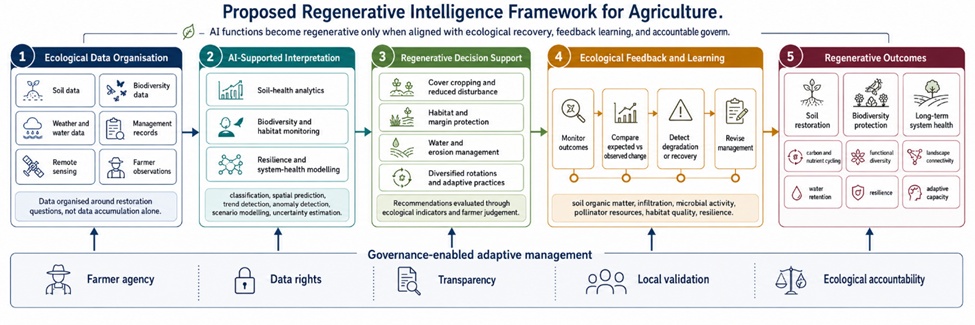
Figure 2. Proposed Regenerative Intelligence Framework for AI-Supported Soil Restoration, Biodiversity Protection, and Long-Term System Health.
The third operational layer is feedback-based learning through interoperable models, knowledge products, and on-farm experimentation. Agricultural system data and models must be translated into knowledge products that support usable decisions across complex farming contexts [23]. On-farm experimentation then provides a practical learning loop that connects farmer knowledge, digital data, ecological monitoring, and adaptive management [24]. Table 2 presents the proposed regenerative intelligence framework for agriculture.
Table 2. Proposed Regenerative Intelligence Framework for Agriculture: Soil Restoration, Biodiversity Protection, Long-Term System Health, Ecological Feedback, Governance Conditions, and Implementation Logic
Framework dimension | Core regenerative question | AI-supported function | Ecological feedback pathway | Governance condition | Implementation logic |
Soil restoration | Are soil functions recovering over time? | Soil sensing; digital soil mapping; soil-health analytics; restoration decision support | Monitor soil organic matter, structure, nutrient cycling, erosion, water retention, and biological activity | Soil indicators must be ecologically meaningful, locally validated, and uncertainty-aware | Use AI to diagnose degradation, guide restoration practices, and revise management based on soil response |
Biodiversity protection | Are habitats, species interactions, and functional diversity being protected? | Remote sensing; image analysis; acoustic monitoring; ecological indicator integration | Track habitat quality, landscape connectivity, crop diversity, pollinator resources, and beneficial species conditions | Biodiversity metrics must avoid reductionism and include field, farm, and landscape scales | Use AI to identify habitat risks, support diversification, and protect ecological interactions |
Long-term system health | Is the farming system becoming more resilient, adaptive, and ecologically durable? | Trend detection; resilience assessment; scenario modelling; risk analytics | Connect short-term decisions to soil, biodiversity, water, productivity, and livelihood trajectories | Monitoring horizons must extend beyond immediate performance indicators | Use AI to detect degradation, test adaptation options, and strengthen resilience capacities |
Ecological feedback | Are decisions being revised when ecological outcomes change? | Feedback dashboards; adaptive recommendations; anomaly detection; learning systems | Compare expected and observed ecological responses across seasons and management zones | Feedback must be transparent, interpretable, and open to farmer correction | Use AI as a learning support system, not as a fixed prescription engine |
Governance-enabled adaptive management | Who defines regenerative goals, indicators, data rights, and acceptable risks? | Participatory platforms; audit trails; explainable recommendations; shared data systems | Link ecological monitoring to accountability, learning, and institutional support | Governance must protect farmer agency, data access, transparency, and ecological accountability | Use AI within participatory governance structures that prevent greenwashing and narrow optimisation |
For farmers and farm advisors, regenerative intelligence implies that decision-support tools should be adaptable to local conditions rather than imposed as fixed scripts. Farmers often reinterpret and rework agricultural decision-support tools in practice, which shows that successful implementation depends on local meaning, trust, and usability [25]. Practical systems should therefore combine soil-health monitoring, biodiversity-sensitive indicators, field observations, and farmer judgment. Regenerative decision support must help farmers learn from ecological feedback rather than simply follow algorithmic recommendations.
For agricultural technology firms, policymakers, certification bodies, conservation organisations, sustainability auditors, and agri-food companies, the framework implies a broader evaluation logic. Agriculture 4.0 should be assessed according to whether it works for people, production, and the planet, not only whether it increases automation or efficiency [26]. This requires ecological dashboards, participatory data practices, long-term monitoring protocols, and safeguards against superficial sustainability claims. Regenerative intelligence should become auditable through evidence of soil restoration, biodiversity protection, adaptive learning, and system-health improvement.
Future research should empirically test regenerative intelligence across farming systems, landscapes, governance settings, and technological configurations. Agricultural AI raises social and ethical issues related to transparency, responsibility, fairness, autonomy, and sustainability, all of which should be central to research on AI-supported regeneration [27]. Needed studies include longitudinal evaluations of soil and biodiversity outcomes, farmer-centred design research, ecological indicator development, comparative work across production systems, and governance studies on data rights and accountability. The strongest future agenda will examine not only whether AI improves decisions, but whether it supports durable ecological recovery.
This article has developed a conceptual framework for regenerative intelligence in agriculture centred on AI-supported soil restoration, biodiversity protection, and long-term system health. The framework argues that intelligent agriculture should not be evaluated only by production optimisation, input efficiency, or predictive accuracy. It should also be judged by whether it strengthens ecological feedback, supports adaptive stewardship, protects biodiversity, restores soil function, and builds durable system health. Regenerative intelligence offers a foundation for agricultural futures that are productive, biodiverse, soil-restoring, farmer-aware, and ecologically accountable.
None
None
None
None
Open Access The author(s) retain copyright. This article is licensed under the Creative Commons Attribution-NonCommercial-ShareAlike 4.0 International License. It may be shared and adapted for non-commercial purposes with appropriate attribution, an indication of changes, and distribution of adaptations under the same license. Third-party material may be subject to separate terms identified in its credit line. View the license at https://creativecommons.org/licenses/by-nc-sa/4.0/.
 Agro Intelligence Research Press