Smart farming increasingly embeds artificial intelligence, machine learning, predictive analytics, remote sensing, robotics, and automated decision-support systems into agronomic decision-making. These technologies promise more precise, timely, and data-intensive forms of farm management. Their growing role suggests that agronomic decisions are no longer shaped only by farmer observation, seasonal experience, and advisory knowledge, but also by algorithmic interpretation. This article addresses the theoretical problem that AI-supported farming systems may improve technical efficiency while simultaneously reshaping farmer judgment, experiential knowledge, trust, and decision authority. Smart farming is therefore not merely a matter of technological adoption. It is also a reconfiguration of how farming problems are recognised, evaluated, prioritised, and acted upon. The objective of the article is to develop a theory of human–AI decision dependence in smart farming. The theory explains how repeated interaction with algorithmic systems can create new forms of reliance, cognitive offloading, skill transformation, and redistributed authority. It also explains why dependence on AI can be supportive, excessive, or contested depending on the quality of system design, institutional context, and farmer capacity to interpret recommendations. The article contributes a conceptual model of human–AI decision dependence in smart farming. It argues that dependence is not simply a user attitude toward technology but a sociotechnical process through which judgment, skill, trust, evidence, and authority are redistributed. This perspective helps future smart farming research examine not only whether AI systems perform accurately, but also how they change the human capacities and decision relations on which farming depends.
Smart farming has become a major pathway through which agricultural systems are expected to respond to productivity, sustainability, labour, and climate pressures. Early accounts of big data in smart farming described a transition from farm management based mainly on human observation and periodic measurement toward systems that integrate sensors, platforms, analytics, and decision-support infrastructures into everyday production decisions [1]. This transition has been reinforced by arguments that smart farming can support sustainable agriculture through improved monitoring, targeted intervention, and more efficient resource use [2]. Yet the growing role of digital decision systems also raises a theoretical question that cannot be answered by performance metrics alone: how does dependence on AI systems reconfigure farmer judgment?
The question matters because smart farming is not a neutral extension of conventional agronomy. Responsible innovation scholars have shown that smart farming technologies bring socio-ethical challenges concerning control, accountability, inclusion, and the distribution of benefits [3]. Agriculture 4.0 debates similarly suggest that digital tools should be understood as part of wider innovation systems that reshape relations among farmers, advisors, firms, platforms, and policy actors [4]. A theory of human–AI decision dependence is therefore needed to explain how algorithmic systems change not only what farmers decide, but also how farming judgment itself is formed.
The article develops the concept of algorithmic agronomy to describe a decision context in which agronomic problems are increasingly framed through machine-readable data, predictive outputs, platform recommendations, and automated classifications. Reviews of digital agriculture show that smart farming includes remote sensing, machine learning, decision-support systems, robotics, and data platforms that can transform the informational basis of farm management [5, 6]. These systems may expand farmers’ access to evidence, but they may also privilege forms of knowledge that can be captured, standardised, modelled, and operationalised. The central theoretical concern is therefore the changing relation between farmer experience and algorithmic mediation.
This article is an original theory-building article that synthesises literature from smart farming, agricultural technology studies, human–AI interaction, and rural sociology. It does not present new empirical data, but builds a conceptual account of how human–AI decision dependence emerges through repeated reliance, trust calibration, skill reconfiguration, cognitive offloading, and redistributed authority. The argument proceeds by situating the article within sociotechnical and digital agriculture debates, defining algorithmic agronomy as a decision context, examining farmer judgment and experiential knowledge, theorising decision dependence, and proposing research propositions. The contribution is to move smart farming scholarship beyond adoption and accuracy questions toward a theory of how AI changes the practical conditions of agronomic judgment.
The theoretical background for this article begins with the recognition that smart farming is a sociotechnical transformation rather than a purely technical upgrade. Social science reviews of digital agriculture argue that smart farming and Agriculture 4.0 reorganise knowledge flows, advisory relations, data ownership, labour practices, and innovation responsibilities [6]. Responsible innovation perspectives further show that agricultural AI systems must be evaluated in relation to who defines the problem, who controls the data, who interprets outputs, and who bears the risks of failure [3, 7]. These insights position farmer judgment as an outcome of human, technical, institutional, and ecological relations rather than as an isolated individual capacity.
Human–AI interaction and automation reliance offer a second theoretical foundation, even when the empirical setting is agricultural rather than industrial or clinical. In farming, decision-support systems can shift the farmer’s role from direct evaluator to interpreter, monitor, validator, or override authority, especially when recommendations are generated by opaque models or platform systems [8]. European studies of smart farming technologies show that farmers evaluate digital tools not only by technical promise but also by fit with work routines, expected usefulness, reliability, and perceived control [9, 10]. This suggests that dependence emerges through interaction between system performance, farmer expectations, institutional pressures, and the farmer’s continuing ability to judge when algorithmic advice should be trusted.
Agricultural knowledge studies add a third foundation by emphasising that farming decisions rely on situated expertise, local ecological interpretation, embodied skill, and practical reasoning. Digitalisation may alter agricultural knowledge by changing the roles of farmers, advisors, data intermediaries, and technology providers in producing actionable knowledge [11]. The issue is not that algorithmic systems simply replace farmer knowledge, but that they change the conditions under which knowledge is recognised as valid, transferable, and decision-relevant. A theory of human–AI decision dependence must therefore explain how farmer judgment is hybridised, constrained, supported, or displaced within digital agronomic systems.
Algorithmic agronomy refers to a smart farming decision environment in which agronomic problems are mediated through digital measurement, computational modelling, predictive analytics, and automated recommendation systems. Machine learning reviews show that agricultural AI is already applied to yield prediction, disease detection, irrigation management, crop monitoring, weed identification, and machinery optimisation [12]. Deep learning applications extend this mediation by enabling image-based crop diagnosis, remote sensing interpretation, and complex pattern recognition across agricultural datasets [13]. In this context, agronomy becomes increasingly organised around data streams, model outputs, thresholds, alerts, and prescriptions.
The decision context of algorithmic agronomy is also shaped by data infrastructures and platform relations. Digital agriculture platforms can enable innovation by connecting data, models, services, and decision tools, but they also raise privacy, security, and governance concerns that affect farmers’ autonomy and confidence [14]. The politics of digital agricultural technologies further shows that platformisation can concentrate interpretive power in firms and technical intermediaries, thereby influencing which problems are made visible and which decisions are encouraged [5]. Algorithmic agronomy therefore alters decision authority by embedding agronomic reasoning within infrastructures that farmers may use but not fully control.
The technologies involved in algorithmic agronomy are diverse, but their theoretical significance lies in how they structure evidence and action. Smart farming applications in crop data management, robotics, automation, and precision agriculture translate field conditions into measurable variables and recommended interventions [15-18]. Economic analyses of agricultural robots and automation show that these systems can alter labour requirements, operational timing, and the distribution of decision tasks across humans and machines [18]. This means that algorithmic agronomy does not merely add information to existing judgment; it changes the temporal, cognitive, and organisational structure of decision-making.
Algorithmic agronomy also changes what counts as relevant agronomic evidence. Predictive models may prioritise variables that are sensor-readable, historically available, computationally tractable, or commercially valuable, while farmer observations may remain local, qualitative, embodied, and difficult to encode [11, 19]. This shift can support more systematic decision-making, but it can also create dependence when farmers must act on outputs whose assumptions, uncertainty, or contextual limits are not fully transparent [20, 21]. Table 1 maps the key features of algorithmic agronomy as a decision context in smart farming.
Table 1. Algorithmic Agronomy as a Smart Farming Decision Context: Technologies, Decision Functions, Data Inputs, and Implications for Farmer Judgment
Dimension of algorithmic agronomy | Main technologies and systems | Typical decision functions | Primary data inputs | Implications for farmer judgment |
Data-intensive field monitoring | Sensors, satellite imagery, UAV imagery, soil probes, weather stations, crop cameras | Detecting crop stress, monitoring soil moisture, identifying spatial variability, tracking field conditions | Soil moisture, vegetation indices, images, weather data, crop growth indicators, field maps | Farmer observation becomes supplemented by continuous data streams, but judgment may shift toward interpreting dashboard outputs rather than directly reading field conditions. |
Predictive agronomic analytics | Machine learning models, deep learning systems, forecasting algorithms, crop-growth analytics | Yield prediction, disease forecasting, pest risk estimation, irrigation timing, input planning | Historical yields, crop records, sensor data, remote sensing data, disease images, climate records | Farmer judgment becomes partly anticipatory and model-mediated, with decisions influenced by probabilistic outputs and predicted future risks. |
Automated recommendation systems | Decision-support platforms, digital advisory tools, prescription maps, variable-rate systems | Recommending fertiliser application, pesticide use, irrigation scheduling, planting density, harvest timing | Farm management records, agronomic rules, model outputs, platform databases, machinery data | Farmers may move from independent decision-makers to evaluators of recommended actions, increasing the importance of explanation, contextual interpretation, and override capacity. |
Robotics and autonomous operations | Field robots, automated machinery, robotic weeding, autonomous tractors, smart implements | Performing or assisting physical tasks, reducing labour demand, standardising operations, optimising field execution | Machine vision, GPS data, field boundaries, task plans, equipment telemetry | Practical skill may shift from manual operation toward supervision, calibration, troubleshooting, and exception handling. |
Platform-based agronomic coordination | Farm management platforms, cloud analytics, data-sharing systems, proprietary service ecosystems | Integrating data, coordinating decisions, benchmarking performance, linking farmers to advisory or commercial services | Aggregated farm data, user profiles, service data, input recommendations, market-linked information | Decision authority may become redistributed toward platforms and service providers, raising concerns about autonomy, dependence, data governance, and accountability. |
Trust and accountability environment | Explainable AI tools, audit trails, model confidence indicators, governance mechanisms | Supporting interpretation, validating recommendations, identifying uncertainty, assigning responsibility | Model metadata, confidence scores, decision histories, user feedback, validation data | Farmer judgment depends on calibrated trust, including the ability to recognise when algorithmic outputs are useful, uncertain, biased, or inappropriate for local conditions. |
Farmer judgment is a situated and interpretive capacity through which producers connect weather, soil, crop behaviour, labour availability, market signals, machinery constraints, and local ecological memory into practical decisions. Digital agriculture research shows that farming knowledge is not simply information processing, because decisions emerge from embodied experience, field observation, advisory exchange, and accumulated familiarity with place-specific variability [11]. In smart farming contexts, this judgment is increasingly exercised alongside sensors, platforms, models, and automated recommendations that translate farm conditions into digital signals [1]. The theoretical issue is therefore not whether farmers use data, but how data-mediated agronomy changes the meaning and practice of judgment.
Experiential knowledge has historically allowed farmers to recognise weak signals, interpret exceptions, and adapt general advice to situated conditions. Studies of smart farming adoption show that farmers evaluate technologies through practical expectations shaped by local work routines, farm scale, reliability, usability, and perceived control [9, 10]. This means that farmer expertise remains active even when algorithmic tools are introduced, because users must still decide whether the output fits the field, the season, the machinery, and the risk context. Algorithmic agronomy therefore creates a hybrid knowledge environment in which experiential interpretation and computational recommendation coexist uneasily.
The risk is that algorithmic agronomy can narrow the recognised domain of valid agronomic knowledge. Responsible innovation debates warn that digital farming systems may privilege the perspectives of developers, platforms, and data-rich actors over farmers whose knowledge is tacit, contextual, or difficult to encode [3, 7]. The politics of digital agriculture further suggests that technologies can redistribute power by making some forms of expertise more legible and governable than others [5]. When farmer knowledge is treated mainly as input data or user feedback, judgment may be partially displaced from the centre of agronomic reasoning.
Figure 1 illustrates how algorithmic agronomy converts farm conditions into model-mediated decision signals that reshape farmer judgment and decision authority.
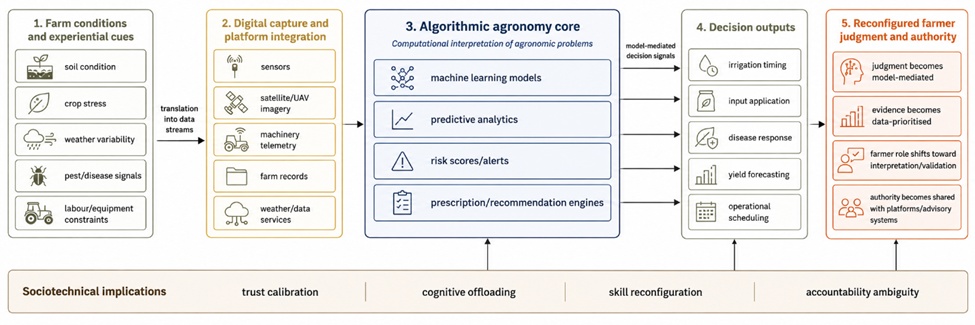
Figure 1. Algorithmic Agronomy as a Smart Farming Decision Context: From Farm Conditions to Model-Mediated Decision Authority
Yet the relationship between algorithmic systems and farmer judgment should not be understood only as displacement. Agriculture 4.0 scholarship argues that digital tools can support people, production, and the planet when they are designed around human capacities and practical farming needs rather than narrow technical optimisation [20]. Similarly, responsible digital agri-food innovation calls for stronger social scientific engagement so that farmers’ expertise, values, and institutional contexts become central to technology development [22]. Farmer judgment may therefore be hybridised rather than eliminated, provided that algorithmic systems are designed to extend interpretation rather than replace it.
Human–AI decision dependence in smart farming refers to the process through which farmers increasingly rely on algorithmic systems to define problems, interpret evidence, prioritise actions, and justify agronomic decisions. This dependence can emerge gradually as farmers repeatedly use digital platforms for monitoring, forecasting, prescriptions, and operational coordination [14]. Machine learning and deep learning applications in agriculture intensify this tendency because they can produce outputs that appear more comprehensive, objective, or timely than unaided human observation [12, 13]. Dependence is therefore not a single decision to trust technology, but a pattern of reliance formed through repeated interaction.
Dependence is shaped by perceived accuracy, usability, institutional pressure, commercial integration, and risk avoidance. Farmers may rely on AI recommendations because the systems appear technically advanced, because advisory institutions promote them, because input suppliers integrate them into service packages, or because not using them seems risky in competitive production systems [5, 19]. Platform-based digital agriculture can also produce lock-in when data histories, machinery compatibility, service contracts, and advisory functions become concentrated within particular ecosystems [14]. In such cases, dependence reflects the structure of the decision environment as much as the farmer’s individual trust.
Supportive dependence occurs when AI systems improve decision quality while preserving farmer agency, contextual interpretation, and meaningful override capacity. Studies of responsible innovation in digital agriculture emphasise that technologies should be aligned with user needs, ethical accountability, and practical conditions of use [3, 23]. In this supportive form, dependence is not inherently harmful because farmers use algorithmic outputs as one source of evidence within broader practical reasoning. The crucial condition is that the system strengthens rather than substitutes farmer judgment.
Excessive or contested dependence emerges when algorithmic outputs become difficult to question, when explanations are weak, or when institutional expectations pressure farmers to follow recommendations despite local uncertainty. Research on algorithmic governmentality in precision agriculture shows that trust is socially constructed through narratives of data objectivity, efficiency, and predictive control [21]. Concerns about data governance and digital farming futures further show that farmers may face uncertainty about who controls data, how recommendations are produced, and who is accountable for harmful outcomes [24]. Human–AI decision dependence is therefore a sociotechnical relation involving trust, authority, accountability, and autonomy.
Algorithmic agronomy produces skill shifts because the farmer’s work increasingly includes monitoring, interpreting, validating, and troubleshooting digital systems. Automation and robotics in field crop production can reduce some manual or routine tasks while increasing the importance of supervision, calibration, system maintenance, and exception management [18, 25]. Smart farming technology trends similarly suggest that labour impacts are not limited to substitution, because digitalisation changes the kinds of skills that become valuable in agricultural work [16]. The relevant theoretical distinction is therefore between deskilling, where practical capacities are eroded, and reskilling, where new interpretive and technical capacities are developed.
Trust calibration is central to whether decision reliance becomes productive or problematic. Farmers must learn when AI outputs are reliable, when they are uncertain, and when local conditions require deviation from the recommendation [10]. Recent work on artificial intelligence in farming identifies trust as a key challenge because agricultural AI depends not only on model performance but also on transparency, user confidence, accountability, and fit with farming realities [26]. Calibrated trust requires enough confidence to use the system and enough scepticism to interrogate it.
Decision reliance is also shaped by cognitive offloading, because algorithmic systems can take over tasks of monitoring, prediction, comparison, and prioritisation. Crop data management systems and smart farming platforms can reduce the cognitive burden of managing complex information, but they may also make farmers less practised in independent diagnosis if outputs become routine substitutes for field-based interpretation [17]. The challenge is intensified when decision-support tools present recommendations without adequate explanation or uncertainty communication [8]. A theory of decision dependence must therefore treat reliance as a dynamic balance between support, offloading, skill maintenance, and critical interpretation.
The proposed theory links six constructs: algorithmic mediation, farmer judgment, trust calibration, skill reconfiguration, decision reliance, and redistributed authority. Algorithmic mediation describes how smart farming technologies translate field conditions into data, models, alerts, prescriptions, and platform recommendations [1, 12]. Farmer judgment refers to the situated interpretive capacity through which farmers evaluate whether these outputs make sense under local ecological, operational, and economic conditions [11]. Human–AI decision dependence emerges when these constructs become repeatedly connected in everyday agronomic practice.
The first mechanism is evidential reframing, through which algorithmic systems influence what is visible, measurable, and actionable. Remote sensing, machine learning, and platform analytics can expand the evidence base available to farmers, but they can also privilege quantifiable variables and model-readable patterns [13, 15]. The second mechanism is interpretive delegation, through which farmers rely on AI systems to identify problems, predict outcomes, or rank interventions [8]. These mechanisms alter judgment by shifting part of the interpretive burden from farmer experience to computational systems.
The third mechanism is trust-mediated reliance, in which farmers’ dependence on AI increases or decreases according to perceived accuracy, transparency, fit, and accountability. Research on smart farming perceptions shows that expectation and experience do not always align, making trust an evolving relation rather than a fixed adoption attitude [10]. Work on responsible precision agriculture also suggests that trust depends on whether systems are developed and governed in ways that farmers perceive as legitimate and usable [23]. Table 2 presents the proposed theoretical model of human–AI decision dependence in smart farming.
Table 2. Proposed Theory of Human–AI Decision Dependence in Smart Farming: Constructs, Mechanisms, Outcomes, and Research Implications
Core construct | Definition in the proposed theory | Main mechanism | Possible outcome | Research implication |
Algorithmic mediation | The process through which AI systems, platforms, models, sensors, and automated recommendations structure agronomic evidence and action. | Field conditions are translated into digital data, predictive outputs, risk scores, alerts, prescriptions, or operational recommendations. | Farming decisions become increasingly shaped by what the system can measure, model, and recommend. | Research should examine how model design and data infrastructures define agronomic problems before farmers act on them. |
Farmer judgment | The situated, experiential, interpretive, and practice-based capacity through which farmers evaluate conditions and decide what action is appropriate. | Farmers compare algorithmic outputs with local knowledge, embodied experience, ecological cues, and operational constraints. | Judgment may be supported, hybridised, narrowed, or displaced depending on system design and use context. | Research should investigate how farmers preserve interpretive agency when using AI-mediated recommendations. |
Trust calibration | The farmer’s ongoing adjustment of confidence in AI outputs according to perceived reliability, transparency, explanation, and contextual fit. | Farmers learn when to rely on, question, override, or ignore system recommendations. | Well-calibrated trust supports appropriate reliance, while miscalibrated trust can produce over-reliance or under-reliance. | Research should identify design features that help farmers understand uncertainty, limitations, and appropriate use conditions. |
Skill reconfiguration | The transformation of farming skill as digital systems redistribute tasks between humans and machines. | Manual, observational, diagnostic, and planning skills are partly replaced or supplemented by monitoring, interpretation, calibration, and troubleshooting skills. | Farmers may experience deskilling, reskilling, or hybrid skill formation. | Research should examine whether smart farming systems maintain, erode, or transform farmers’ practical capacities over time. |
Decision reliance | The repeated use of AI outputs as a basis for agronomic action, justification, or risk management. | Reliance accumulates through repeated successful use, institutional pressure, platform integration, or perceived risk reduction. | Dependence may become supportive, excessive, or contested. | Research should distinguish beneficial decision support from forms of dependence that reduce autonomy or weaken critical judgment. |
Redistributed authority | The shift in decision influence among farmers, algorithms, advisors, platforms, firms, and institutions. | Algorithmic recommendations become embedded in advisory systems, machinery, contracts, data platforms, or governance expectations. | Authority over agronomic decisions becomes shared, obscured, or displaced away from farmers. | Research should analyse accountability, data governance, and farmer autonomy as central dimensions of smart farming. |
The fourth mechanism is authority redistribution, through which decision influence moves across farmers, platforms, advisors, technology firms, and automated systems. Digital agriculture research shows that data-sharing arrangements, platform ownership, and innovation governance affect who can interpret, use, and benefit from farm data [14, 24]. This mechanism explains why human–AI decision dependence is not only psychological or cognitive but also institutional and political. The proposed model therefore treats dependence as a relational condition produced by technology design, farmer practice, platform governance, and agricultural institutions.
Figure 2 presents the proposed theory of human–AI decision dependence by linking algorithmic mediation, trust calibration, skill reconfiguration, decision reliance, and redistributed authority.
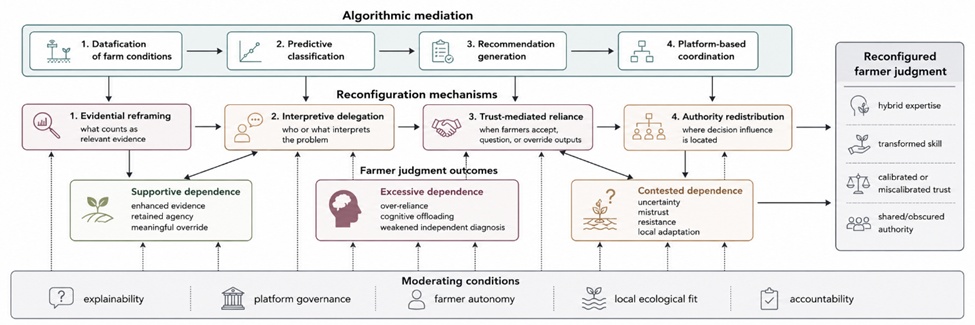
Figure 2. Proposed Theory of Human–AI Decision Dependence in Smart Farming: Mechanisms Linking Algorithmic Mediation to Reconfigured Farmer Judgment
The first proposition is that stronger algorithmic mediation will increase the likelihood that farmer judgment becomes dependent on system-defined categories of evidence. When smart farming systems organise decisions around sensors, dashboards, predictive scores, and prescriptions, farmers may increasingly interpret fields through platform-readable indicators rather than through direct experiential observation alone [1, 15]. This does not imply that judgment disappears, but it suggests that judgment becomes partially reoriented around computational representations. Future research should therefore examine how different technologies shape what farmers perceive as relevant evidence.
The second proposition is that trust calibration moderates the relationship between algorithmic mediation and decision reliance. If farmers understand system uncertainty, data limitations, and contextual assumptions, they are more likely to develop appropriate reliance rather than automatic compliance or rejection [10, 26]. Conversely, weak explainability or institutional pressure may produce over-reliance when farmers defer to outputs that appear authoritative but are poorly suited to local conditions [21]. This proposition positions trust as a practical capacity that must be designed, learned, and governed.
The third proposition is that skill reconfiguration determines whether human–AI dependence becomes enabling or constraining. Smart farming may enable reskilling when farmers gain new capacities in digital interpretation, system supervision, and data-informed planning [16, 18]. It may produce deskilling when repeated cognitive offloading reduces farmers’ confidence or ability to diagnose field conditions without algorithmic support [17]. Research should therefore examine skill trajectories longitudinally rather than treating adoption as a single event.
The fourth proposition is that institutional and platform context shapes whether decision authority remains with farmers or becomes redistributed away from them. Digital agriculture platforms can support coordination and innovation, but they can also create dependence through proprietary ecosystems, data asymmetries, and externalised accountability [5, 14]. Responsible innovation scholarship suggests that more democratic, transparent, and farmer-centred governance can reduce these risks by keeping farmers involved in problem definition, system evaluation, and decision accountability [22, 23, 27]. Future studies should therefore connect human–AI decision dependence to data governance, advisory institutions, platform power, and farmer autonomy.
This article has developed a theory of human–AI decision dependence in smart farming. It has argued that algorithmic agronomy does not simply provide farmers with better tools for decision-making. It reconfigures the conditions under which agronomic problems are defined, evidence is interpreted, trust is formed, skills are maintained, and authority is exercised.
The theory positions farmer judgment as a sociotechnical practice rather than a purely individual attribute. In smart farming, judgment becomes entangled with sensors, models, platforms, automated recommendations, advisory systems, and institutional expectations. Human–AI decision dependence can therefore be supportive when it expands farmer capacity, but problematic when it narrows autonomy, weakens experiential knowledge, or obscures accountability.
Future research on smart farming should treat human–AI decision dependence as a central theoretical and practical issue. Evaluation should move beyond accuracy, adoption, and efficiency to examine how AI systems reshape expertise, trust, skill, and decision authority. A farmer-centred approach to algorithmic agronomy requires technologies that strengthen rather than replace the practical judgment on which sustainable farming depends.
None
None
None
None
Open Access The author(s) retain copyright. This article is licensed under the Creative Commons Attribution-NonCommercial-ShareAlike 4.0 International License. It may be shared and adapted for non-commercial purposes with appropriate attribution, an indication of changes, and distribution of adaptations under the same license. Third-party material may be subject to separate terms identified in its credit line. View the license at https://creativecommons.org/licenses/by-nc-sa/4.0/.
 Agro Intelligence Research Press